Biography
Lazarus of Bethany
About Lazarus of Bethany
Lazarus of Bethany appears in the Gospel of John as the brother of Martha and Mary and as a friend whom Jesus loved. His name belongs to a household in Bethany, a village near Jerusalem, rather than to the poor man called Lazarus in Jesus's parable in Luke. John supplies no occupation, birth date, ancestry, or words spoken by Lazarus. Nearly everything the Gospel says about him is concentrated in two connected scenes: his illness, death, and return from the tomb, followed by a supper at which his presence draws public attention. A careful biography must begin with those limits instead of turning later devotional traditions into missing chapters of his life.
John introduces Bethany through relationships. Lazarus is ill; his sisters send Jesus the message that the one he loves is sick. The narrator states that Jesus loved Martha, Mary, and Lazarus, yet Jesus remains where he is for two days before setting out. The story does not portray affection as protection from suffering or explain the delay as neglect. Jesus tells the disciples that the illness will serve God's glory and later says plainly that Lazarus has died. Thomas urges the others to accompany Jesus toward Judea despite danger. Lazarus himself remains unseen while his family, friends, and the disciples respond to illness, delay, fear, and grief.
When Jesus reaches the area, John says Lazarus has been in the tomb four days. Bethany is described as about two miles from Jerusalem, and mourners have come to console the sisters. Martha goes out first and voices both sorrow and trust. Jesus's exchange with her centers on resurrection and belief; Mary later comes, falls at his feet, and weeps with the mourners. The narrative says Jesus becomes deeply troubled and weeps. These emotions belong to Jesus and the grieving community, not to an imagined account of Lazarus's experience after death. The Gospel offers no description of what Lazarus saw, felt, or remembered while dead.
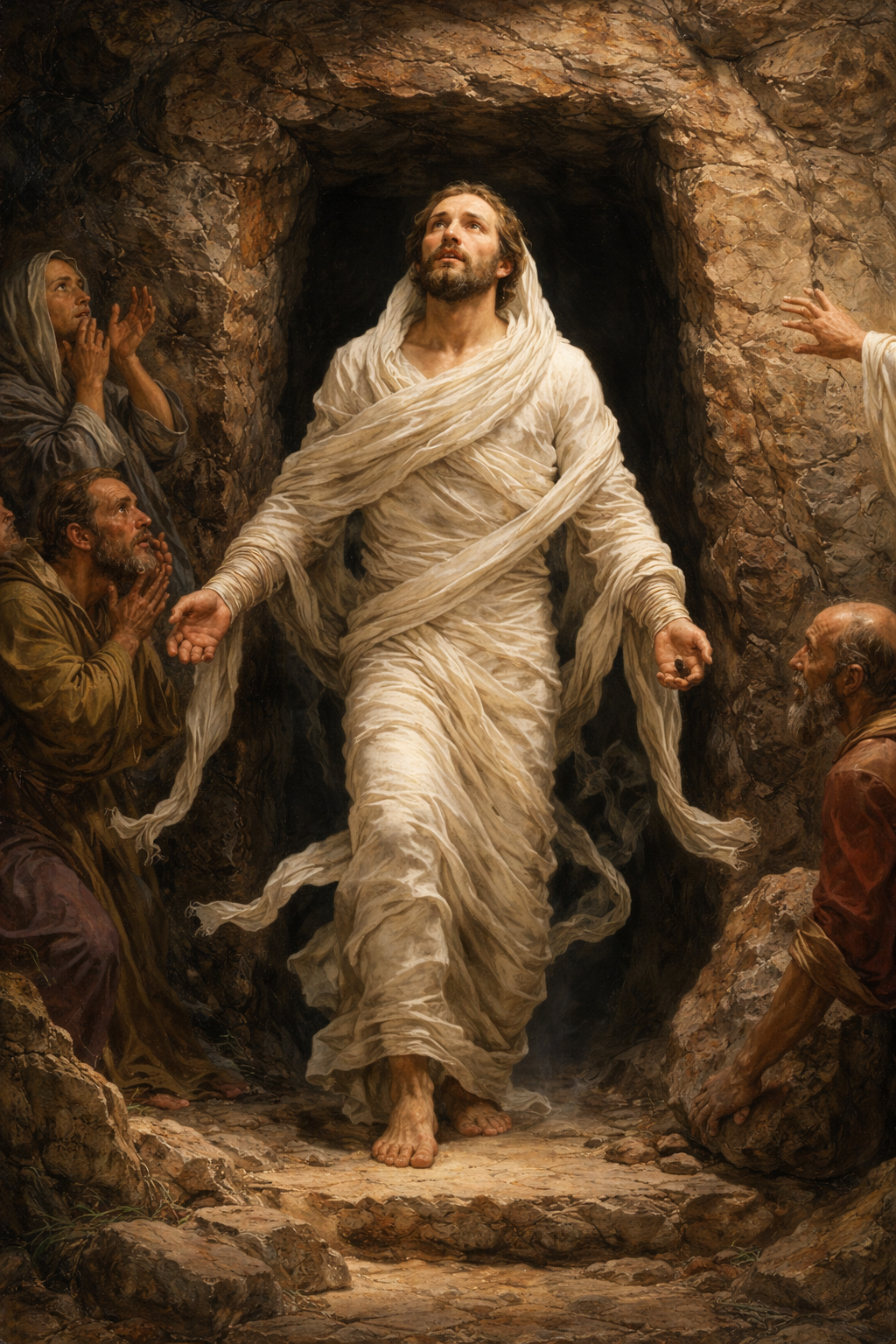
At the tomb, Jesus orders the stone removed. Martha warns of decay because her brother has been dead four days. Jesus prays aloud and then calls, ‘Lazarus, come out!’ John narrates that the dead man emerges with burial cloths around his hands, feet, and face; Jesus tells those present to untie him and let him go. Christian tradition receives this as the raising of Lazarus, while John's literary purpose is also explicit: the sign discloses Jesus's identity and presses witnesses toward belief or opposition. Lazarus is restored to ordinary mortal life in the story. John does not call this the final resurrection or say that Lazarus could never die again.
The sign produces divided consequences. John says many mourners believe in Jesus, while others report the event to the Pharisees. A council follows, and the authorities decide that Jesus must die. Lazarus therefore stands within a story that moves quickly toward the Passion, but he is not responsible for the council's violence. Six days before Passover, Jesus returns to Bethany for a dinner. Martha serves, Mary anoints Jesus, and Lazarus reclines at table. A crowd comes to see both Jesus and the man raised from the dead. The chief priests then plan to kill Lazarus as well because his presence is associated with growing belief.
John says nothing further about Lazarus. It does not narrate an escape, appointment as bishop, missionary voyage, second death, or burial place. Eastern Christian tradition developed a Cyprus continuation: Lazarus is remembered as bishop of Kiteia, living for years after the raising and dying there. An OCA account also preserves a ninth-century story in which a coffin bearing an identifying inscription was found and relics were transferred to Constantinople by order of Emperor Leo VI, traditionally dated to 898. These are important records of Byzantine remembrance, but they are much later than the Gospel and cannot establish an apostolic itinerary or precise first-century chronology.
Western traditions developed a different destination, placing Lazarus and his sisters in Provence. The Cyprus and Provence accounts cannot both function as a single mapped biography, and neither is supplied by John. This packet therefore maps Bethany at settlement level for the Gospel scenes and records Kiteia and Constantinople only as later traditional associations. It supplies no coordinate for the tomb, no sea route, and no historical death date. The title ‘bishop’ is retained only as an Eastern traditional title, not as a documented office. The catalog's former confessor classification is likewise removed because John's narrative does not use it and the later stories do not securely establish it.
Lazarus is remembered liturgically in more than one way. The Roman General Calendar now commemorates Martha, Mary, and Lazarus together on July 29; the 2021 decree explains the shared observance through the Bethany household's friendship with Jesus and acknowledges earlier Latin uncertainty surrounding Mary's identity. In Eastern Orthodox practice, Lazarus Saturday is a movable observance immediately before Palm Sunday, focused on the raising narrated in John. The OCA also marks the traditional translation of Lazarus's relics on October 17. Calendar dates document later communities' worship and reception. They are not substitutes for an unknown birthday, date of death, or date of the Gospel event.
No saying by Lazarus survives in the Gospel. The short quotation attached to his record is therefore Jesus's command addressed to him, not a line invented in Lazarus's voice. The virtues associated with Lazarus are similarly modest: friendship within the Bethany household, endurance as his life becomes exposed to public danger, and quiet presence at the later meal. Even these actions are known only through John's narrative. His enduring significance lies less in a recoverable public career than in the place his story occupies at the threshold of the Passion: grief is neither denied nor romanticized, violence grows around a public sign, and hope is expressed through a person called by name from a tomb.
Wondering how to weigh the stories and sources? Learn how to read a saint biography.