Biography
Leodegar of Autun
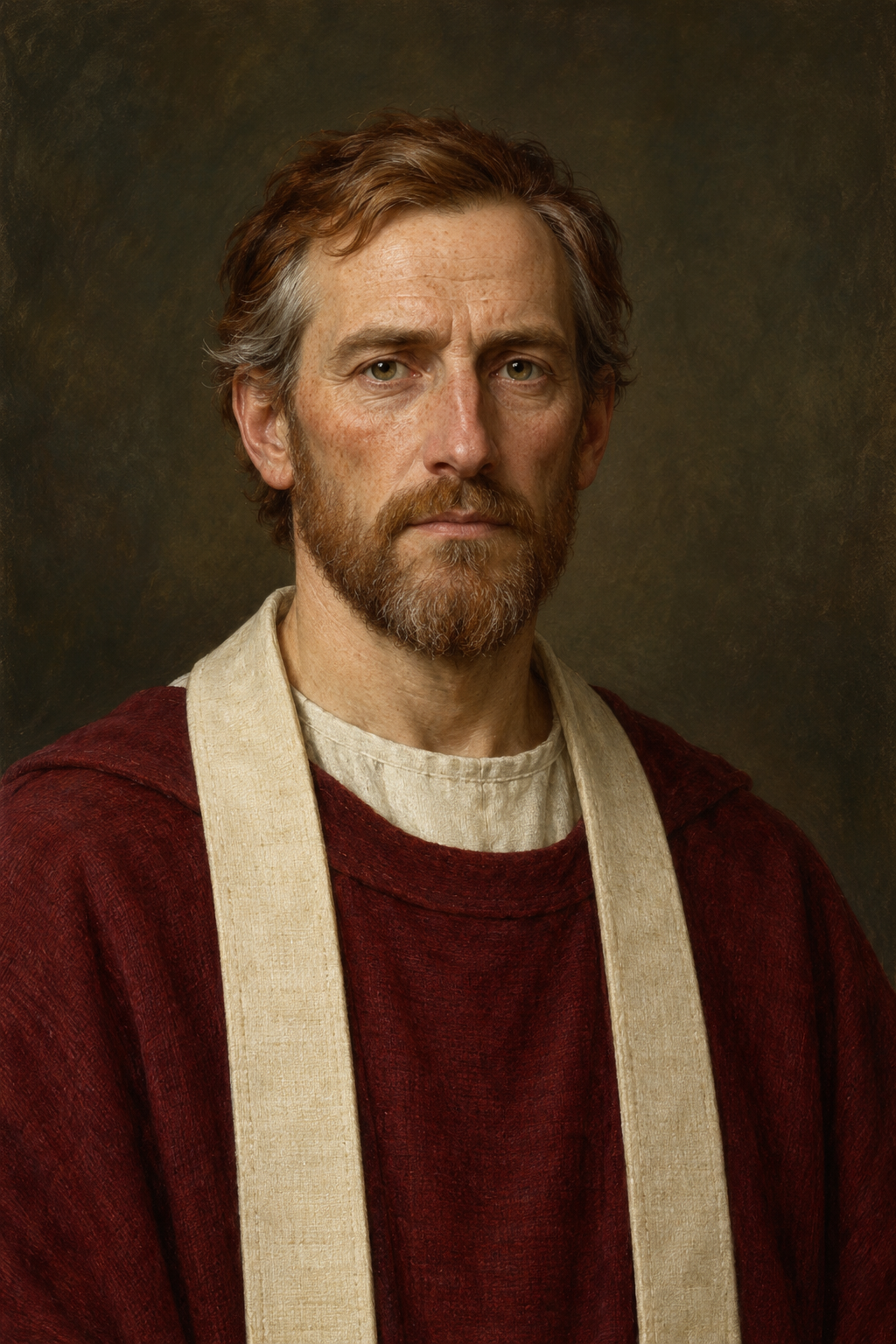
About Leodegar of Autun
Leodegar, known in French as Léger, was a seventh-century bishop whose religious work was inseparable from Frankish politics. From an aristocratic family, he served as archdeacon at Poitiers and abbot of Saint-Maixent before Queen Bathild helped bring him to the see of Autun. He restored the cathedral.
His responsibility for the city extended beyond its principal church. The Orthodox Encyclopedia describes food being provided for poor people at the cathedral and repairs to gates and other buildings. Such work belonged to the bishop’s public responsibilities.
A council associated with his episcopate addressed monastic discipline, although its status and participants are not securely known. Its regulations required obedience to monastic superiors, restricted personal property and required permission for journeys outside the monastery. They invoked Benedict’s Rule at a time when several monastic traditions still coexisted in Frankish lands. The evidence concerns a particular disciplinary programme, rather than an immediate, universal replacement of all other rules.
He was an active political leader, defending Burgundy’s independence against Neustrian centralization. In 673 he helped bring Childeric II to power. The struggle was not simply between an innocent churchman and a secular persecutor: Leodegar participated in the contests over royal authority that eventually brought him into conflict with the mayor of the palace, Ebroin.
Accused of plotting against Childeric, Leodegar was exiled to Luxeuil. After the king’s assassination he returned to Autun, but Ebroin regained power and besieged the city. Leodegar surrendered to prevent its sack. He was blinded, mutilated, deprived of his episcopal office, and ultimately beheaded. Later bishops recognized him as a martyr, and his remains were taken to Saint-Maixent.
Šenk dates the account to the 680s, soon after Leodegar’s death. Its proximity to the events makes its deliberate portrayal of episcopal conduct particularly significant for historians. The early narrative made political involvement part of his holiness. Martin Šenk observes that its author portrayed service at court and resistance to Ebroin as a necessary struggle against evil. The account gave extensive attention to royal politics, sometimes following events in which Leodegar himself did not appear. It was written to explain what a good bishop should do in that world, not to separate his ecclesiastical responsibilities from public power.
Other contemporary traditions complicate the picture. Šenk discusses the account of Bishop Praejectus of Clermont, whose death followed a dispute involving Hector, an ally of Leodegar. That narrative places Leodegar’s involvement among the circumstances behind Praejectus’s killing, but its details and attribution of responsibility are difficult to reconstruct. The allegation cannot simply be treated as a proved commission of murder. It does show why the conflicts require attention to more than the writings of Leodegar’s admirers.
A letter addressed to his mother Sigrada and a testament benefiting the see of Autun also survive. The testament refers to inherited land. These records add family and property relationships to the later narratives, without resolving every disputed detail of his ancestry.
His memory quickly acquired several biographies. Historian Charles Mériaux argues that even the third account, once dismissed as a compilation, may illuminate the interest in Leodegar at Saint-Vaast in Arras near the end of the seventh century. The early texts reflect communities shaping and transmitting his reputation.
In Alsace he became patron of Murbach and Masevaux. The historical dictionary notes an important qualification: the earliest charter evidence cited for Masevaux’s dedication is a twelfth-century forgery, though it may preserve material from an authentic earlier act. His supposed precise kinship with Odile is also uncertain.
At Lucerne, Leodegar and Maurice share the patronage of the institution known as Saint-Leodegar-im-Hof. The former Benedictine foundation became a collegiate church in 1456. The Lucerne foundation also became connected institutionally with Murbach. That relationship is documented in the twelfth century, when its monks were drawn from the Alsatian community. The shared saint’s name thus belonged to a network of religious houses as well as to local devotion.
Lucerne also honors him as a city patron. A cap preserved in its church treasury was long regarded as his own, but scientific examination reported in 2021 dated its felt foundation to the late eleventh century. The object is evidence of later devotion, not a garment worn by the seventh-century bishop.
The investigation also identified later alterations to the cap. In the fifteenth century it was covered with costly silk velvet and edged with silk and colored fringe; further ornament was added in the seventeenth century. Signs of wear suggest that someone used it, but the occasion remains unknown. These changes show how an object associated with the patron was preserved and embellished over time. They do not restore the traditional attribution to Leodegar himself.
He is traditionally invoked for eye disorders and against demonic possession, and is a patron of millers and the canton of Lucerne. These are devotional associations. His feast is October 2.
Wondering how to weigh the stories and sources? Learn how to read a saint biography.