Biography
Leopold III
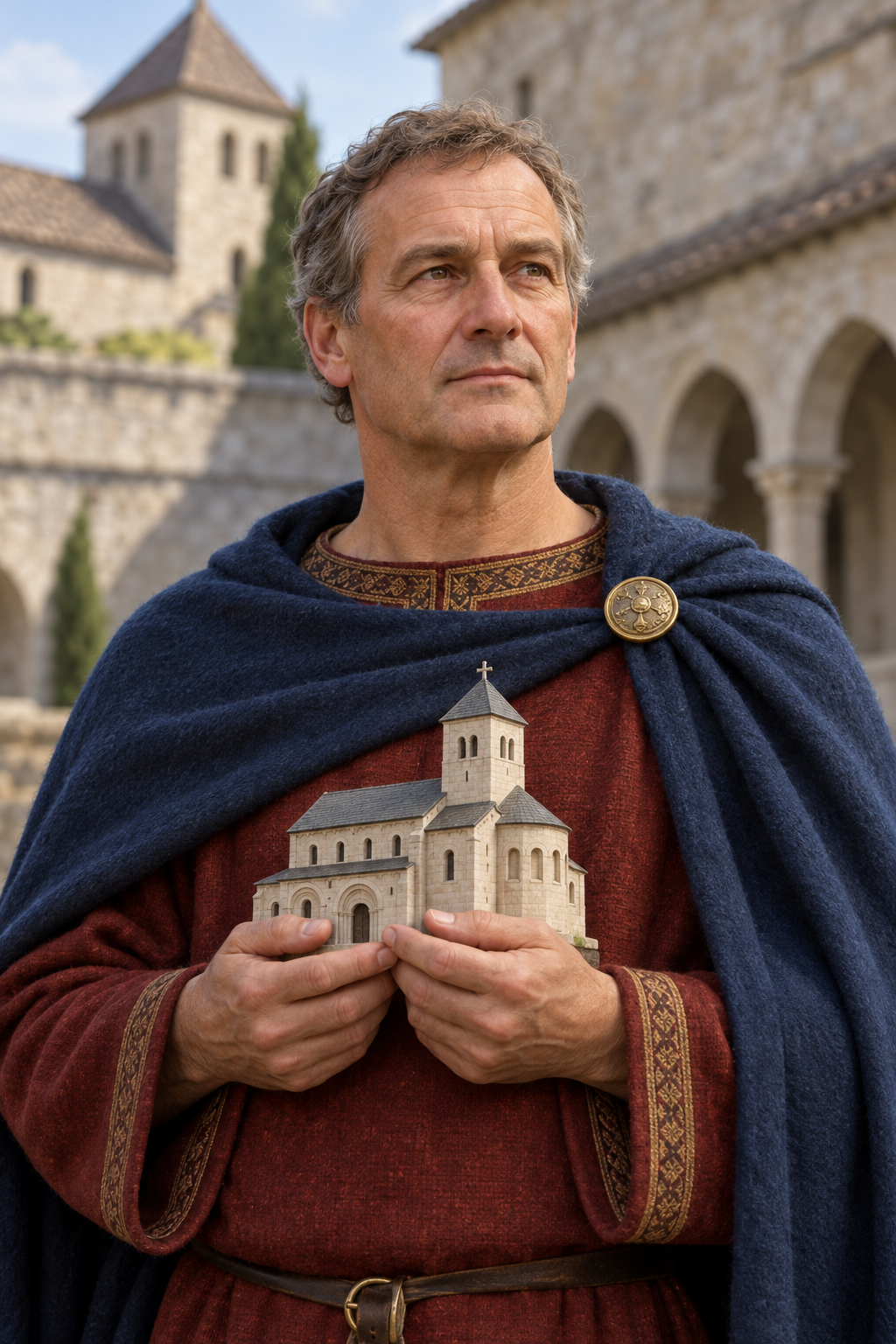
About Leopold III
Leopold III was a Babenberg margrave whose religious foundations helped shape medieval Austria. Born around 1075, he succeeded his father as ruler of the Austrian march in the closing years of the eleventh century. Little is securely known about his youth. His later reputation for piety grew alongside the political importance of his family and the monasteries that preserved its memory.
In 1105 he abandoned Emperor Henry IV’s army during the emperor’s conflict with his son. The change of allegiance benefited Leopold: in 1106 he married Agnes, the younger Henry’s widowed sister. Her wealth and imperial connections strengthened the Babenbergs. This was an important political alliance as well as a marriage, and its advantages extended to their children.
Agnes also belongs in the story of Klosterneuburg’s foundation. The abbey’s chronology identifies both spouses as founders and dates the church’s foundation stone to June 12, 1114. The community initially differed from the one known today: Augustinian canons arrived in 1133 under Provost Hartmann. The church was consecrated on September 29, 1136, only weeks before Leopold’s death. A great bronze candlestick associated with Agnes survives among the abbey’s treasures.
At Heiligenkreuz, another foundation connected faith with the growth of a community. The abbey traces its beginnings to about 1133, when Leopold acted on the request of his son Otto, who had entered the Cistercian monastery of Morimond. The new house stood in the southern Vienna Woods. Its name, Holy Cross, preceded the arrival of the celebrated cross relic later in the century. The distinction matters because the monastery’s beginnings are sometimes confused with that later gift.
Heiligenkreuz developed beyond its founder’s lifetime. The abbey’s history describes the production of manuscripts and the establishment of daughter houses during the following centuries. Its surviving medieval buildings belong to successive stages of construction, not to a single finished complex that Leopold would have seen. His foundation supplied a beginning; the later work of monks, patrons and craftspeople gave the institution much of its lasting form.
His support for religious houses also enlarged princely power. Historian Heide Dienst describes disputes over property, including Leopold’s retention of part of the endowment intended for Klein-Mariazell. She also records campaigns against Hungary. His reign cannot therefore be reduced to uninterrupted peace or disinterested generosity.
Leopold was considered during the royal election of 1125, but the familiar account of a humble refusal needs qualification. Brunner reads the surviving narrative against the competing interests of the electors. Age and a large family may have supplied an appealing explanation for an unsuccessful candidacy rather than a complete account of his motives.
The succession exposed tensions within his family. Karl Brunner discusses a papal condolence letter urging harmony between Agnes and her sons after Leopold’s death. Adalbert, an older son, did not succeed him; Leopold IV did. Brunner treats explanations based simply on a father’s affection or dislike with caution, examining political arrangements instead. The surviving evidence does not justify turning a complicated ruling household into an uncomplicated picture of domestic harmony.
Leopold died on November 15, 1136. Klosterneuburg’s chronology describes a hunting accident as probable, rather than certain. The abbey became the center of his remembrance, and its chronology records his canonization by Innocent VIII in Rome on January 6, 1485. The interval between his death and formal canonization spans more than three centuries.
One familiar story places a lost bridal veil at the origin of the abbey. A gust carries Agnes’s veil away; Leopold later finds it while hunting and fulfills a vow to build a monastery there. Klosterneuburg explicitly calls this a legend, first written down in the fourteenth century. A later addition introduces an apparition of Mary and the child Jesus. The baroque reliquary made to display the veil belongs to the story’s subsequent devotional history.
Later rulers also shaped his public image. Brunner notes that familiar depictions give Leopold an archducal hat and other symbols that belong to later centuries. These are expressions of dynastic remembrance, not reliable evidence of his clothing. Agnes’s contribution could become less visible within such imagery, even though she had participated in the foundation.
After the canonization, Klosterneuburg used print, pictures, sermons and songs to make Leopold known. A 2019 exhibition described this effort and Emperor Maximilian’s interest in presenting dynastic history. Ladislaus Sunthaym prepared a family history; the monumental Babenberg family tree translated that research into a visual account for pilgrims. This work helped connect the saint’s memory with a much later ruling house and with the identity of the land.
The Archdiocese of Vienna honors him on November 15 and identifies him as patron of Austria, Vienna and Lower Austria, as well as Upper Austria alongside Florian.
In Klosterneuburg, the Leopoldi festival continues the memory of pilgrimage and communal celebration. The municipality recalls earlier distributions of food and coins to the people and describes the modern fair. Religious remembrance and local custom remain closely connected around the founder’s name.
Wondering how to weigh the stories and sources? Learn how to read a saint biography.