Biography
Lidwina of Schiedam
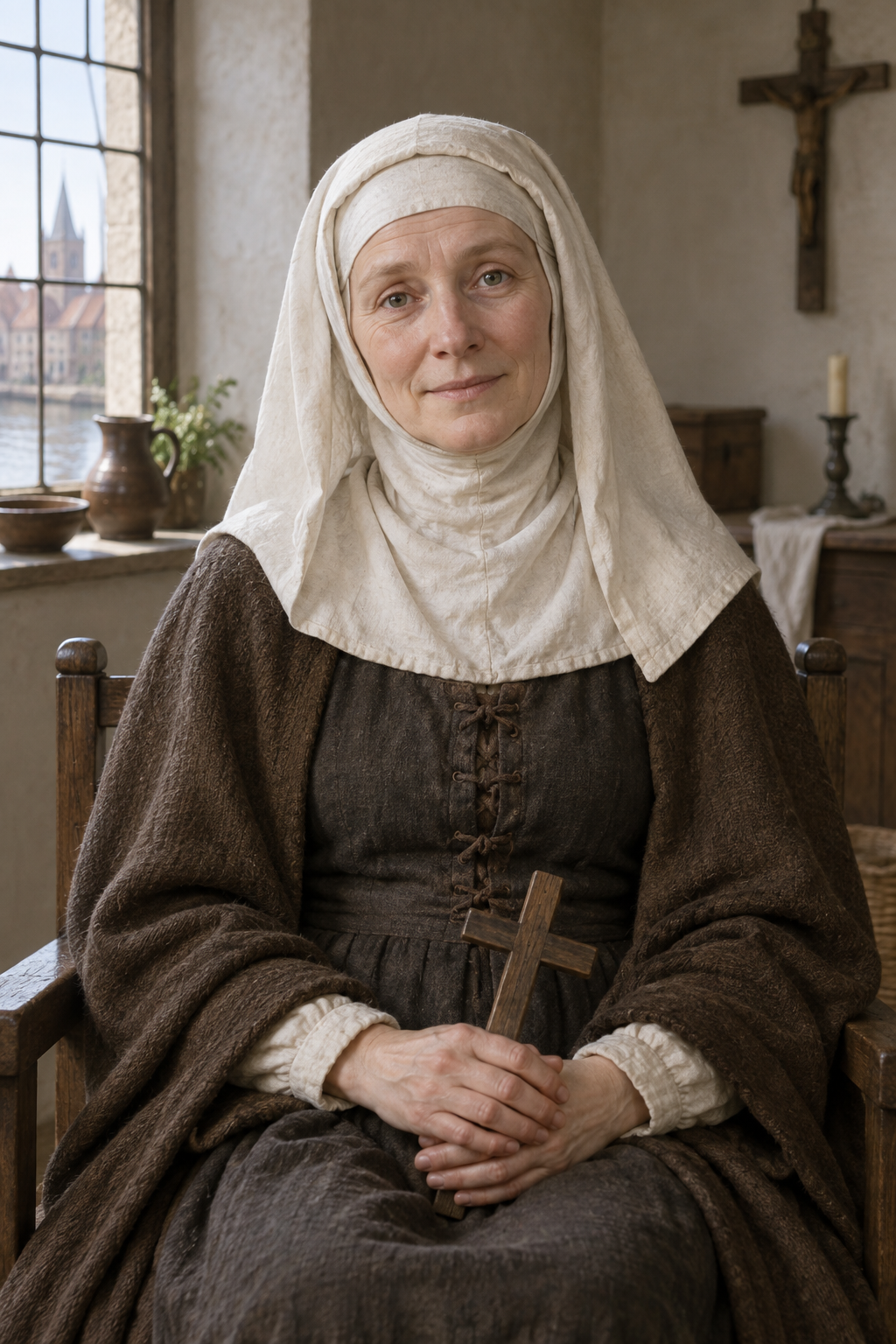
About Lidwina of Schiedam
Lidwina lived her entire life in Schiedam, a town in the county of Holland. Medieval narrative sources and modern source catalogues agree that she was born there in 1380 and died there in 1433. They say that she was the only daughter in a family of nine children. Beyond those broad points, the evidence comes through devotional biographies rather than civic records or letters written by Lidwina herself. Even the exact day of her birth is disputed in modern church sources: one gives March 18 and another April 18. A responsible account therefore retains the well-supported year while leaving the month and day unsettled. Her many name forms—Lidwina, Liduina, Liedwy, and Lydwine among them—reflect the manuscript and linguistic history of her cult.
Around 1395, when Lidwina was about fifteen, she went onto the ice with friends and fell. The early tradition says that the impact broke a rib and that she never recovered her previous health. Later writers supplied extensive descriptions of wounds, infections, impaired movement, and other symptoms. Those accounts cannot support a confident modern diagnosis, and assigning one retrospectively would turn hagiographic description into medical evidence it was never designed to provide. What can be said with reasonable confidence is that the injury began a long period of serious illness and disability. Lidwina spent much of the remainder of her life confined at home and dependent on care. Her person should not be reduced to the injury or treated as valuable because she experienced pain.
The earliest surviving life was composed soon after her death. Marijke Carasso-Kok's repertory identifies a work attributed to Jan Gerlach and dates it between 1434 and 1440. Gerlach may have been a relative and was later said to have lived in Lidwina's household. Other narratives followed, including versions associated with Hugo van Rugge, Thomas a Kempis, and the Franciscan preacher Jan Brugman. Because these authors shaped their material according to devotional ideals, closeness in time does not make every detail straightforward reportage. Their texts remain essential witnesses to how Lidwina was known, visited, and remembered, but their theological interpretations and miracle stories require explicit attribution.
According to these lives, Lidwina initially experienced anger and distress rather than effortless acceptance. A priest named Jan Pot encouraged her to meditate on the Passion of Christ. The narratives then describe prayer becoming a central practice in her constrained daily life. They interpret her suffering as participation in Christ's suffering and report visions of Christ, Mary, angels, heaven, and purgatory. Such claims belong to the faith and literary world of her biographers; they are not independently verifiable events. Modern readers should also resist an implication the sources sometimes invite: illness is not evidence that a person has been chosen to suffer for others, and acceptance of changed circumstances does not remove the need for treatment, access, companionship, or relief.
Lidwina's room nevertheless became a social and religious place rather than merely a scene of isolation. The traditions describe neighbors, clergy, civic figures, and travelers seeking conversation or prayer. They also portray her sharing gifts with people in poverty and directing assistance toward others despite her own household's limited means. These details come through admiring witnesses and cannot all be reconstructed independently. They are still important because they depict agency within disability: Lidwina listened, advised, prayed, and participated in networks of mutual care. Compassion is shown here through attention and distribution of help, not through passive endurance. The distinction keeps the focus on choices she reportedly made rather than praising symptoms she could not choose.
The medieval lives include conflicts as well as consoling scenes. Lidwina was examined by physicians, depended on relatives and attendants, and sometimes encountered skepticism or intrusive treatment. The texts frame several episodes as tests of holiness and add extraordinary claims about fasting and bodily condition. These cannot be translated into clinical facts. Their historical value lies partly in showing how late-medieval communities spoke about a chronically ill woman's body, authority, and dependence. Lidwina's reputation allowed a person with limited mobility to become a recognized religious figure without holding monastic office. Yet the same reputation also exposed her body to scrutiny. Both agency and vulnerability belong in the account.
Lidwina died in Schiedam on April 14, 1433. Accounts written soon afterward helped establish local pilgrimage and commemoration. The Catholic Encyclopedia reports that a chapel was built over her grave by 1434. Brugman prepared a Latin life in the fifteenth century; Schiedam's municipal archive preserves a copy of the illustrated edition printed in the town in 1498. Its woodcuts made the fall on the ice one of the best-known images associated with her. Art and print therefore shaped memory of Lidwina almost as decisively as prose. The image is evidence for late-fifteenth-century reception and skating history, not a picture made at the moment of the accident.
Her remains and public cult passed through later changes in Dutch religious history. The Catholic Encyclopedia records removal of the relics to Brussels in 1615 and their return to Schiedam in 1871. On March 14, 1890, Pope Leo XIII formally confirmed the longstanding veneration. Roman Catholic observance keeps April 14 as her feast. These acts document reception rather than prove each incident in the medieval narratives. They show a local woman becoming a saint with an international devotional history while remaining closely identified with one city. The modern basilica and civic archive continue different parts of that memory: worship, manuscripts, images, and local history.
Lidwina remains significant as a laywoman whose influence developed from a home marked by prolonged illness and restricted movement. The surviving record is neither a modern medical case history nor a neutral diary. It is a layered collection of near-contemporary memory, devotional interpretation, later print culture, and official recognition. Its visions and miracles can be named as traditions without being asserted as established history. Its descriptions of suffering can be reported without romanticizing disability. Within those limits, the sources preserve specific forms of action: welcoming visitors, sustaining prayer, sharing resources, and becoming a focus of communal memory. Historical care allows those actions to remain visible while refusing to make pain itself her defining virtue.
Wondering how to weigh the stories and sources? Learn how to read a saint biography.