Biography
Lorenzo Ruiz
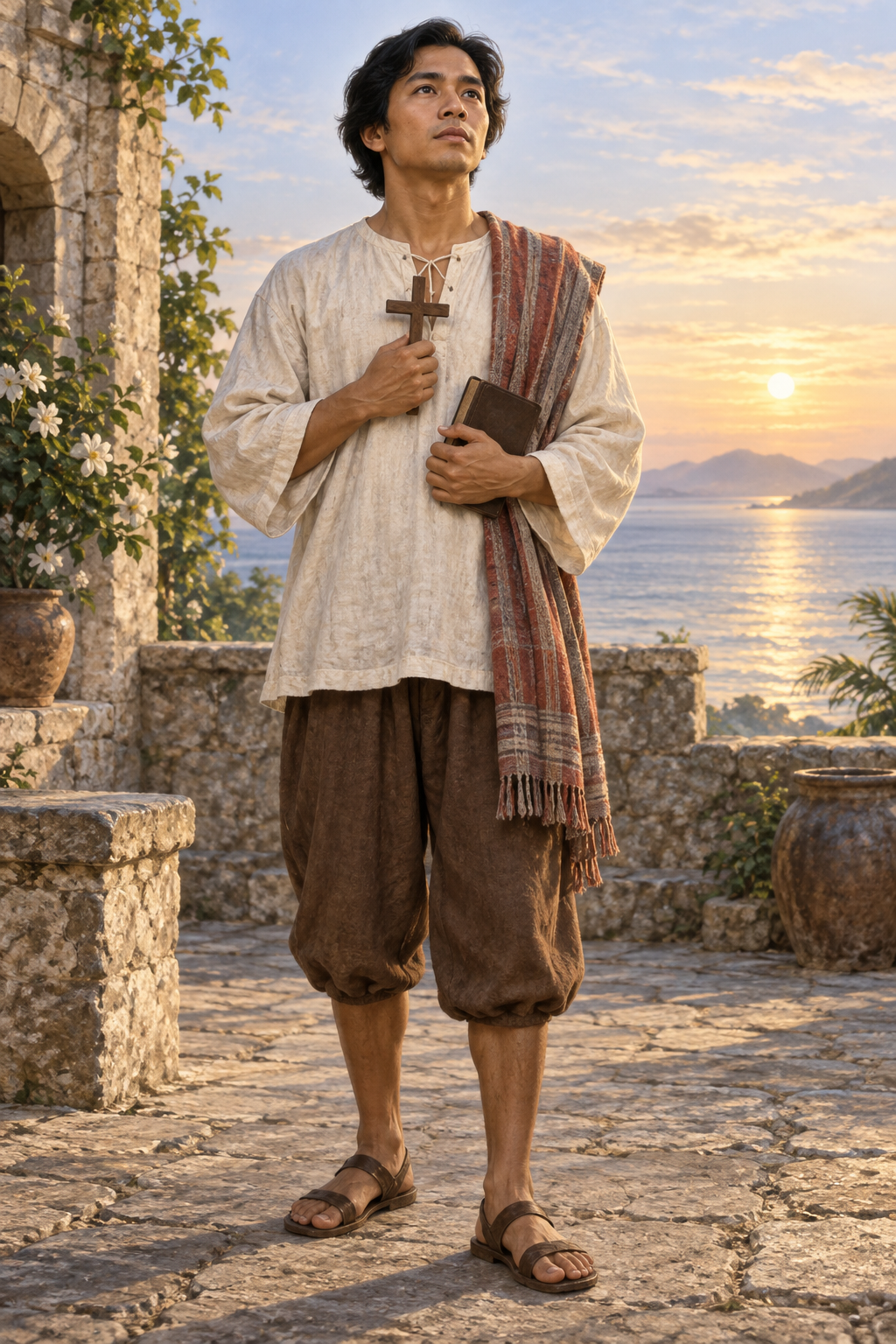
About Lorenzo Ruiz
Lorenzo Ruiz is honored as a Filipino lay martyr. John Paul II’s beatification homily describes him as coming from Binondo in Manila, a husband and father who served in his parish. These details are important because they situate his holiness in ordinary lay life. Lorenzo was not remembered first as a public religious leader; he belonged to a family and a local Christian community.
His parish service shows faith taking practical form. Church life depends on many kinds of lay participation: care for worship, service to neighbors, family responsibilities, and the quiet tasks by which a community is sustained. The source’s attention to Lorenzo’s parish role protects the account from making martyrdom seem disconnected from the life that preceded it.
Lorenzo’s final witness took place in the context of persecution in Japan. The beatification homily places him with companions who suffered for their faith. Detailed travel routes, judicial records, and the exact manner, place, and date of death should be sourced separately before being used in structured fields. This restraint does not diminish the fact of martyrdom. It preserves it without making claims that exceed the evidence in hand.
John Paul II canonized Lorenzo Ruiz and his companions in 1987. In an address to the Filipino community, the Pope identified Lorenzo as the first native-born Filipino saint. The statement has ecclesial and cultural significance: it recognizes the holiness of a lay Filipino Christian within the universal Church and gives a community long accustomed to missionary narratives a saintly witness rooted in its own people.
Lorenzo’s story also calls for historical sensitivity. The Christian missions and persecutions of East Asia involved different peoples, colonial powers, religious communities, and local authorities. A devotional summary should not simplify that history into a conflict of abstractions. The source supports a more human account: a husband, father, and parish servant was caught in persecution and became a martyr through fidelity to Christ.
For contemporary readers, Lorenzo Ruiz’s legacy makes lay holiness visible. Family life and parish service were not preparation for a less important calling; they were the ordinary form of his Christian vocation. His martyrdom makes that vocation memorable, but it should not erase the everyday faithfulness from which it grew.
The evidence supports a clear, restrained account: Lorenzo Ruiz came from Binondo, Manila; he was a husband, father, and parish worker; he died a martyr with companions in Japan; and he was canonized in 1987 as the first native-born Filipino saint. Further source work is required for precise death fields. That is the proper boundary for this bulk packet.
Binondo gives Lorenzo’s witness a particular Filipino setting. Parish service, marriage, and parenthood were not background details to be discarded once martyrdom entered the story. They were the ordinary commitments through which he lived his faith. The Church’s reception of Lorenzo makes lay holiness visible in family and community life, not only in offices traditionally associated with public religious authority.
His martyrdom must be placed in the history of persecution without simplifying that history. The people involved came from different places, spoke different languages, and lived within political and religious structures more complex than a simple contrast between one culture and another. The source packet does not attempt to retell every event. It keeps its claim focused on the fact that Lorenzo and his companions suffered for Christian faith.
The group context matters morally and historically. Martyr stories can become overly individual when a single name is more famous than the others. John Paul II’s beatification and canonization placed Lorenzo among companions, reminding the Church that witness was shared by people with different roles and backgrounds. His prominence as the first native-born Filipino saint should therefore be received as a recognition of a community’s faith as well as of one man’s courage.
Family life deepens that witness. A husband and father carries responsibilities for people close to him; parish work likewise involves commitments that may be unnoticed by public history. Lorenzo’s life refuses the notion that Christian courage begins only when someone leaves ordinary obligations behind. The source does not supply every personal detail, but it establishes enough to see martyrdom as emerging from a life already shaped by responsibility and service.
The 1987 canonization also has a continuing significance for Filipino Catholics. It recognizes a saint born in the Philippines within the universal Church, affirming that holiness is not imported from elsewhere but can take root in local communities. This reception should encourage historical curiosity and care rather than national triumphalism. Lorenzo’s story belongs to the Church and to the people whose history and faith formed him.
It is a witness grounded in ordinary faithfulness rather than religious office or public rank.
Wondering how to weigh the stories and sources? Learn how to read a saint biography.