Biography
Louis Martin
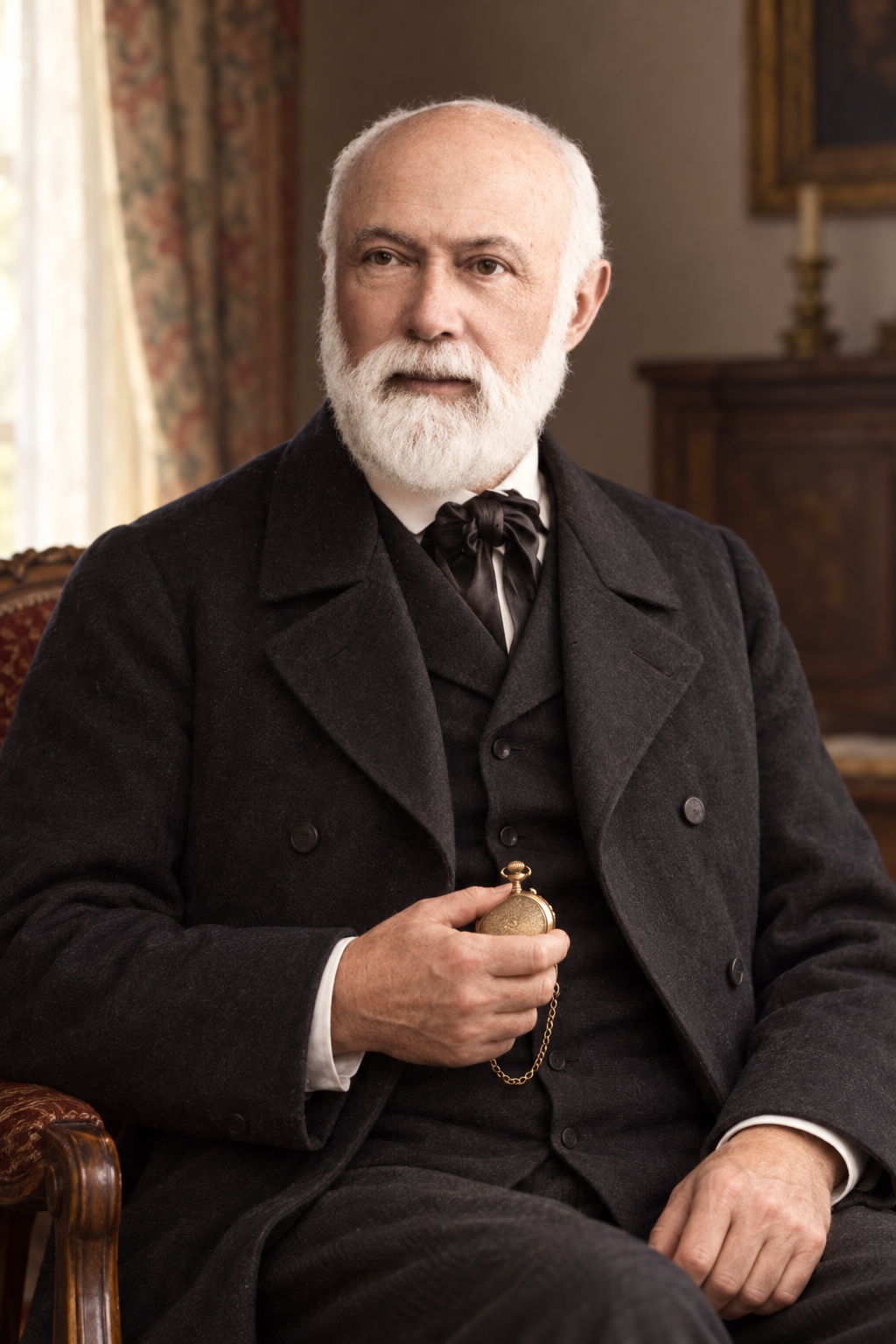
About Louis Martin
Louis Martin was a French watchmaker, husband and father whose youngest daughter became Saint Thérèse of Lisieux. Born in Bordeaux on August 22, 1823, he first hoped to enter religious life at the Great Saint Bernard hospice. Difficulty with Latin prevented that plan from developing. He eventually established himself in Alençon, where his life took a different direction through marriage to Zélie Guérin, a maker of the town’s celebrated lace.
A small account book from 1845–1847 records the practical effort behind his religious hopes. The archive’s description identifies purchases of Latin textbooks and regular payments for lessons, followed eventually by the sale of a dictionary. It also notes clothing, holiday gifts and occasional help for his father. These ordinary expenses make the young man more tangible: he was managing limited daily choices while testing a vocation that he ultimately did not pursue.
His trade required years of preparation. The Alençon sanctuary’s account follows his training through Rennes, Strasbourg and Paris before he opened his watchmaking and jewelry business in 1850. Work did not occupy all his attention. He enjoyed fishing, made time for meditation and joined a circle of young Catholic men associated with Abbé Hurel. Through the Saint Vincent de Paul conference, he also found a practical way to help people in need.
Louis and Zélie married in July 1858, with the civil ceremony on the evening of July 12 and the church ceremony at midnight as July 13 began. Their marriage lasted nineteen years. They initially intended to live in continence, then welcomed nine children, of whom five survived childhood. Louis eventually gave up his own business to assist Zélie in managing her lace enterprise. The surviving correspondence records affection alongside the demands of work and family responsibilities.
Their household combined warmth with strict expectations. The Carmel archives’ family history describes outings, songs and evening entertainments, but also discipline concerning order, punctuality and behavior. Léonie’s upbringing brought particular difficulties. The daughters’ later recollections nevertheless remember being loved and carefully educated.
Louis’s reading notebook gives a more personal glimpse of the home. The Carmel archives preserve prose and poems that he copied and read with his family in the evening. The selections include descriptions of nature, Breton landscapes and a passage about Coligny’s death attributed to Voltaire. These are copied texts, not writings that Louis composed. They show a father sharing literature as well as religious practice with his children, and help explain the imaginative world in which Thérèse and her sisters grew up.
Zélie died on August 28, 1877. Louis then moved to Lisieux to be near her brother’s family and provide support for his five daughters. Widowhood changed the setting of his life without ending his responsibilities as a father. His daughters’ religious vocations gradually took them from the family home. The Church’s account of his life remembers his consent to those choices as part of his own service to them.
His later years included serious illness. The Carmel archives describe memory loss, a disappearance from home and a crisis in which he armed himself against imagined attackers. He entered the Bon Sauveur psychiatric hospital in Caen in February 1889. Periods of distress alternated with lucidity, and he relinquished management of his property. He returned to family care in May 1892, still seriously disabled. This history should not be reduced to either a serene devotional image or a moral judgment about illness.
He died on July 29, 1894.
The family archive identifies the place as La Musse, a property belonging to the Guérins in the Eure. Céline, Léonie and the wider family had shared in caring for him. His dependence in those final years belongs to his story as fully as his earlier craftsmanship and care for his children.
Louis and Zélie were beatified together at Lisieux on October 19, 2008. Cardinal José Saraiva Martins emphasized marriage itself as their path to holiness. His homily also addressed widowed people and those facing sickness or death, connecting their circumstances with the couple’s experience. The recognition concerned the parents’ lives and choices, rather than simply the distinction of having a daughter already honored as a saint.
Pope Francis canonized them on October 18, 2015. In the canonization homily, he placed their family life within a wider call to humble service. He remembered the environment of faith and affection they created for their daughters. The emphasis remained on daily care, a form of service that can be difficult to see from outside a household.
Their liturgical feast is July 12. At Alençon, the sanctuary celebrates it as its patronal feast, bringing couples and families together for prayer.
Their patronage also reaches smaller communities: the founder of Fondation Cana in Abidjan identifies Louis and Zélie as its patrons. These specific associations are documented; they do not establish a universal official patronage for every family or for every illness Louis experienced.
Wondering how to weigh the stories and sources? Learn how to read a saint biography.