Biography
Louise de Marillac
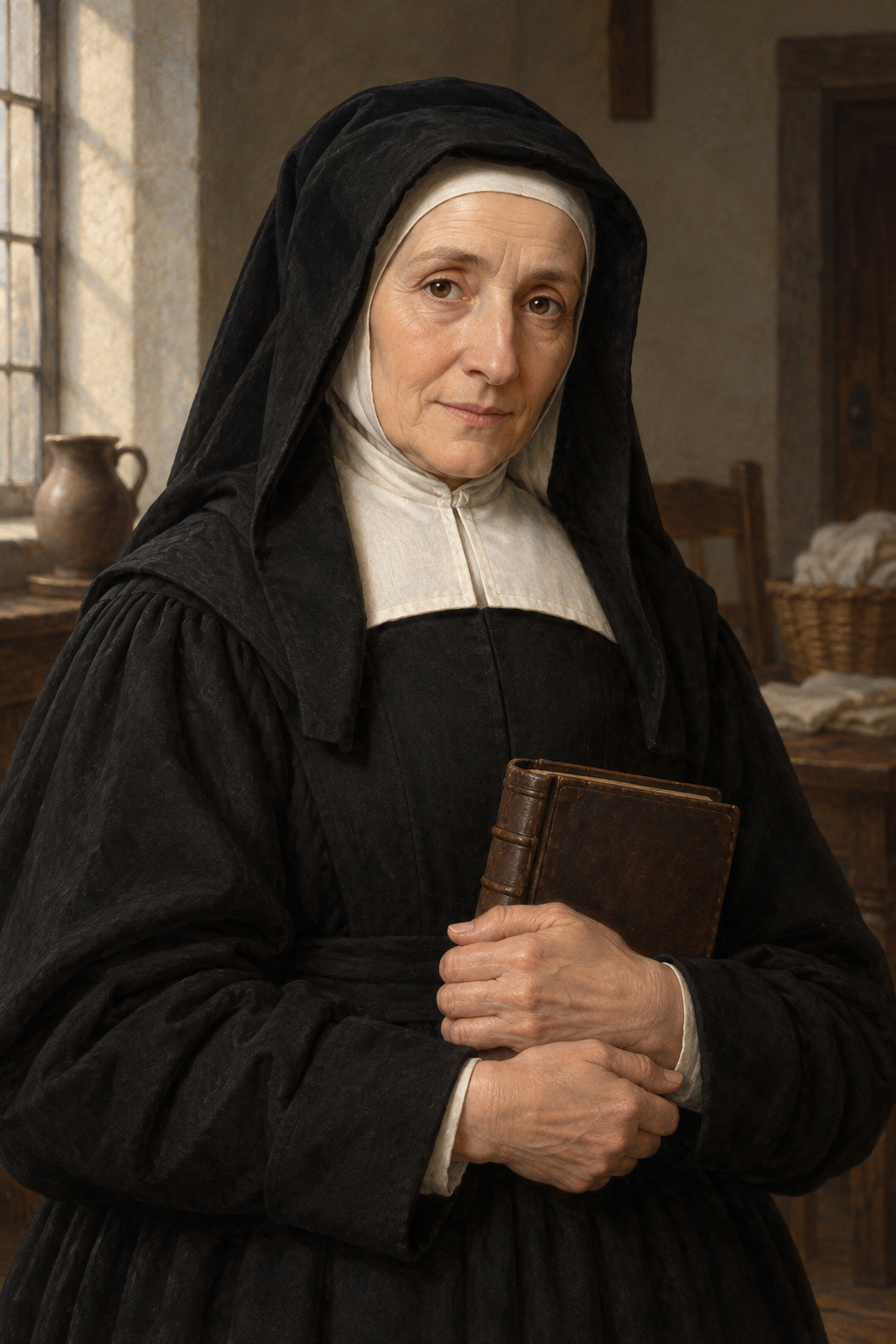
About Louise de Marillac
Louise de Marillac helped give women a new way to serve people in need in seventeenth-century France. With Vincent de Paul, she founded the Daughters of Charity, whose members worked outside a monastery’s enclosure. Their life joined prayer with practical service in homes, hospitals and schools. Louise brought to this work the experience of marriage, motherhood and widowhood, as well as an ability to organize people and institutions.
Born on August 12, 1591, she received an education among Dominican nuns at Poissy. Her wish to enter a convent was refused, and she married Antoine Le Gras in 1613. They had a son. When Antoine became seriously ill, Louise feared that she was being punished for abandoning her religious vocation. At Pentecost in 1623, she experienced an inward assurance that she should remain with her husband and child while awaiting a future community of service. This was her understanding of an experience in prayer, rather than an independently observable event.
Antoine died in December 1625. Louise’s developing relationship with Vincent de Paul helped turn her attention toward organized charity. Yet her later life was not free of anxiety: Elisabeth Charpy notes that she sometimes blamed herself when sisters left the community. Her growth in confidence did not erase every difficulty.
The Daughters’ own history gives an important place to Marguerite Naseau, a village woman who had taught herself to read and taught local children. She came to Paris in 1630 to offer her services, and Vincent entrusted her to Louise. Other country women joined them. Their labor helped sustain charitable work that wealthier women found difficult to combine with their social obligations. The community dates its foundation to November 29, 1633. Its beginnings therefore involved several kinds of contribution: funding and connections, practical labor, teaching and organization.
The work also reached beyond France during the founders’ lifetimes, when they sent sisters to Poland. The community’s account connects that early expansion with its continuing readiness to serve wherever sisters are sent. It also explains a distinctive form of commitment: its members take vows of service to poor people, chastity, poverty and obedience, renewing them annually. These present practices preserve a form of communal dedication shaped around service, rather than permanent enclosure in a monastery, and help explain the character of the institution Louise helped establish.
Louise’s responsibilities extended beyond encouraging goodwill. In 1639, sisters began work at the hospital of Saint Jean in Angers. When the town’s officials required a contract, Louise became a negotiator, helping establish arrangements that could support continuing service. Louise Sullivan’s study also describes her dealings with church authorities over a free school for girls and with the Ladies of Charity over accommodation for abandoned children. Such work required decisions about buildings, permissions and responsibilities as well as personal devotion.
She also had to address conflict within the community. Sullivan examines a letter of October 26, 1639, sent to two sisters together. Louise recognized the good they were doing, then spoke directly about their difficulties and each woman’s failings. She also considered her own responsibility for not always being available. Her encouragement included correction, but it allowed room for the leader herself to acknowledge a part in the problem.
The community’s service carried expectations about religion and conduct. Historian Rose-Marie Peake argues that the Daughters sought to form conservative Catholic lives among both the people they helped and their own members. Her study also emphasizes dependence on elite Parisian support and the labor of women from poorer backgrounds. Peake proposes that maintaining familiar moral ideals helped the community survive criticism of women’s work outside the cloister. This interpretation places Louise’s achievement within the social and religious constraints of her time, rather than treating charitable organization as free from questions of authority and power.
Louise did not wear the large, starched white headdress later associated with the Daughters of Charity. The community’s archives explain that, with Vincent’s permission, she continued to wear the ordinary dress of a devout widow. Early sisters dressed like village women; the distinctive cornette developed over time. Remembering that difference helps distinguish the founder’s seventeenth-century life from the familiar appearance of the community in later centuries.
She died in Paris on March 15, 1660, with family members and sisters around her.
Pope Pius XI canonized her on March 11, 1934.
Vatican News now lists her feast on May 9.
In 1960, John XXIII declared her patron of people engaged in Christian social work. His letter remembered care for sick people at home and in hospitals, abandoned children, older people, galley convicts and people with mental illness. It also recognized the women whose cooperation made that work possible and Louise’s role in preparing them for it. The decree connects her patronage with a shared vocation of service, rather than assigning her separately to every group that the community helped.
Wondering how to weigh the stories and sources? Learn how to read a saint biography.