Biography
Luc Dochier
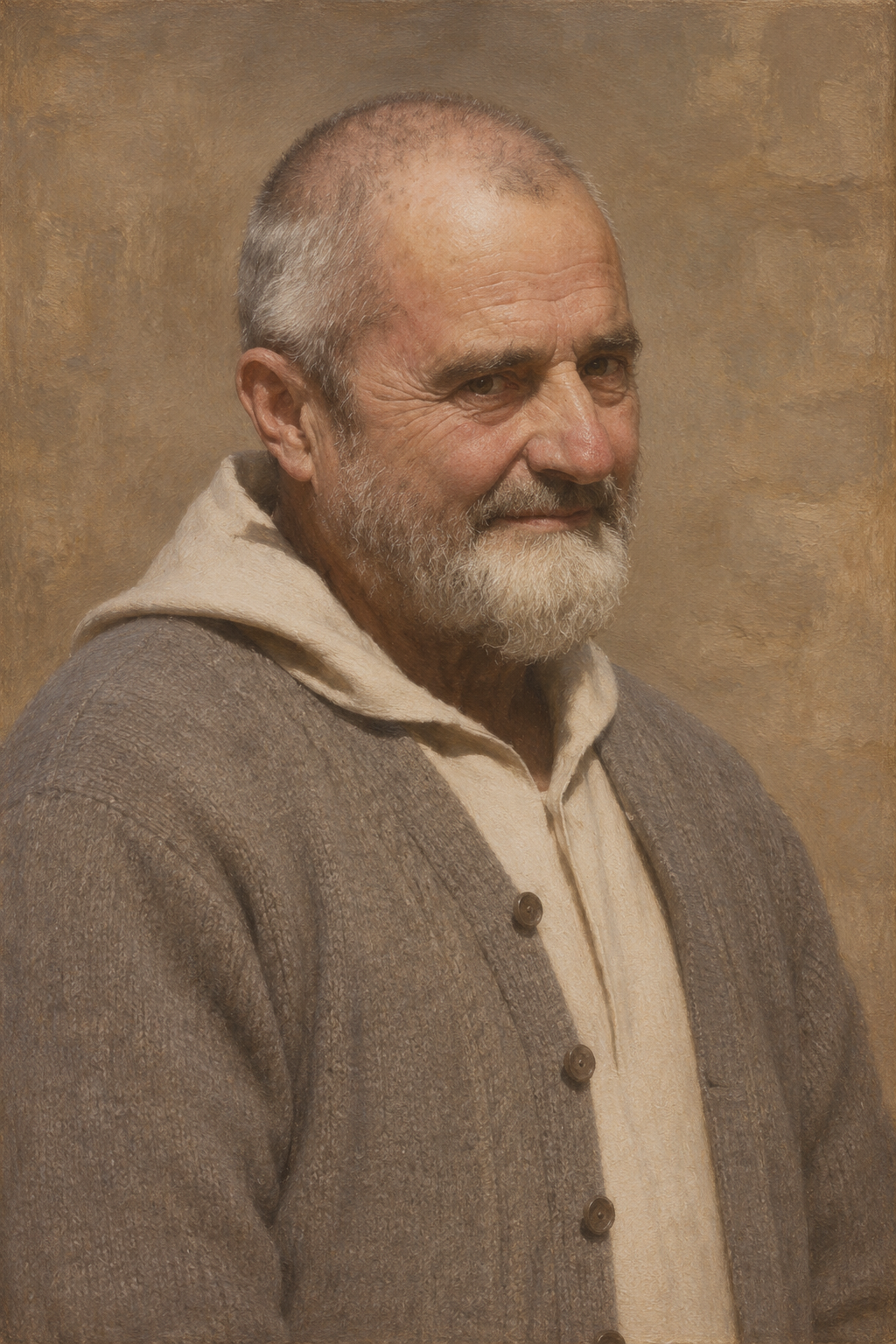
About Luc Dochier
Luc Dochier was born Paul Dochier at Bourg-de-Péage on 31 January 1914 and baptized in the church of Sainte-Marie. The parish’s account locates his family home near the town center and records its destruction during the Second World War. His life would eventually be rooted in Algeria, but his family’s story remained connected to the Drôme.
He studied medicine in Lyon, working at Grange-Blanche and the Antiquaille hospital. In 1940 he successfully defended a thesis on a case of spontaneous, symmetrical bone fissures. The family provided images of the thesis for a later newspaper report, including its dedication to his brother, whose death from tuberculosis had deeply affected him.
His military service took him to Morocco as a medical officer. He entered Aiguebelle in December 1941 and chose the vocation of a lay brother. In 1943 he volunteered to replace a father of a family held prisoner in Germany, remaining there until 1945. After returning to monastic life, he went to Tibhirine in 1946. He made his perpetual profession there on 15 August 1949. His life joined the responsibilities of a monk with the practical work of medicine. During the Algerian war of independence, he and another brother were abducted in 1959 and later released.
While imprisoned, he cared for Russian prisoners suffering from typhus and contracted the disease himself.
His years at Tibhirine were not entirely uninterrupted. Uncertainty about the monastery and dispensary led to stays at Orval in 1962 and Notre-Dame des Neiges in 1964. He returned to Tibhirine in 1965. His own health became increasingly fragile, but he continued serving the dispensary and performing other work within the community.
Assistance could also extend beyond treatment: donations enabled him to provide money or supplies to poor families, including women facing particular difficulties.
The medical service depended partly on help from afar. Luc’s nephew Pierre Laurent recalled his uncle’s visit to Lyon during the winter of 1989–90. Professor Guillemin gathered medical friends around him, and they subsequently organized supplies of medicine and money for Tibhirine. According to Laurent, that support continued until 1996. The same interview records the affection of Algerian patients, some of whom kept his photograph at home. These memories show both the relationships sustained by the dispensary and the network that helped keep it supplied.
Jean-Pierre Schumacher, who lived with Luc, remembered the dispensary as an important bridge between the monks and their neighbors. In a 2011 interview, he recalled Luc receiving as many as eighty people a day. He also described a different kind of service within the monastery. When a brother faced a personal difficulty or a strained relationship, he could turn to Luc, whose wisdom made him a trusted confidant. His humor helped the community, including during periods of fear. Jean-Pierre remembered him finding words that made the brothers laugh at their meetings. The doctor’s schedule differed from theirs: his days combined the dispensary with cooking, and asthma could keep him awake through the night. These are a fellow monk’s memories of the burdens and gifts that shaped their shared life. Luc’s usefulness extended beyond his medical training to the ordinary relationships through which the community endured.
His own writings explain why he continued. In October 1993, he asked for peace in the country he had loved through more than forty-seven years there. Looking back over physical suffering, inner pain and failures, he understood his life as a pilgrimage in which God had accompanied him. He associated the path ahead with Christ’s cross and the hope of resurrection. A letter dated 4 December 1995 is more explicitly practical. Acknowledging problems with his heart and lungs, he said that his presence could still be useful. While he had strength to offer, he felt responsible to others and could not leave Tibhirine. The letter connects remaining with service, without claiming that he was indispensable.
The form of his correspondence also reflected daily responsibilities. His biographers describe short letters, often written on both sides of half a sheet. A response to a correspondent might lead into observations about Algeria or the seasons, requests for medicine or clothing, and a brief spiritual reflection. Longer thoughts sometimes appeared in the margins of books or on loose paper.
In a January 1995 letter, he expressed his trust in God’s mercy and forgiveness when considering what might lie ahead.
In a February 1994 family letter, he imagined his final hours with the Gospel story of the returning son and a glass of champagne, expressing gratitude for a world he had loved.
He was abducted with six fellow monks in March 1996, and their remains were recovered in May. The Church beatified him with the other martyrs of Algeria on 8 December 2018. His birthplace’s parish remembers him as both a monk and a physician, linking local family history with his long service abroad.
Wondering how to weigh the stories and sources? Learn how to read a saint biography.