Biography
Lucy Filippini
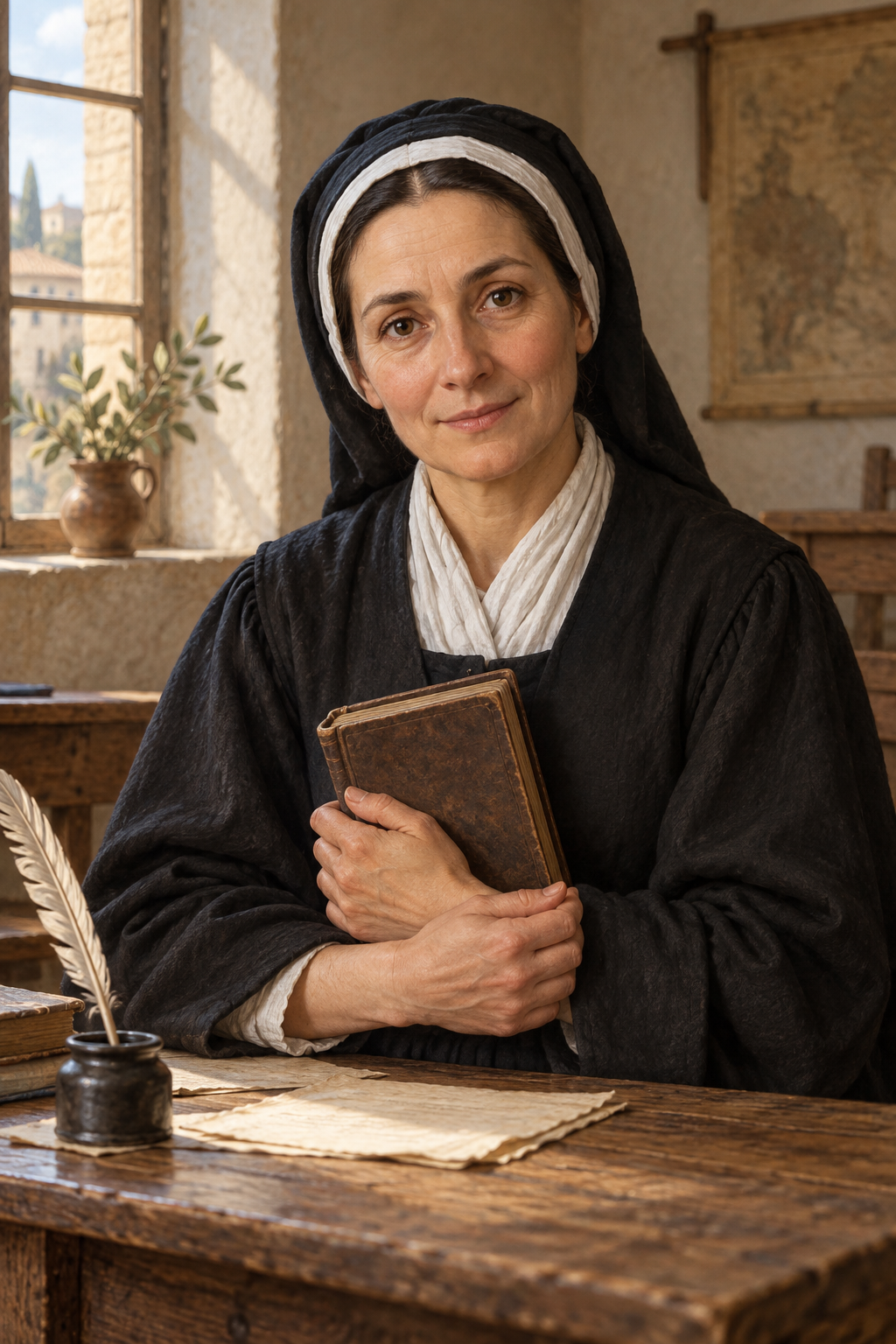
About Lucy Filippini
Lucy Filippini devoted her life to the Christian education of girls and women, especially those from poor families. Born on January 13, 1672, in the town now called Tarquinia, she lost her parents while young. Cardinal Marcantonio Barbarigo helped her continue her education at Santa Chiara in Montefiascone. Her later work grew from this connection with the bishop and from a commitment to teaching religious faith.
She did not begin the schools alone. Rosa Venerini had already developed schools for girls at Viterbo, and Barbarigo invited her to establish schools and train teachers in his dioceses. Lucy was among the women she trained. After about two years, Venerini returned to her own foundation, while Lucy took responsibility for the bishop’s schools. Venerini continued visiting them. Their collaboration gave the expanding work experienced leadership, but also brought together women whose institutions would eventually take different directions.
The school day combined religious teaching with practical skills. The Montefiascone school’s account describes reading, writing, sewing, spinning and lacework, together with religious songs and preparation for worship. The aim included preparing girls for the responsibilities expected of wives and mothers. Barbarigo provided material support, including hemp with which poor pupils could prepare household linen. Families who depended on their daughters’ agricultural labor needed encouragement and practical help to let them attend.
In a 1976 study of her educational practice, Albertina Tesei describes pupils arranged according to ability, with instruction moving from familiar examples toward more difficult ideas. Pictures helped explain lessons, while manual work and singing varied the day. Tesei also notes that punishment remained possible, though presented as an exceptional measure adapted to the pupil. The account reflects a Catholic understanding of discipline and formation; it does not make these schools identical to modern classrooms.
The teachers’ way of life enabled them to work outside a cloister. Tesei describes women who retained their names and wore the modest clothing of their contemporaries, calling Lucy a secular schoolmistress. Their religious commitment took shape through service and community life.
The New Catholic Encyclopedia dates the community’s formal establishment to October 15, 1704, when the teachers received a rule and habit from Barbarigo and made their oblation.
Expansion also brought conflict. The Tuscia biographical dictionary records accusations of association with quietism arising from Lucy’s collaboration with the Pii Operai, the priests involved in the schools’ spiritual direction. It also describes disagreements with Venerini in 1707 that led to a lasting separation between their institutions. These accusations and disputes belong to the history of the foundation; they should neither be hidden nor treated as proof that Lucy taught the doctrine alleged against her.
Macchietti gives a more specific account of the Roman difficulty. In 1707, Lucy asked Venerini to replace her at the school there. Its spiritual direction and school life differed from Venerini’s own approach, and she did not remain: she returned to Viterbo in 1708. She eventually opened her own Roman school in 1713. The two foundations shared an origin without becoming one institution or following an identical course.
Lucy’s later years included concern about the schools’ financial survival. The Montefiascone account reproduces part of a letter to Princess Altieri in which she sought protection for the work and feared a school might close. Her appeal reveals the practical vulnerability behind an institution remembered for its growth. Keeping a school open required support for its teachers and pupils as well as commitment to its religious purpose.
She died at Montefiascone on March 25, 1732.
Pius XI beatified her in 1926 and canonized her on June 22, 1930. Her liturgical remembrance is March 25.
A further recognition followed in a papal letter dated August 21, 1932. Responding to the bishop’s request and the wishes of clergy and faithful, Pius XI named her patron of the Diocese of Montefiascone. The letter recalled her teaching, the schools she helped establish, her death in the diocese and the preservation of her body in its cathedral. It granted the liturgical rights associated with the patronal title.
Today the Diocese of Viterbo identifies her as one of its secondary patrons. Its 2025 jubilee program included a celebration at the Montefiascone co-cathedral.
Her educational work continued through later generations. The American community’s history places its work among Italian immigrants long after Lucy’s lifetime, highlighting Sister Ninetta Ionata’s contribution in New Jersey. This overseas expansion belongs to her successors, rather than to schools she personally opened.
Teachers interviewed for the 350th anniversary of her birth in 2022 described the continuing task of joining kindness with firmness. At the school in Rome’s Via delle Fornaci, they spoke about helping children recover confidence after separation during the pandemic, listening to their experiences and working with families. Such testimony shows a later community adapting its inherited educational purpose to the needs of children in its own time.
Wondering how to weigh the stories and sources? Learn how to read a saint biography.