Biography
Luigi Versiglia
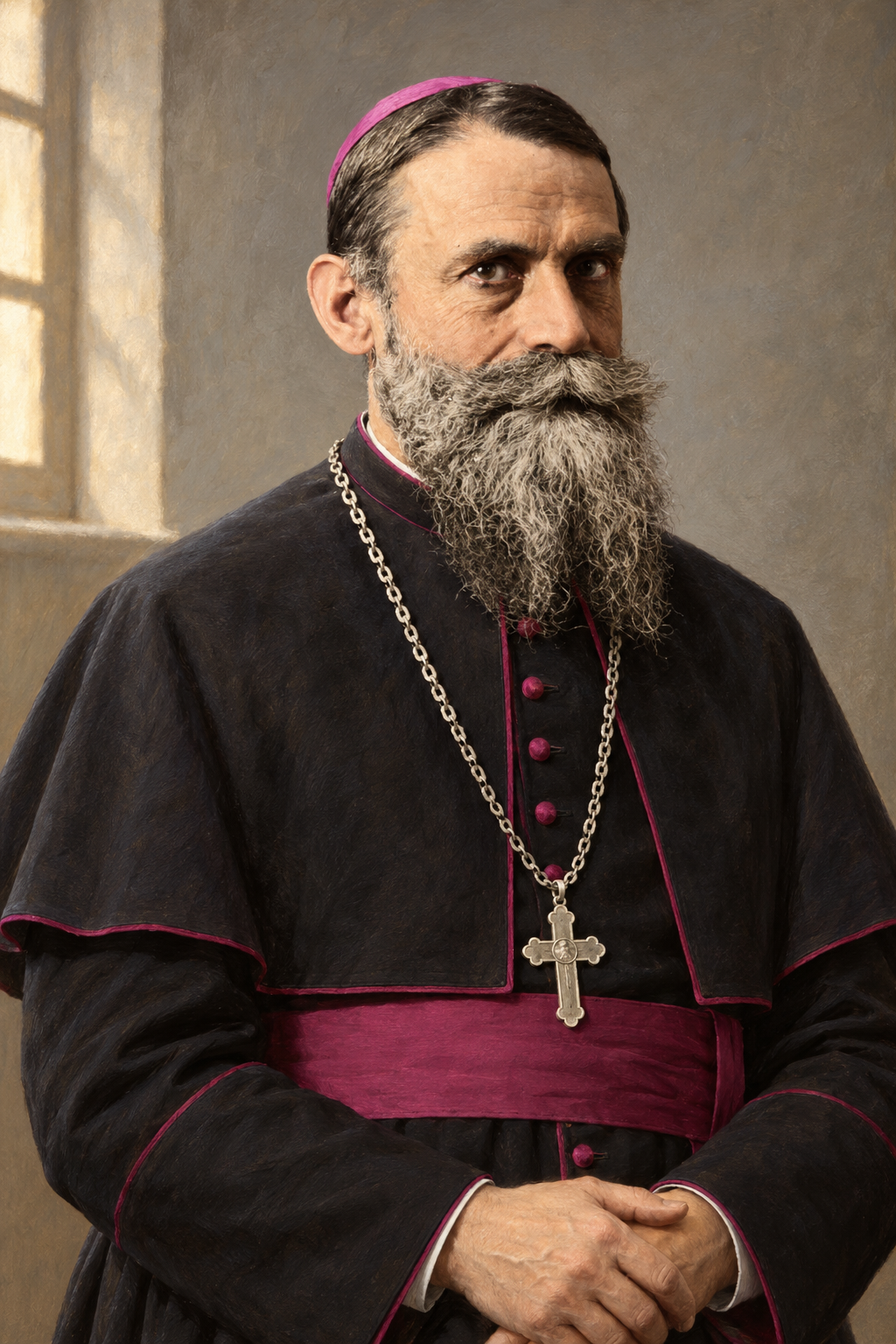
About Luigi Versiglia
Luigi Versiglia was an Italian Salesian bishop whose work in China joined education, parish ministry and the training of local catechists. Born at Oliva Gessi on June 5, 1873, he entered the Salesian school at Valdocco as a boy. He initially resisted the idea of becoming a priest, but eventually chose religious life. He made his profession in 1889 and was ordained in 1895. For the next decade he helped form young Salesians at Genzano, near Rome.
In 1906 he led six Salesians to Macao, where they took charge of a small diocesan orphanage. Their work was disrupted by the Portuguese revolution: the community left Macao for Hong Kong in 1910. Ministry resumed in the Heung Shan district in 1911 and at Macao in 1912. These beginnings placed Versiglia within overlapping Chinese and Portuguese institutions, each with its own practical demands.
The school attached to the Macao orphanage offered an education directed toward employment. Historian Carlo Socol identifies a letter in which Versiglia urged his colleagues to obtain skilled instructors so that the quality of their workshops would not decline. The curriculum combined elementary learning with training in trades such as tailoring, shoemaking, printing, bookbinding and carpentry. Teaching was in Chinese, with Portuguese also studied. Recruiting capable teachers remained difficult; some former pupils became instructors. The work depended on their skills as well as on the missionaries’ plans. Socol explains that the elementary classes followed Chinese government programs, while professional training drew on Salesian methods developed in Europe. This combination involved practical adaptation, not simply copying a school from another country. Language differences and the shortage of instructors continued to limit what could be achieved.
Versiglia was consecrated bishop on January 9, 1921, for the Shiu Chow mission. The Salesian liturgical account remembers his concern for a seminary, homes for older people, formation houses and catechist training. It also preserves his insistence that prayer sustain missionary work. His responsibilities thus included preparing others for ministry and providing places where vulnerable people could receive help.
Expansion brought disagreements within the Salesian leadership. Socol describes friction between Versiglia’s authority as bishop and Ignazio Canazei’s responsibility as religious superior. Staffing, finances and the ownership of institutions caused difficulties. Versiglia favored more mission residences spread across the region, while superiors preferred fewer centers with stronger staffing. The historian also identifies communication problems on both sides. Such tensions complicate any picture of a mission built through effortless agreement.
Chinese women were essential to this work. Nestor Impelido’s archival study describes women catechists who taught children and supported local Christian life. Versiglia arranged their formation with the help of the Daughters of Mary Help of Christians. By 1924 he was drafting rules for a religious community; later reports show that the school of catechists was still dependent on outside support. His 1929 report acknowledged that the catechists’ school could not yet be independent. The project remained unfinished, despite the years of preparation and the work already being done by its members. He did not live to complete the foundation. His successor, Canazei, continued the project that became the Sisters Announcers of the Lord. This distinction gives proper place both to Versiglia’s initiative and to the women and later leaders who carried it forward.
On February 25, 1930, Versiglia and the young priest Callisto Caravario were traveling toward Lin Chow with Chinese companions. Armed men stopped their boat and demanded payment. When the attackers tried to seize three young women, the two missionaries intervened and were beaten. They were taken ashore and shot near Li Thau Tseui. The women were held captive and later freed. Their testimony helped preserve the account of what had happened.
John Paul II beatified the two men on May 15, 1983. In his homily, he explained the Church’s judgment of their deaths as martyrdom through an act of charity rooted in faith. He emphasized their defense of the young women’s dignity and freedom against people who treated them as objects. This is the Church’s theological interpretation of their witness, rather than a complete political account of the violence in the region. The homily also placed their service within a hope for harmony between Chinese cultural life and communion with the wider Church.
They were canonized on October 1, 2000. Salesians celebrate their feast together on February 25, the anniversary of their deaths.
Remembrance also continues near Versiglia’s birthplace. In 2016 the Diocese of Tortona reported the creation of a pastoral community bearing his name, bringing together parishes in Casteggio, Mairano and Oliva Gessi.
An interview published by the diocesan newspaper in 2020 explicitly identifies him as this community’s patron. It describes visits to his birthplace, celebrations shared by several parishes and historical research into his return journeys to Italy. These local activities preserve the memory of a life that connected a small Italian village with Christian communities in China.
Wondering how to weigh the stories and sources? Learn how to read a saint biography.