Biography
Margaret Clitherow
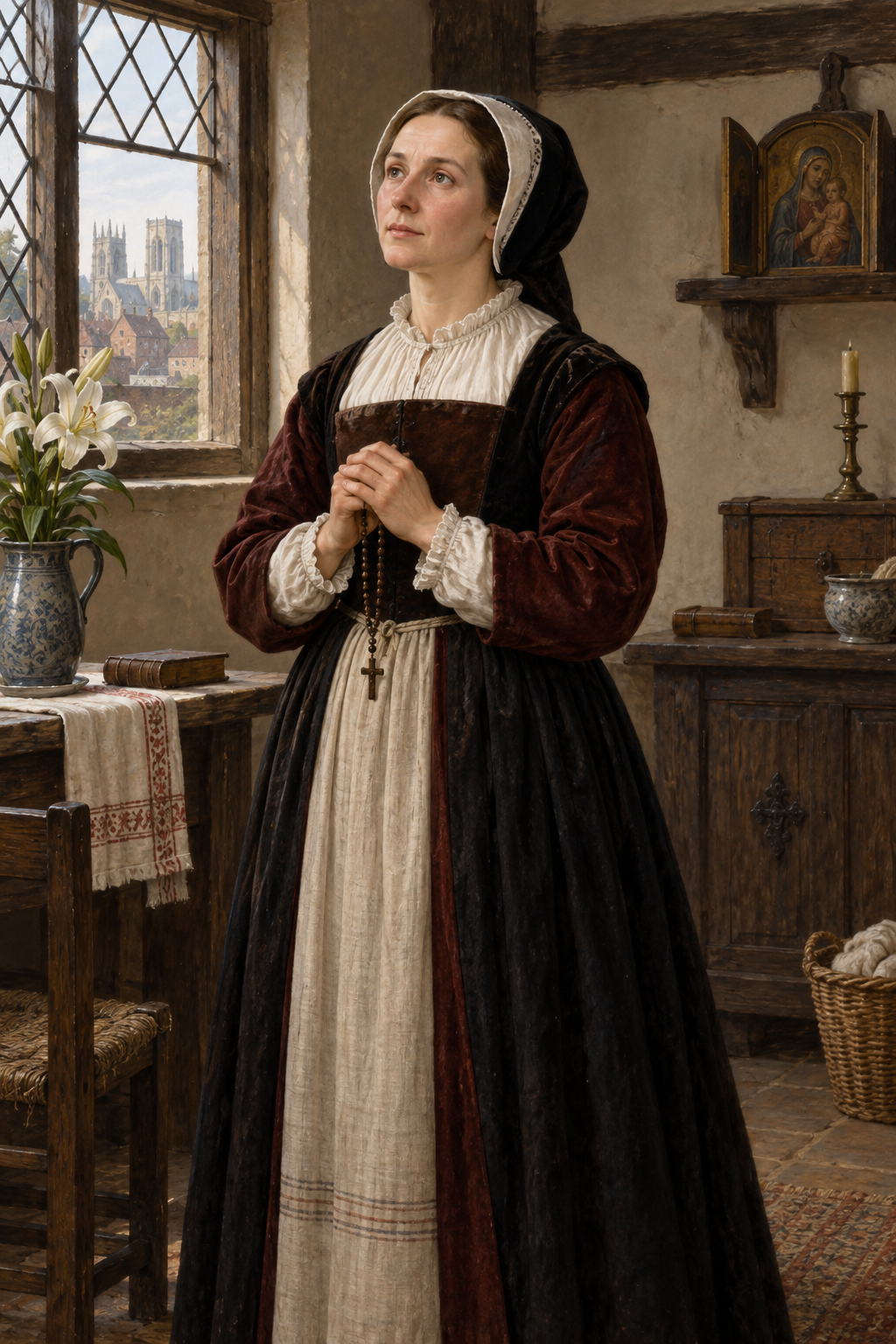
About Margaret Clitherow
Margaret Clitherow was a Catholic laywoman in York during the Elizabethan settlement, when laws against Catholic worship made the ordinary practice of her faith a matter of public risk. The evidence for her life comes from modern local-history research and scholarly study of the account written by the Catholic priest John Mush, who knew her and became an early memorialist. These sources preserve a concrete outline of her choices and prosecution, but they must be read critically: Mush wrote as a Catholic martyrologist, while later devotional retellings sometimes give details a certainty the evidence does not support. The secure story is significant without embellishment.
York Museums Trust places her birth in York in 1556 and names her father as a city sheriff and churchwarden. It reports that she married John Clitherow, a prosperous butcher whose shop and home stood on the Shambles, while still young. The same account says she appears to have become Catholic in the early 1570s, through the influence of the wife of Thomas Vavasour, a prominent Catholic in York. The wording “appears” matters: it signals a reconstruction from historical evidence rather than a dated personal record of conversion. Her husband remained responsible for reporting Catholic worship in his parish, so the household’s religious difference created pressure within the family as well as danger from the authorities.
The state’s legal framework hardened in the years that followed. A 1581 statute made attendance at Catholic worship and the sheltering of priests subject to severe penalties, including death for the latter offence. Margaret was imprisoned in 1577 for failing to attend the established church. Two further periods of incarceration followed at York Castle, the last lasting about twenty months according to the History of York. Prison formed part of her religious life in a literal sense: the museum account says she learned to read while confined. That fact does not prove what books she read or how she interpreted them, but it shows that her education continued in circumstances intended to punish her religious nonconformity.
Her commitment also connected her to other Catholics facing execution. Between 1582 and 1583, five priests were put to death at Tyburn on York’s Knavesmire. The local-history account says that after her release from prison Margaret made night-time pilgrimages to the gallows. This episode is reported by a later historical summary rather than a surviving first-person statement from Margaret, so it is best treated as part of the documented local tradition around her, not as an unmediated transcript of her thoughts. It nonetheless illustrates how the execution of priests shaped the setting in which she chose to offer refuge.
Margaret created a concealed room in the family house on the Shambles to shelter Catholic priests. Under the law, harboring them was a capital offence. During a search of the house in March 1586, the hiding place was revealed after a frightened boy disclosed its location. The sources establish the practical form her resistance took: she used domestic space to provide a place of safety. They do not establish every later story told about the people who passed through the house, so this account does not name visitors or invent episodes of clandestine worship beyond what the evidence records.
The authorities charged Margaret with harboring priests and brought her before a court at York’s Guildhall. York Museums Trust says she refused trial by jury, which led to an automatic sentence of pressing. Cambridge historian Claire Cross examines the relationship between Margaret and John Mush, whose account of her martyrdom was composed within months of her death. Cross’s study is important because it treats the making of a martyr narrative as part of the historical record: Mush was not only a witness and priest but also a writer shaping how English Catholics remembered her. His account preserves a near-contemporary Catholic interpretation, but the genre and purpose should remain visible when using it.
Margaret was taken to the toll-booth on Ouse Bridge and pressed to death on 25 March 1586. York Museums Trust records that the sentence used a heavy weight and that officials tried to persuade her to conform before carrying it out. The method was an exceptionally brutal punishment connected to her refusal to plead. Some contemporary or later observers called her mad or accused her of suicide; those descriptions reflect conflict over the meaning of her death, not neutral diagnoses. The historical evidence supports stating that she was executed after refusing a jury trial in a prosecution for harboring priests. Her own interior motives beyond the actions attributed by the sources cannot be recovered with equal confidence.
Mush’s writing helped preserve Margaret’s memory among Catholics at a time when official accounts classified her as a criminal. Cross’s scholarly article follows that process of memorialization and makes clear that the account of a martyr is itself a historical artifact. The distinction matters: one can recognize the closeness of Mush’s testimony and its importance to Margaret’s reputation without treating each rhetorical element as an independent court record. The modern account presented here relies on that scholarly framing alongside York Museums Trust’s civic and material-history narrative.
The Catholic Church canonized Margaret with thirty-nine other English and Welsh martyrs on 25 October 1970. Pope Paul VI’s homily at the canonization places her within a group whose deaths represented the long and varied history of Catholic persecution in England and Wales. The Catholic Bishops’ Conference calendar for England lists her joint optional memorial with Anne Line and Margaret Ward on 30 August. York continues to connect her memory with the Shambles house and the Bar Convent, where a relic traditionally identified as her hand is preserved; the relic’s identification should be described as a tradition, not independently verified here.
Margaret’s historical significance is clearest in the documented acts that brought her into conflict with the state: maintaining Catholic practice, providing shelter for priests, and refusing a jury in the trial that led to her death. Her story also shows how early modern martyrs were remembered through accounts written by people close to them and through later civic, ecclesiastical, and devotional traditions. Keeping those layers distinct allows her courage and the violence of her execution to remain visible without turning uncertain biographical details into established fact.
Wondering how to weigh the stories and sources? Learn how to read a saint biography.