Biography
Marguerite Bays
About Marguerite Bays
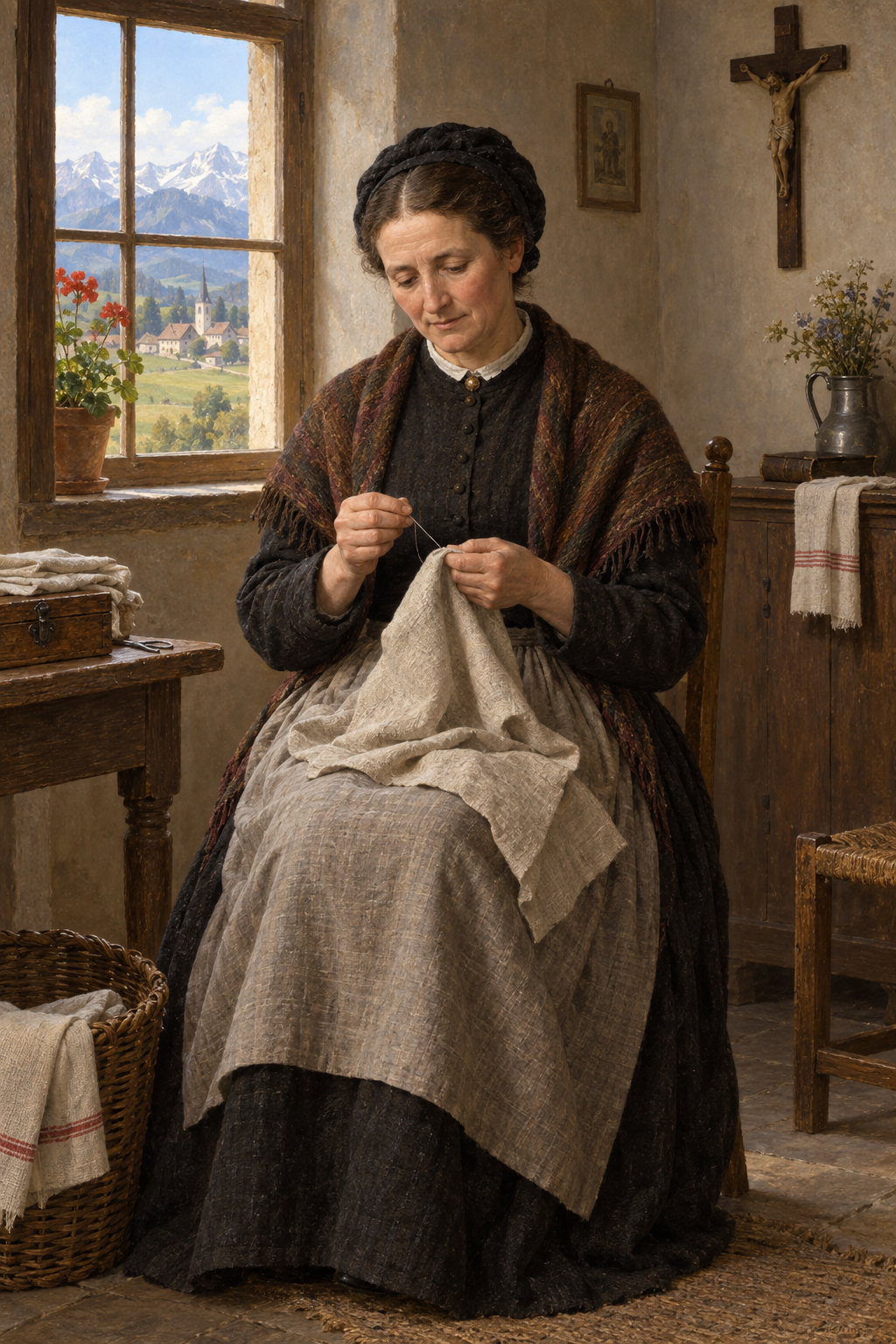
Marguerite Bays was born on 8 September 1815 in La Pierraz, a rural place in the parish of Siviriez in Switzerland's canton of Fribourg. She was the second of seven children in a farming household. A letter issued for her 1995 beatification says she learned basic reading and writing and trained as a seamstress around the age of fifteen. She made clothing throughout her life and helped with household and farm tasks. Her life was rooted in one small community, not in travel, public office or the foundation of a religious order. The family's work and relationships were the setting of her service.
Bays did not enter a convent. The local diocese remembers her choosing an unmarried life within her family and parish, earning her living as a seamstress. She attended Mass, prayed in the church at Siviriez and took time to visit neighbors who were ill or near death. She also taught children the Catholic faith. These actions were woven into her workday rather than set apart in a public institution. The Catholic account of her life calls this lay holiness; the historical point is that much of her care was ordinary labor, often performed in homes and with little formal recognition.
The foundation that maintains her memory preserves more particular stories of service. It describes Bays sewing clothes for some poor children without charge and taking children to Notre-Dame du Bois. She worked in other households, where conversations with mothers brought her into contact with family hardship. Accounts also describe her sitting with the sick and dying. These are local and devotional memories rather than a full register of every person helped. They make clear what “service” could mean for someone with a needle, limited income and a familiar place in the parish. Her work could give material help and companionship together.
Her family life was not always peaceful. Later accounts speak of conflict with her sister-in-law Josette after Josette married Bays's brother Claude in 1860. They also remember Bays caring for Josette during her final illness. The precise private exchanges cannot be reconstructed from a cause biography, and the stories tend to present Bays as patient in every dispute. The record can responsibly convey that she remained within a large household whose members had different needs and tensions. Her chosen path did not free her from domestic obligations; it asked her to live her religious commitments amid them.
Bays entered the Franciscan Third Order on 22 February 1860 and professed its rule in Romont a year later. The abbey near her home distinguishes these two stages, resolving what otherwise looks like a date conflict between accounts. The Third Order let a lay person take part in Franciscan spirituality without becoming a nun. Her work, prayer and care for people in poverty continued in the same area. The profession did not create a new congregation or remove her from her family. It gave an existing pattern of life a recognized spiritual form. Later writers sometimes make the reported wounds the center of her story; her Franciscan identity also points to everyday simplicity and service.
Church biographies report Bays’s illness, recovery and mystical experiences; the short accounts do not independently establish a diagnosis or miracle.
A 2019 interview with the postulator of Bays's cause describes the reports of wounds and prayer-related suffering that drew attention beyond Siviriez. It also recounts Bishop Étienne Marilley asking for a medical consultation. The church account says the examination supported a mystical interpretation; this does not by itself prove a supernatural medical cause. People who knew Bays could describe what they observed, while later writers supplied theological explanations. Her local work remained visible alongside the stories that made others curious about her. A careful account can name the reported events and the investigation without requiring readers to accept an unverified diagnosis.
Fribourg's wider setting matters. The Historical Dictionary of Switzerland describes sharp conflict over religion and public power after the Sonderbund War of 1847. An anticlerical cantonal government and Bishop Étienne Marilley's exile were followed by a conservative electoral comeback and a revised constitution in 1857. Bays was no political leader, but her reputation developed in a place where public Catholic identity carried social meaning. Catholics, their opponents and local newspapers differed over the significance of reported religious experiences. Her life in a small farming community belonged to this changing society, even when the sources portray her as focused on family, prayer and neighbors rather than elections.
Bays died on 27 June 1879 in Siviriez. A contemporary Fribourg newspaper reported her death a week later, according to Borcard. That date agrees with the Dicastery and a later Holy See decree; the biographical body of John Paul II's 1995 letter instead says 26 June, even while its formal feast text says 27 June. The cause for her beatification began in 1927 and needed additional evidence after an early inquiry was judged insufficient. Over time, Catholic presentations of her life gave more emphasis to care for poor neighbors and to her work as a lay woman, not only to extraordinary experiences.
John Paul II beatified Bays on 29 October 1995. In his homily he described the love expressed in each ordinary action of her life. Francis canonized her on 13 October 2019 and likewise spoke of simple prayer, patience and quiet giving. These are Catholic interpretations of her life, not independent evidence for every reported healing or wound. Her lasting significance lies in the combination of paid sewing, family responsibility, parish teaching and care for sick and poor neighbors. The record is strongest when these concrete actions remain central and the limits of the mystical evidence are made clear.
Wondering how to weigh the stories and sources? Learn how to read a saint biography.