Biography
Maria Caterina Troiani
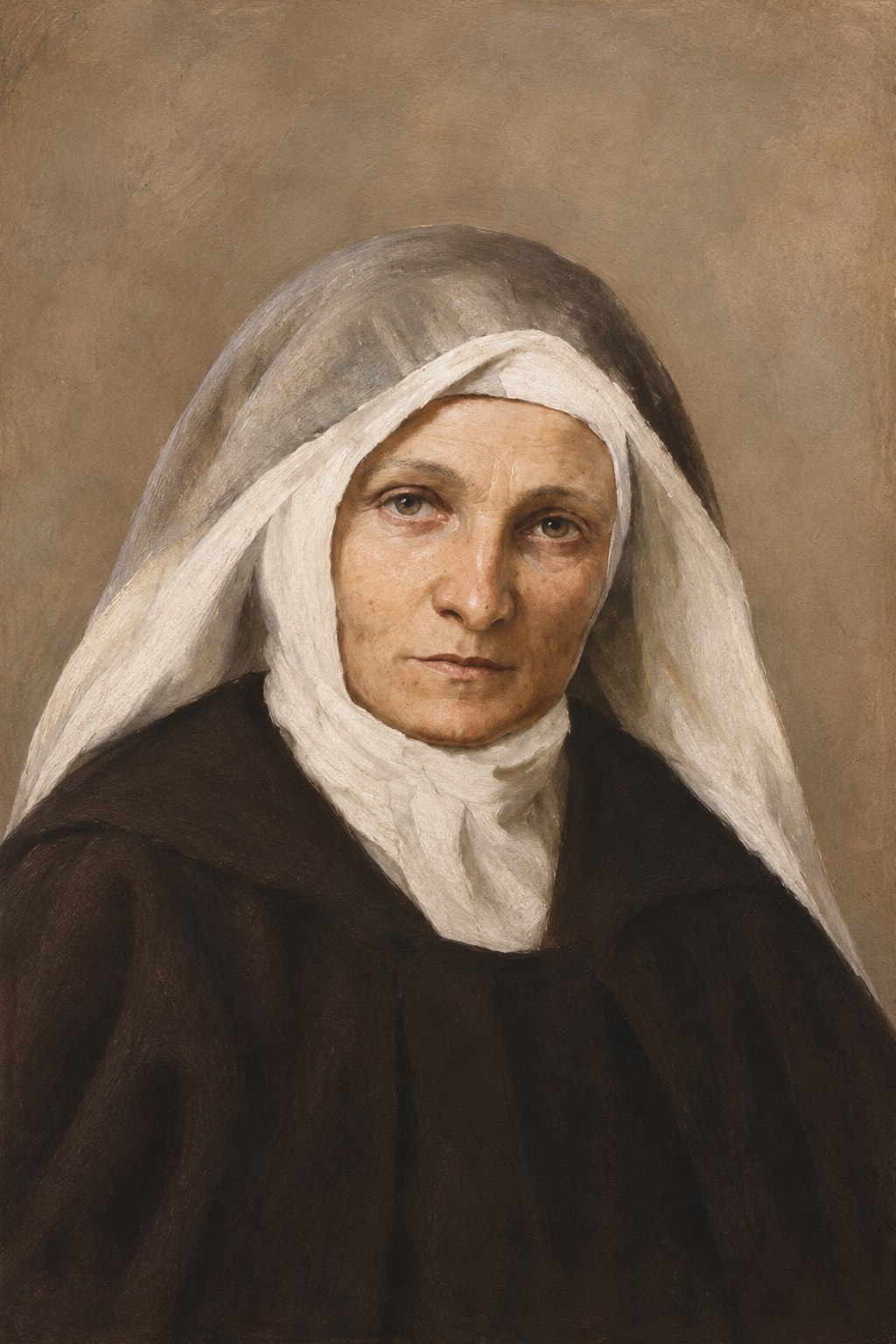
About Maria Caterina Troiani
Maria Caterina Troiani was born Costanza Troiani at Giuliano di Roma on 19 January 1813. Her mother died in 1819, and Costanza was entrusted to the Poor Clares at Ferentino. She grew up among the sisters and eventually chose their religious life. She became a novice at sixteen and made her profession the following year. The convent was therefore both the place of her childhood education and the community in which she began her adult vocation.
As Sister Maria Caterina of Saint Rose of Viterbo, she served as secretary in the Ferentino community. She also assisted the abbess, Maria Aloisia Castelli, as camerlenga, a position involving the house’s administration. Years of convent work preceded the journey for which she became best known. Her preparation included education and the practical responsibilities of a religious household. The later founder emerged from a community that already had its own leadership, discipline and pattern of service.
An invitation from Bishop Perpetuo Guasco, the apostolic vicar in Egypt, opened the possibility of a new mission. Troiani travelled with other sisters in 1859. During their stop at Malta, they learned that Guasco had died. Without the churchman who had invited them, the enterprise appeared much less secure, and the sisters considered returning to Italy. Troiani encouraged them to continue. John Paul II recalled this episode at the audience following her beatification, as an expression of her determination to carry through a difficult commitment.
They reached Cairo in September 1859 and established a school. The sisters encountered children from different linguistic and religious backgrounds, and the school’s work required attention to those differences. Troiani gave particular care to pupils whose poverty made education difficult to obtain. Teaching was central to the mission, but it was accompanied by the everyday needs of children and their households. Food, care and instruction belonged together in the work that grew around the sisters’ house.
The mission’s first superior was Castelli. When she became ill, the responsibilities of the new house fell increasingly to Troiani, under arrangements made by the apostolic delegate. Troiani was elected superior in 1863. The institutional biography records her continuing leadership until her death and the opening of further houses for the care and education of abandoned girls. These developments required decisions about community life as well as the work outside it. A foundation initially linked to Ferentino was becoming a distinct religious undertaking.
The community settled in Cairo’s Cot Bey district. Ferentino could not provide the continuing support the new foundation needed, and in 1868 the Congregation of Propaganda Fide authorized it to become an autonomous institute. That decision gave the Egyptian community an institutional basis for further growth. Troiani organized the developing congregation and its educational work. The sisters were known as the Franciscan Missionary Sisters of Egypt; the congregation later adopted the name Franciscan Missionary Sisters of the Immaculate Heart of Mary.
The sisters’ work also brought them into contact with African girls who had been enslaved. In the congregation’s historical remembrance, care for these girls included liberation, education and help in finding a household; some later entered religious life. Sister Telesphora Pavlou also recalls the community’s arrival in Jerusalem in February 1885, at the invitation of the Franciscan Custos. There the sisters took responsibility for the House of Maria Bambina and the education of girls in need. The Egyptian foundation thus extended into another setting during Troiani’s lifetime.
Her assistance crossed religious boundaries. In the beatification homily, John Paul II recalled Catholics, Orthodox Christians and Muslims receiving her help. He also remembered the sisters’ care during two cholera outbreaks, when tending sick people put their own lives at risk and some members of the community died. The ministry involved exposure to suffering as well as efforts to relieve it. The same homily placed Troiani’s prayer and active service within the traditions of Clare and Francis of Assisi.
War in 1882 disrupted the community’s life in Egypt. Troiani and the sisters had to arrange safety for the children in their care and leave the country. Their journey brought them through several places before they could return to Cairo. The Clairval account describes the relief of finding the house still standing and the renewed demands of caring for people after their return. Such interruptions made the continuity of the mission uncertain. The community nevertheless resumed its work rather than abandoning the foundation.
Troiani died in Cairo on 6 May 1887. Her community continued the educational and charitable work she had helped establish. Her remains were transferred to the congregation’s house in Rome in 1967, and John Paul II beatified her on 14 April 1985. The Church honours her as a blessed religious founder. Her life connects a childhood and long formation in an Italian convent with a later mission centred on girls, poor families and people affected by slavery in Egypt.
Wondering how to weigh the stories and sources? Learn how to read a saint biography.