Biography
Maria de Mattias
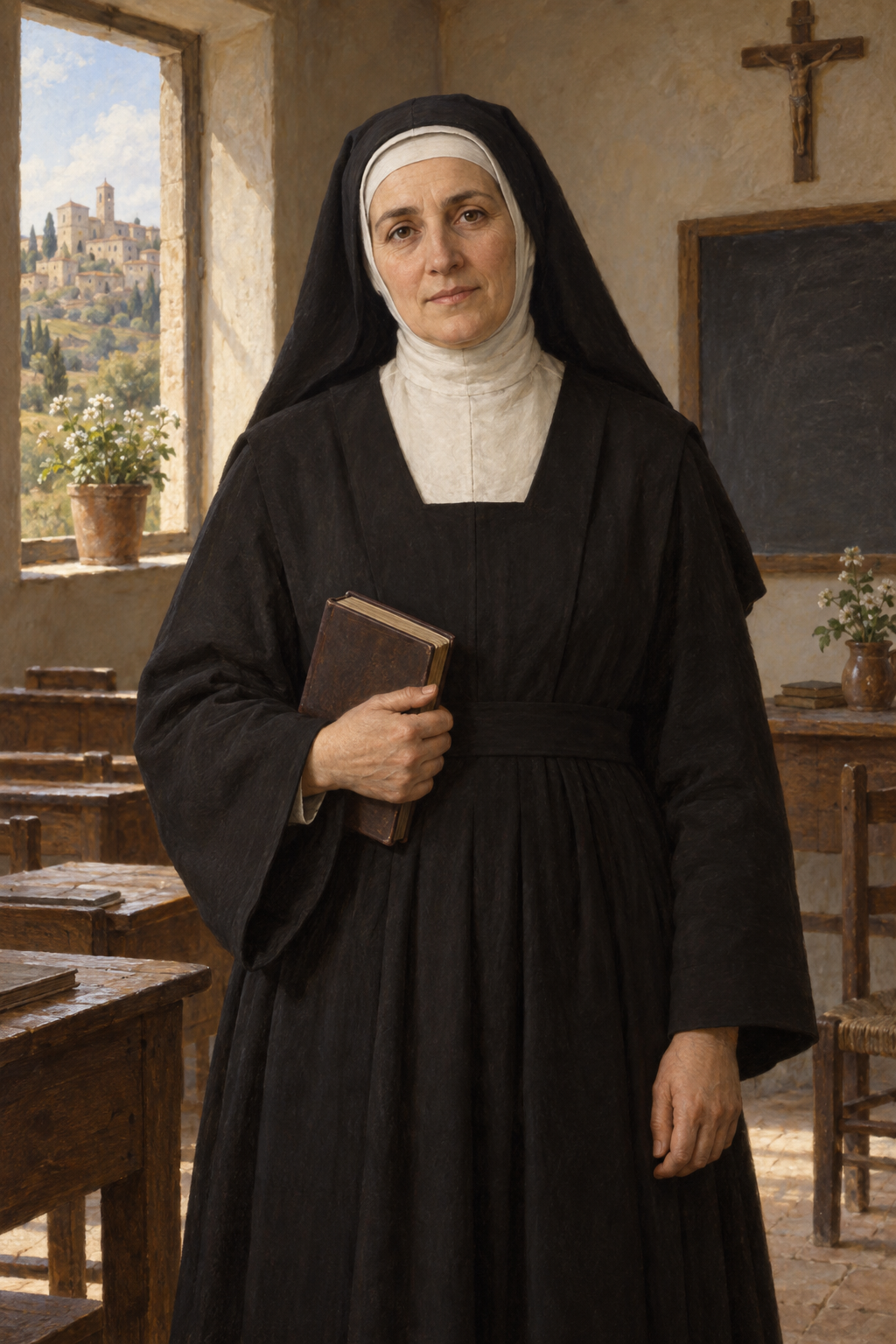
About Maria de Mattias
Maria de Mattias was born in Vallecorsa, then within the Papal States, on 4 February 1805. Accounts of her family's means disagree: an older encyclopedia calls her parents poor, while later records describe them as prominent locally. She did not have the sustained formal schooling that would have been available to many boys. The U.S. Adorers' history says she taught herself to read and write. What matters for her later work is that limited access to schooling did not keep her from becoming a teacher and organizing schools for girls in rural communities.
Vallecorsa was a mountain village in a politically unsettled region. Keyes's biographical account describes her father Giovanni as holding local standing and her mother as Ottavia de Angelis. It draws on de Mattias's letters and the account written by Giovanni Merlini, her long-term adviser. Some vivid childhood scenes in later retellings are difficult to verify independently. The family's place in local society, however, helps explain both the restrictions she faced as a girl and the contacts she could draw on when she sought to teach elsewhere.
In 1822 Gaspare del Bufalo preached a popular mission at Vallecorsa. The Missionaries of the Precious Blood's chronology places de Mattias among those who heard him. Later community accounts describe the preaching as a turning point in her understanding of prayer and public service. That is a retrospective account of influence, not a record of every thought she had at seventeen. Giovanni Merlini, another missionary, became an important adviser in the years that followed. Their relationship would help her turn an intention to teach into a community capable of supporting schools beyond one village.
De Mattias's surviving correspondence shows her taking part in decisions about her own future. In a letter dated 6 October 1833 to Bishop Giuseppe Maria Lais, she discussed a proposed teaching position at Ceccano and named people who could speak to her qualifications. Colagiovanni's study notes that it is the earliest surviving letter in the present collection, not necessarily the first she wrote. The letter matters because it records a woman negotiating a possible appointment in her own voice. It should not be mistaken for evidence that she had already founded a school at Acuto.
The opening at Acuto came on 4 March 1834. John Paul II's canonization decree identifies a public school for girls as the beginning of her institute in the diocese of Anagni. De Mattias taught there and gathered other women around a shared pattern of prayer, instruction and service. Girls' education was the first visible work, but she also addressed young women and mothers. These gatherings connected schooling with the religious formation of households. The date is a foundation marker for the community, not the date of every later house or of final papal approval.
Keyes describes an early plan larger than a single classroom. De Mattias wanted women to teach other women and to make religious instruction available to people beyond the school age. A boarding arrangement helped prepare future teachers and members of the community. She worked on rules for shared life while remaining concerned with local children and adults. Her correspondence with Merlini shows advice and occasional disagreement, rather than a founder simply carrying out instructions written by someone else. The community developed through trial, travel and the practical difficulty of sustaining small rural houses.
The community did not remain confined to Acuto. Scanzani's regional biographical dictionary traces new houses through towns of central and southern Italy, as well as later foundations abroad. Its list includes openings in Pescasseroli and Morino in 1841, Cascia in 1842 and several more places in the following decade. The details show a pattern of responding to local requests for schools rather than building one large institution. Each new house required sisters prepared to teach, local support and communication with church authorities. De Mattias's leadership was exercised through these relationships as much as through the original school.
The general administration's chronology says Pius IX granted a decree of praise on 30 May 1855 after reports from bishops about the sisters' work with poor girls. It also dates a printed rule to 1857, after the decree. Those stages should not be collapsed into a single final approval: the institute already existed and taught before the papal act, while its written rule and later legal standing continued to develop. The recognition reflected years of work in small towns, supported by women who had joined de Mattias and carried the schools' daily responsibilities.
Scanzani records support from Pius IX and Zenaide Beloseski Wolkonsky for houses in Rome. These allies were important to an institute that depended on property, teaching space and permissions. The same reference lists many foundations but gives a different final school and sister total from the congregation's general history. Its figures should not be blended with counts of communities from other sources. What the lists establish securely is a spread beyond Acuto during de Mattias's lifetime, including Rome and other towns where women taught and led religious gatherings. The wider network also meant that decisions had to be coordinated across distances.
De Mattias died in Rome on 20 August 1866. The Dicastery records that Pius XII beatified her on 1 October 1950 and John Paul II canonized her on 18 May 2003. Its memorial listing is 20 August, though the congregation and some local calendars observe her on other days. Those later honors do not settle every discrepancy in accounts of her early schooling or the size of the institute. Her documented contribution is clearer: she founded a community whose women opened schools, taught people with limited educational access and sustained their work across numerous small towns.
At her canonization, John Paul II emphasized de Mattias's devotion to Christ's blood and her concern for people she called her beloved neighbor. The homily is a church interpretation given long after her death, rather than a contemporary description of Acuto's first classroom. Its emphasis helps explain why her sisters understood teaching as more than literacy alone. In the historical record, her religious purpose took practical form in schools, shared rules, travel and sustained relationships with women who became teachers. Her legacy depended on their labor as well as on her direction.
Wondering how to weigh the stories and sources? Learn how to read a saint biography.