Biography
María del Tránsito Cabanillas
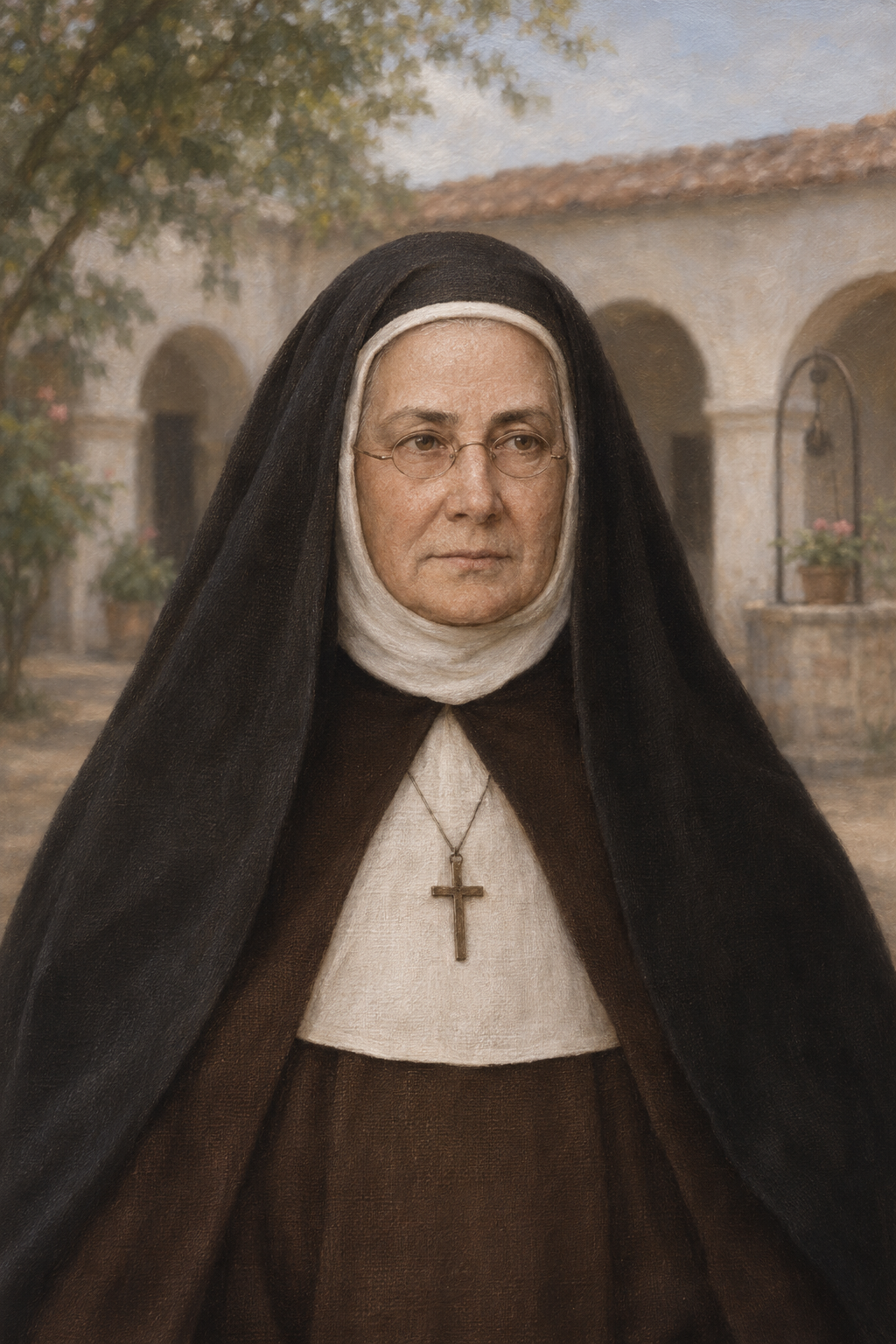
About María del Tránsito Cabanillas
María del Tránsito Cabanillas worked for many years as a laywoman before founding a religious community devoted to education. Born at the Santa Leocadia estate in Córdoba in 1821, she grew up in a large family and later moved into the city of Córdoba. She helped care for younger relatives while continuing her education. The Holy See’s account remembers her teaching catechism and visiting poor and sick people, sometimes accompanied by her cousin Rosario. These activities preceded the foundation for which she would later become known.
Her congregation’s biography places her among members of the Vincentian conferences who brought practical help to people in need. It also remembers service during Córdoba’s cholera epidemic in 1867. Such work belonged to a life that combined family responsibilities, religious associations and direct assistance in homes. She did not begin with an established institution of her own. The later school and community developed from concerns already visible in these earlier years: care for people who were ill or poor and religious education for children.
She entered the Franciscan Third Order after her mother’s death in 1858 and made a private vow the following year. Yet she also explored an enclosed religious vocation. In 1873 she entered a Carmelite monastery in Buenos Aires, leaving when ill health made it impossible to remain. A later attempt with the Visitation community in Montevideo also ended because of illness. These attempts did not produce the religious life she had expected. They were followed by renewed work toward a community that would educate and care for poor children.
The preparation required people, property and rules. Historian José Antonio Cambria traces negotiations with church authorities and the support of Agustín Garzón in San Vicente, then a developing settlement outside central Córdoba. His account describes the search for land and resources, discussion with other possible foundations and contact with Franciscan friars. Quírico Porreca became closely involved in drafting statutes and preparing the first community. The documentary history therefore shows several collaborators and a process of negotiation behind the foundation, rather than a completed institution appearing all at once.
The later Río Cuarto foundation required public support as well as religious authorization. Historian Andrea Severi describes the creation of a municipal commission to collect funds for the school building. Porreca appealed both to local collaborators and to the provincial governor, presenting education as a response to the needs of girls whose families lacked resources. Cabanillas also sought permission for the new house. These requests reveal the practical work behind a foundation: raising money, obtaining approval and making a case for the school in the language of its own society. The appeals linked instruction with work, family life and moral formation, reflecting the expectations then placed on girls. The project therefore belonged to the civic history of Río Cuarto as well as to the religious history of the sisters.
The community’s own account describes the opening of the Santa Margarita de Cortona school in San Vicente and another foundation at Río Cuarto in 1879. Tránsito sought assistance from neighbors to sustain the work, while also attending to the formation of the sisters. Education included religious teaching and practical skills, shaped by the expectations placed on girls and women in that period. The congregation remembers both the work of building and maintaining its houses and her concern for the religious life within them.
Cambria’s study also preserves evidence of disagreement. Documents concerning the Río Cuarto foundation show differing views about authority and the selection of a local superior. The historian notes that Porreca described himself as founder, while other records named Cabanillas in that role. He treats their work as a shared effort and warns that surviving documents do not give an equally full account from both sides. This evidence makes the history more complex than a narrative of uninterrupted agreement. It does not diminish the clear record of Cabanillas’s work in establishing and forming the community.
A recent archival study places the congregation among several women’s communities founded in Córdoba during the late nineteenth century. It identifies education of poor girls as a central purpose and records Porreca’s part in the first statutes. The sisters belonged to a wider institutional response to changes in education and relations between church and state. Within that setting, their school offered a specifically Catholic and Franciscan form of education rather than an abstract project detached from its time.
Cabanillas died in Córdoba on 25 August 1885. The congregation’s virtual library preserves that place and date alongside its commitment to collecting material about her life and work.
Her Catholic beatification took place in Rome on 14 April 2002. In the homily, John Paul II recalled her unsuccessful attempts at contemplative life and the Franciscan community that followed. His account emphasized the persistence of her vocation through changes she had not planned. Her enduring significance remains attached to the schools and religious family that grew from that work.
Wondering how to weigh the stories and sources? Learn how to read a saint biography.