Biography
Maria W. Stewart
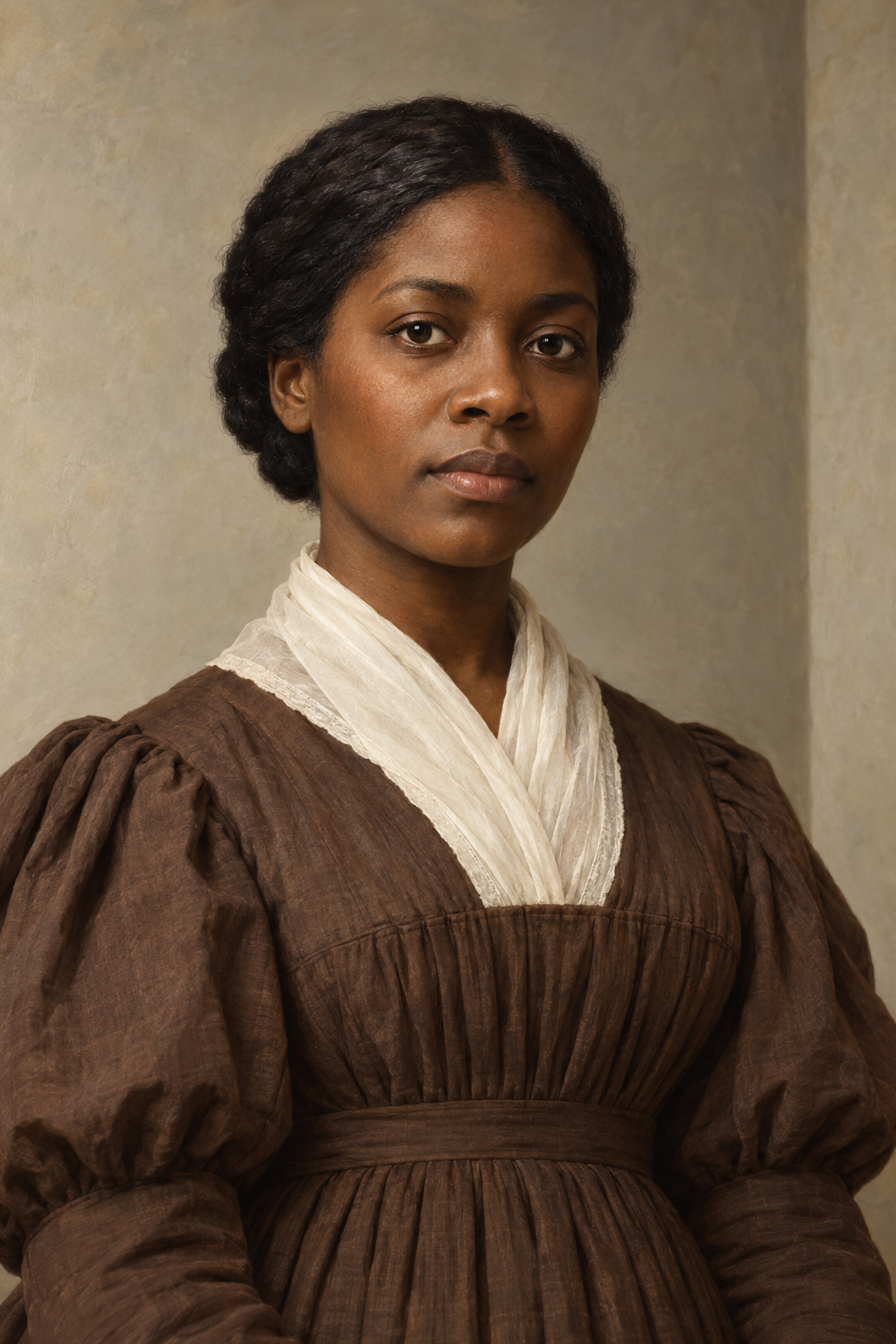
About Maria W. Stewart
Maria W. Stewart brought Christian conviction into public arguments against slavery and racial discrimination. Born in Hartford, Connecticut, in 1803, she lived and worked in several American cities. In Boston she married James W. Stewart in 1826 and belonged to the African Baptist Church. His death in 1829 left her a widow. Her friendship with the abolitionist David Walker helped connect her with the struggle for Black freedom. In 1831, William Lloyd Garrison published her religious and political writing. Four public lectures followed in 1832 and 1833. After losing her parents at five, she worked in a clergyman’s household with little formal schooling. She left at fifteen and pursued her own education, including study of the Bible.
Her appearance before a mixed audience at Franklin Hall challenged expectations about who could address political questions in public. Historian Cheryl Jorgensen-Earp places the address within Boston’s unequal opportunities for free Black residents: legal freedom did not remove barriers to employment, housing, or participation in white institutions. Other women had lectured before Stewart; she was not the first American woman to speak publicly. Stewart’s importance lies more precisely in her public political arguments about race and gender. The scholarship reads her forceful language as a challenge to discrimination, rather than violence. Religion and politics were connected in her argument; separating them would obscure what she was trying to accomplish.
At Franklin Hall in September 1832, Stewart described how qualified Black women could be refused employment because white employers feared losing customers. She challenged the assumption that domestic service was the only work available to them. Exhausting labor, she argued, also deprived people of the strength and opportunity to pursue education. Her speech combined criticism of white prejudice with appeals to Black listeners to cultivate learning, act together, and seek their rights. She urged petitioning the legislature and treated intellectual development as a matter of collective concern.
Stewart spoke in explicitly Christian terms, understanding her responsibility to address injustice through Scripture and her sense of divine calling. Her comparison between the condition of free Northern Black people and slavery expressed the force of her protest; it should not erase the legal and material differences between those conditions. The surviving published lecture preserves her argument through a printed text, rather than a recording of every word spoken in the hall.
Her religious thought also addressed the authority of Black women within their households. In a study published by UCLA, Jaimie D. Crumley reads Stewart’s early writing as placing Black women’s spiritual and social concerns at the center of its theology. Mothers appear as responsible teachers of children, whose work mattered to their community’s future. Crumley connects this emphasis with later womanist theology, while identifying it as an early form rather than a term Stewart herself used. In this interpretation, Stewart’s religious commitments concern freedom and dignity in earthly life as well as salvation.
Her farewell address defended women’s speech through biblical examples, including Deborah and Mary Magdalene. It also revealed disappointment with opposition within her own community. Its later appeal to set political discussion aside and trust divine deliverance complicates a picture of unchanging militancy. She continued to value education, work, and moral responsibility.
Stewart later taught in New York, Baltimore, and Washington. In her memoir she recalled poverty, the difficulty of sustaining fee-paying schools, and help from people of different denominations. She remained attached to the Episcopal Church despite disputes over her affiliation and racial exclusion within church life. Her account describes both the injury of discrimination at Communion and her participation in organizing Saint Mary’s Church. These are her recollections, not independently inspected parish minutes.
Stewart’s concern for education also found expression in fiction. Her story “The First Stage of Life” appeared in the Repository of Religion and Literature and of Science and Art in 1861. Literary scholar Nazera Sadiq Wright discusses its young character Letitia, who loses her mother and suffers neglect after being placed with an aunt. Another household takes her in, but her behavior leaves her isolated until she begins to seek a different way of living. Wright interprets the girl’s transformation as a lesson about children’s education and the responsibilities of adults toward them. The story is a work of fiction, not evidence that these incidents happened to Stewart. Wright also situates it within a Black periodical culture in which material could be shared in classrooms and read aloud to children. This later writing extended Stewart’s educational interests into a different form from the public addresses of her Boston years.
Her work in Washington also included service as matron at Freedmen’s Hospital. A pension connected with her late husband’s military service helped her publish a collection of writings in 1879. She died that December.
The Episcopal Diocese of Los Angeles lists her with William Lloyd Garrison on December 17 in its December 2025 prayer calendar. This is a documented Anglican commemoration, distinct from Catholic canonization.
Wondering how to weigh the stories and sources? Learn how to read a saint biography.