Biography
Mariana de Jesús de Paredes
About Mariana de Jesús de Paredes
Mariana de Jesús de Paredes was a laywoman from Quito, remembered for prayer, care for people in poverty and a demanding life of penance. She was born on October 31, 1618, into a family of Spanish ancestry. Her religious life developed outside a convent. The Causes of Saints account identifies her with the Franciscan Third Order and recalls her help for Indigenous and Black people in need.
After losing her parents, Mariana was raised by her elder sister, Jerónima, and her brother-in-law. Jesuit priests shaped her education and spiritual direction. Stories about missionaries awakened a wish to travel and serve far from home. Fabio Giovanni Locatelli’s study describes her attempts to leave with companions, including her nieces, and the family’s determined opposition. Concern for the young women’s reputations and marriage prospects formed part of that opposition.
Plans for a convent also failed to become a lasting vocation. Mariana eventually lived in a separate part of the family home under spiritual direction. Locatelli interprets this arrangement as a negotiated outcome: it gave her room for a religious life while keeping her within the household. His reading places both personal religious aspiration and restrictions on women within the story. It also draws attention to the Jesuits’ double role in encouraging her ambitions and helping regulate the way she could pursue them.
The best-known account of her final illness concerns a crisis in 1645. Testimonies discussed by Tannia Rodríguez describe an earthquake at Riobamba and fear of further earthquakes and disease in Quito. They report that Mariana offered her life to God for the safety of the city after hearing a sermon by Alonso de Rojas. Later testimony associated her illness and death with the passing of the danger. This is the devotional understanding preserved by those accounts; it does not establish that her death ended an epidemic or prevented earthquakes.
Mariana died in Quito on May 26, 1645. Pius XII canonized her on July 9, 1950. Her annual feast is May 26.
Her memory had already acquired a public significance beyond the process of canonization. Ecuador’s Constituent Assembly named her a national heroine on November 30, 1946. Rodríguez examines this recognition within a longer history in which devotion to local holy figures helped communities express collective identity. Mariana’s reputation belonged both to religious practice and to changing ideas about the nation.
Images also helped carry that memory. Art historian Hannah Joy Friedman examines portraits and statues through which Mariana became familiar to people who had never known her. A painting attributed to Hernando de la Cruz, dating from shortly after her death, is preserved at Carmen Alto. Its presentation belongs to the visual language of holiness as well as portraiture. It cannot simply be treated as an unmediated record of her appearance.
Friedman also describes tensions surrounding the display of her image before official beatification. A portrait placed on an altar could invite a form of public veneration that church rules did not yet permit. The survival and circulation of such images therefore tell a story of devotion developing ahead of formal recognition. Her study includes a statue adapted from an image of the Virgin Mary, illustrating how existing sacred objects could take on new identities within a community’s worship.
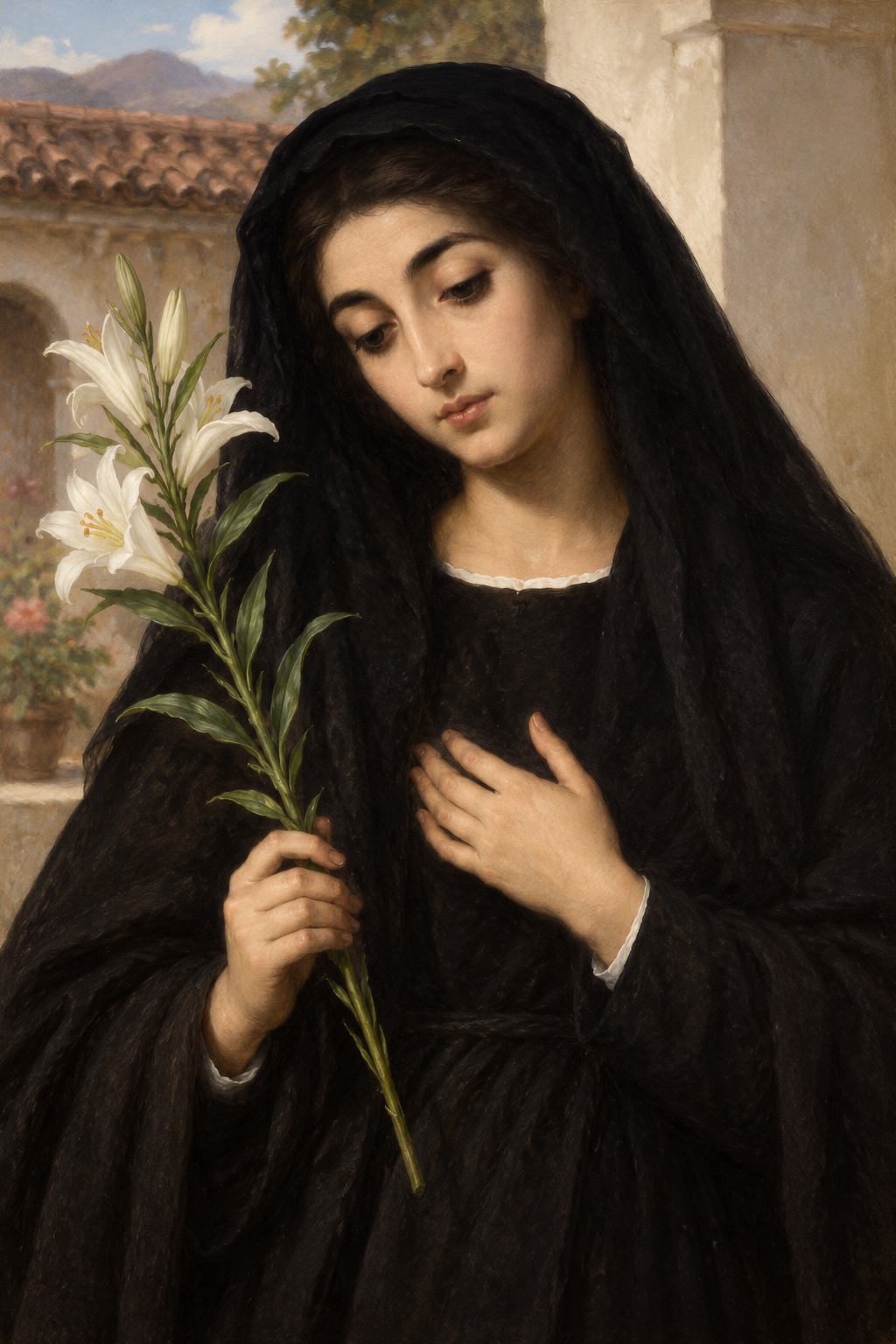
A later painting by Antonio Salas, described by Ecuador’s Casa de la Cultura, gives another example. Mariana appears in dark clothing with devotional objects that identify her religious life. The lily recalls the name by which she is widely known, the Lily of Quito. The museum account identifies her as a patron saint of Ecuador. Such paintings preserve the symbols through which successive generations have recognized her, rather than providing a single, neutral account of her life.
Her family home became part of another enduring religious history. The Ecuadorian Carmelites record that Juan Guerrero de Salazar gave the property for the foundation of the monastery now called Carmen Alto in 1653. Mariana had died eight years before the Carmelite nuns arrived. Their account remembers her interest in Teresa of Ávila’s writings, while distinguishing that spiritual connection from membership in a convent. The Carmelite delegation in Ecuador names Mariana as its patroness. The monastery’s continuing association with her family house provides a specific place in which that remembrance has been sustained.
The Instituto Santa Mariana de Jesús likewise identifies her as its patroness and distinguishes her from its founder, Mercedes de Jesús. Its presentation recalls Mariana’s learning, family relationships and Ignatian spirituality. This continuing institutional devotion extends her remembrance beyond her own household, while preserving the difference between the seventeenth-century woman and the later community that took her name. The institute’s account describes education in reading, writing, sewing, embroidery and music. It also recalls time with her nieces and friends, alongside help for poor people inside and outside the home. These details give her remembered life a domestic setting as well as a history of solitary prayer.
Wondering how to weigh the stories and sources? Learn how to read a saint biography.