Biography
Marie-Azélie Guérin
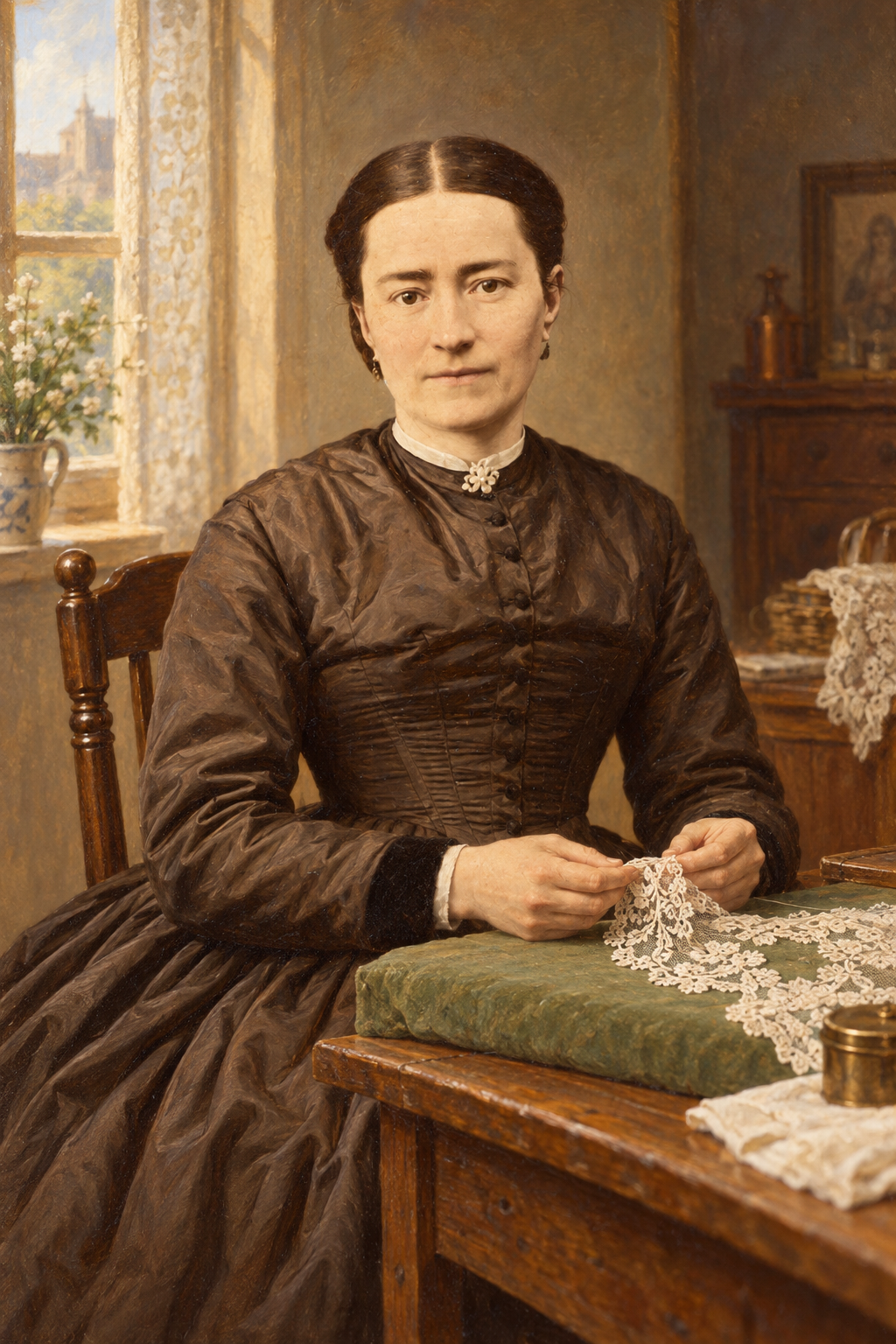
About Marie-Azélie Guérin
Marie-Azélie Guérin, usually called Zélie Martin, was a French lace manufacturer, wife and mother. She was born on December 23, 1831, in Gandelain, near Alençon. Her early desire to enter religious life was not fulfilled. After being refused admission to a convent, she trained in lace making and developed a business producing the intricate needle lace known as point d’Alençon. She had studied with the sisters of Perpetual Adoration in Alençon. Her own account remembered a severe upbringing, which continued to influence her religious sensitivity and concern with duty.
She married the watchmaker Louis Martin in Alençon on July 13, 1858. Their household eventually included nine children, four of whom died young. Their youngest daughter was Thérèse, later Saint Thérèse of Lisieux. As Zélie’s business grew, Louis gave up his own shop to assist her. The couple had to reconcile commercial responsibilities with the needs of a large family.
Lace making demanded skill, patience and close attention to detail. The Carmel archives preserve patterns used in Zélie’s work, including perforated green parchment for the final assembly. She specialized in joining separate pieces so that the connections were not visible. These surviving materials offer a concrete reminder of her professional ability and the painstaking labor behind the finished lace.
Claude Tuduri’s study of lace makers places her workshop within a trade dependent on merchants and changing demand. Periods of heavy orders could follow shortages of work, requiring Zélie and her employees to rearrange their plans. Louis took responsibility for commercial affairs, but the family’s enterprise remained largely dependent on lace dealers. A successful workshop still faced pressures that personal diligence could not remove.
Tuduri also cautions against allowing the beauty of the finished work to obscure the insecurity of the women who made it. His discussion presents the Martins’ care for their workers within the limits of nineteenth-century social protection. Their personal generosity mattered, but it did not solve the wider problems of a precarious trade. This context helps explain why accounts of Zélie’s enterprise contain both achievement and exhaustion.
Her letters preserve a more personal view. Writing to Pauline on March 4, 1877, she recalled the attraction religious life had continued to hold for her after marriage. She explained that Louis had understood and comforted her. The arrival of their children changed the center of their hopes: caring for them became a source of happiness and a religious vocation in its own right.
The same letter moves between grief for her recently deceased sister, concern for her daughters and ordinary family news. It begins with a visit to a sick worker and her husband. Zélie’s account is affectionate without presenting family life as effortless; her worries about Léonie appear beside her delight in the younger children. By the time she finished writing, she had spent four hours on letters to several relatives. Correspondence helped her sustain close relationships across the distances separating members of the family.
In a letter written that day to her sister-in-law, she described increasing pain and the continuing pressure of orders. A customer had asked for fifteen meters of lace within four months despite knowing she was ill. Zélie wanted to consult a doctor she trusted and was skeptical of advertised remedies.
A Vatican family-life publication also draws attention to her attempts to change her approach to Léonie. It cites a later March 1877 letter in which Zélie contrasted earlier reliance on force with a determination to treat her daughter gently. The passage preserves a mother’s recognition that her own conduct needed to change, alongside her hopes for the child.
Zélie died on August 28, 1877.
She and Louis were beatified together at Lisieux on October 19, 2008. In his homily, Cardinal José Saraiva Martins described marriage as the setting in which their holiness developed. He emphasized their mutual respect, fidelity and shared life through joy, bereavement and illness. Their recognition offered encouragement to married people, parents and those who had lost a spouse, while remaining rooted in the particular choices of this family. The cardinal also connected their assistance to people in poverty with their faith: they understood care for those in need as service to Christ, expressed through concrete acts.
Pope Francis canonized the couple on October 18, 2015. His homily remembered their daily service within the family and the atmosphere of faith and love in which their daughters grew. The church’s remembrance thus includes Zélie’s work and relationships as a laywoman, together with the religious vocation of her famous daughter.
Their joint feast is July 12. They are patrons of the sanctuary dedicated to them in Alençon, which welcomes couples and families.
In Abidjan, the founder of Fondation Cana also explicitly names Louis and Zélie as its patrons. His testimony describes a community seeking to support married life through prayer and practical service. This documented association carries their remembrance beyond France into a different setting of family life.
Wondering how to weigh the stories and sources? Learn how to read a saint biography.