Biography
Marie Marguerite d’Youville
About Marie Marguerite d’Youville
Marie Marguerite Dufrost de Lajemmerais was born on 15 October 1701 in Varennes, in New France. Her father died when she was a child, leaving a well-connected family short of money. Relatives helped her attend the Ursulines’ school in Québec for two years. She then returned home to help her mother care for younger children. Claudette Lacelle's archival biography shows the mixture of privilege and insecurity in her early life: family connections opened a school door, while household responsibilities limited her education. Her later decisions in Montréal grew from this upbringing, not from a childhood spent inside a convent.
In Montréal she married François d’Youville in 1722. The couple had six children, four of whom died young. Her husband's trade in alcohol with Indigenous people drew criticism, and his death in 1729 left her with family duties and a complicated estate. She renounced the indebted succession but kept their home and supported her surviving sons, who later became priests. Municipal historian Annick Brabant describes her work in confraternities and commerce during widowhood. These details matter because the widow who later led a charitable institution had already managed a household, grief, debts and business. Her religious commitments developed alongside these practical responsibilities.
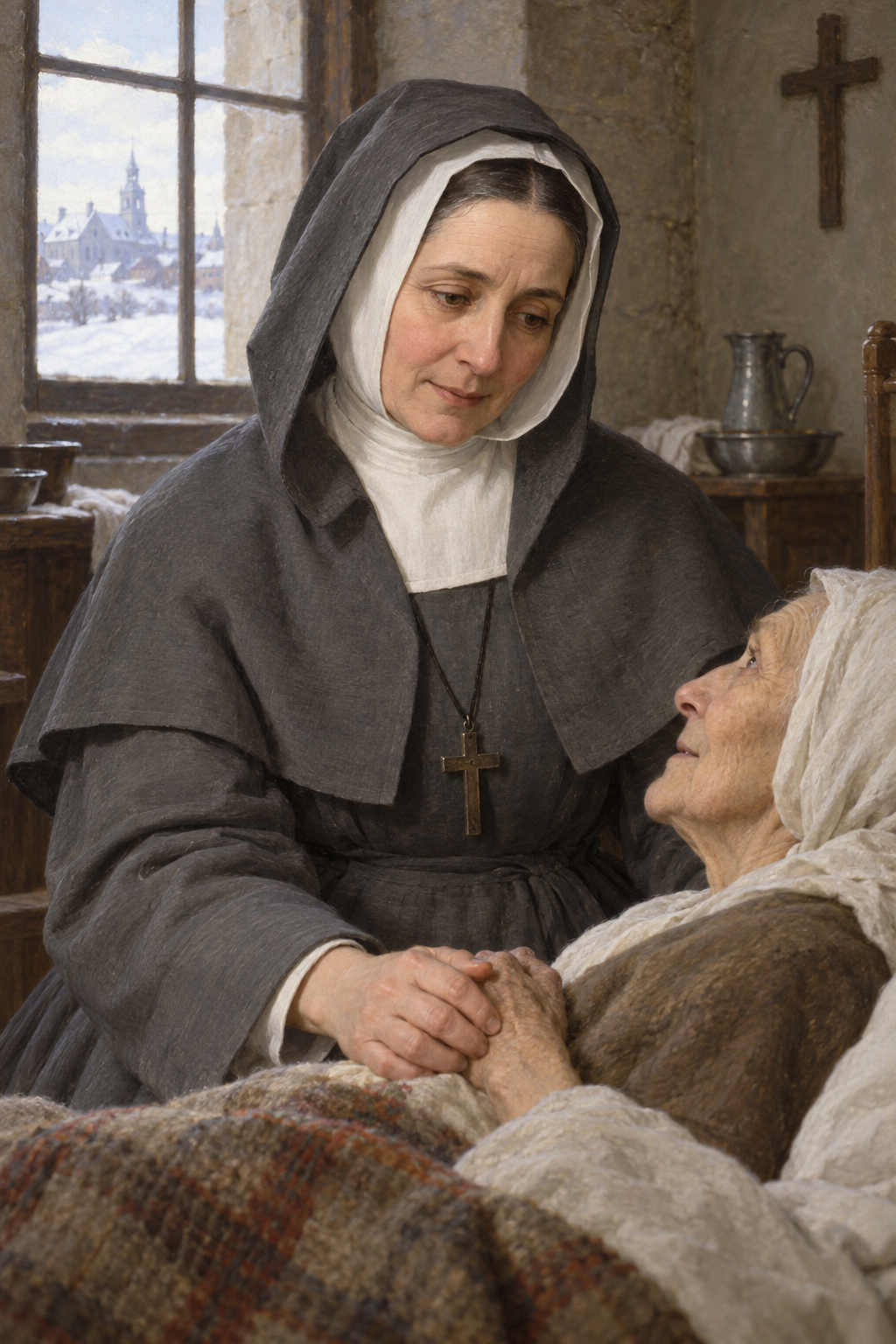
On 21 November 1737 d’Youville welcomed Françoise Auzon, a blind older woman, into her home. On 31 December she and three companions privately committed themselves to service for poor people. They did not begin as a fully recognized order; the Grey Nuns' own history notes that colonial authorities discouraged new religious communities. Women without family support or means had few places to turn, and the existing General Hospital then served men. The companions pooled time and resources to provide shelter. Their first commitments are the community's founding point, while the legal and ecclesiastical recognition came years later.
Their first work met resistance. Some Montréal residents mocked them as “grey” or supposedly intoxicated women, an insult connected with François d’Youville's alcohol trade. The women enlarged their house to take in more people. Fire destroyed that first shelter in January 1745, and two days later they made a written commitment to hold resources in common and serve those in need. Lacelle describes repeated moves before the women found a stable institutional home. Their association survived because its members kept providing food and lodging through shortages and suspicion.
The General Hospital had been founded by François Charon de la Barre in the 1690s. By 1747 it was indebted and its building needed repair. On 27 August colonial authorities provisionally appointed d’Youville to manage it, and she moved in with companions and residents that October. A “general hospital” then was more like a hospice than a modern acute-care hospital: it sheltered poor, older and displaced people, and eventually women and children as well as men. Taking over the institution meant cleaning and repairing a building while finding food and income for its residents. Parks Canada's historic-site record preserves the building as evidence of that long period of care.
Her appointment remained contested. Intendant François Bigot attempted to close Montréal’s hospital and move its residents to the one in Québec. Letters preserved by the Grey Nuns show d’Youville defending the repairs and cultivation she had organized. She responded to criticism of what the institution spent on its residents and argued that the improved property should not simply be handed over. The correspondence reveals administrative work behind the more familiar descriptions of charity: food, buildings and land had to be maintained through a political dispute. The sisters’ future depended on decisions beyond the ward, and d’Youville used her written arguments to protect the work they had begun.
The hospital's work also sits within the slavery of colonial Montréal. Historian Dominique Laperle, using Grey Nuns registers and Marcel Trudel's research, documents three or four enslaved Indigenous people held personally by d’Youville and three people donated to the hospital. Their captivity is part of the institution's history, even though charitable accounts usually omit it. Laperle disputes descriptions of her as one of the colony's largest slaveholders and finds no evidence of a large-scale trade run by the hospital. British prisoners housed or employed there were held by the state and require a different legal description. These distinctions do not diminish the documented enslavement.
On 18 May 1765 a major fire swept through the General Hospital, displacing the sisters and the people living there. The Grey Nuns' archives preserve a later statement of losses and records of goods received to help the institution recover. Stone walls and some timbers survived, and the community rebuilt. The fire was not the same one that destroyed the women's first house in 1745. D’Youville also acquired property to support the hospital's income after the disaster. The surviving records show a practical recovery: supplies, repairs and space for residents had to be found, regardless of the spiritual meanings later writers gave the event.
D’Youville died in Montréal on 23 December 1771. The community she founded continued, and later Grey Nuns established other houses and hospitals; those later achievements belong to generations of sisters after her.
John XXIII beatified d’Youville on 3 May 1959, and John Paul II canonized her on 9 December 1990. The Dicastery lists 23 December as her memorial.
At the canonization, John Paul II presented d’Youville's attention to poor people as a witness to the Gospel and praised the sisters' common life. That is the Catholic Church's theological reading of her work. The historical record gives the reading a concrete setting: a widow's household, a contested charitable association, a failing hospital, repeated fires and the daily need to feed residents. It also requires facing enslavement within the same institution. Her life is neither a sequence of effortless good deeds nor an institution detached from its time. Readers can recognize the care she organized while keeping the experiences of those who worked and lived under her authority in view.
Wondering how to weigh the stories and sources? Learn how to read a saint biography.