Biography
Marie-Rose Durocher
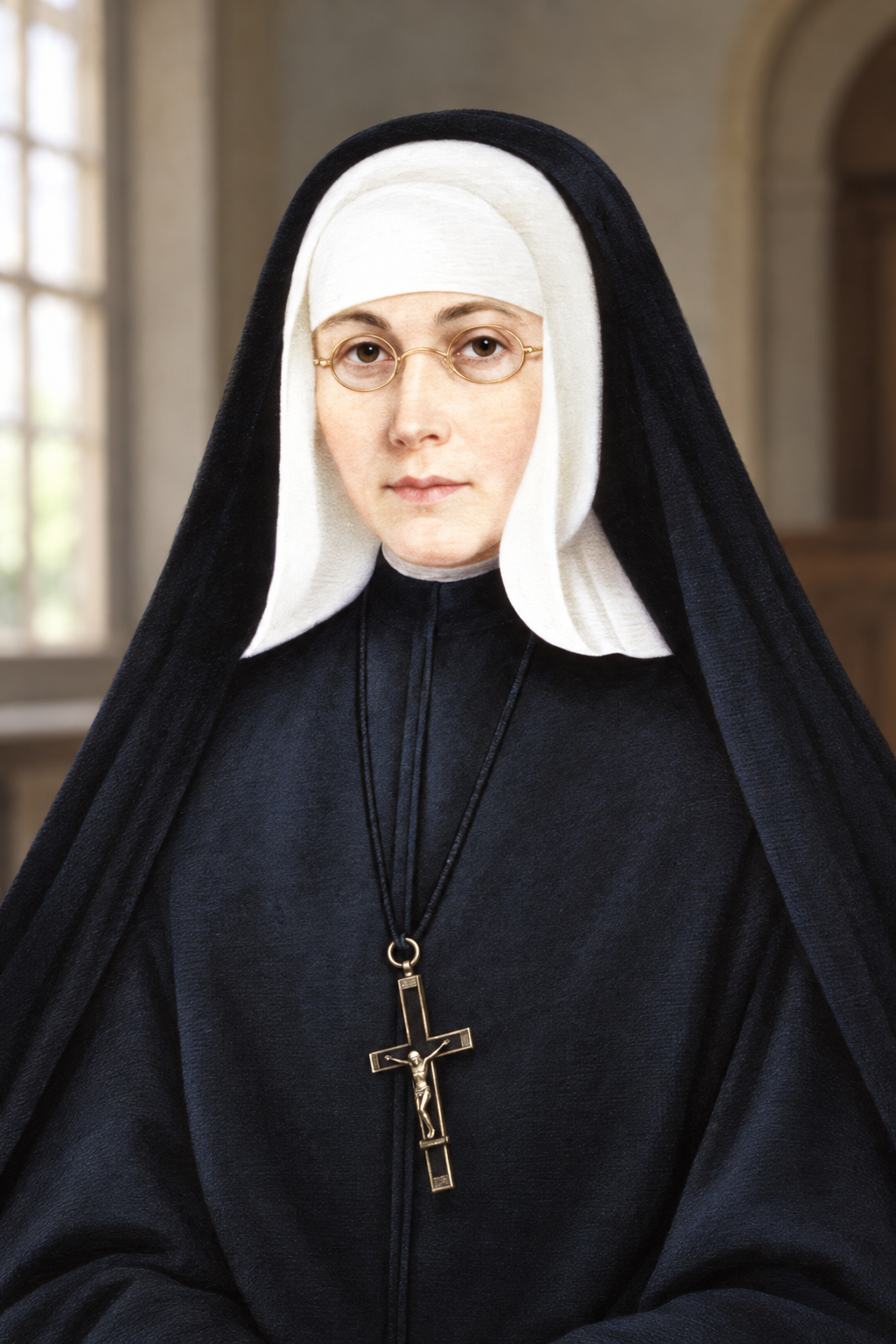
About Marie-Rose Durocher
Marie-Rose Durocher grew up as Eulalie Durocher in Saint-Antoine-sur-Richelieu. Ill health interrupted her education and delayed her wish to enter religious life. After her mother’s death, she managed the family household. She later joined her brother Théophile at the rectory in Beloeil, where her responsibilities extended beyond housekeeping.
Her education combined family instruction with periods at convent schools. According to Marguerite Jean’s scholarly biography, her grandfather first taught her at home. After his death, she boarded with the Congregation of Notre-Dame in Saint-Denis. She later received private instruction from a teacher associated with the Collège de Saint-Hyacinthe. In 1827 she entered the congregation’s Montreal boarding school with the intention of becoming a novice. Repeated interruptions for ill health brought that plan to an end, but did not end her interest in religious life.
With her friend Mélodie Dufresne, she visited people in need, taught children catechism, and helped organize parish activities. These experiences brought the shortage of educational opportunities for girls into focus.
The parish priest of Longueuil had sought a teaching community from Marseille. Eulalie and Mélodie hoped to join that foundation, but the French sisters did not come. In 1843 the two women moved into the parish school with Henriette Céré, who was already teaching there. With the support of Bishop Ignace Bourget and spiritual guidance from the Oblates, they became the first members of a new teaching congregation. Eulalie took the name Marie-Rose and became its first superior.
A letter dated October 18, 1843, reproduced in Jules Henri Prétôt’s later biography, brings the preparations into view. Writing from Beloeil to her friend, Eulalie reported that the bishop wanted the Longueuil foundation to proceed. She asked her companion to return the next day if possible. If travel proved impossible, she proposed a period of prayer instead. Alongside the urgency, she cautioned her friend against becoming angry or anxious if she could not come. The published letter shows practical arrangements and religious preparation proceeding together; the original manuscript has not been inspected here.
The congregation distinguishes its beginning in October 1843 from the founders’ first religious vows in December 1844. Their perpetual vows followed in August 1846.
Marie-Rose wanted education to be available to children whose families could not pay for it. Fees from boarding pupils helped fund free schooling. The curriculum included music, drawing, English, and home economics alongside basic instruction. In 1844, she sent two sisters to learn teaching methods from the Brothers of the Christian Schools in Montréal. Her responsibilities therefore included preparing teachers as well as organizing schools.
The first school building had originally been an inn before becoming parish property. The sisters moved to larger premises in 1844. The founding house later served several civic purposes and was eventually moved and reconstructed to preserve it. Its history retains a tangible connection to the modest setting where the women began their community.
Leadership also brought conflict. Jean dates a dispute with Charles Chiniquy to 1846, when he entered the Oblate novitiate and sought control over teaching in the sisters’ schools. Marie-Rose refused, and he publicly criticized the community. This episode belongs to his Catholic period; his later Protestant ministry should not be read back into it.
Later correspondence reproduced by Prétôt records her attention to sisters living away from the motherhouse. In September 1848, she encouraged Sister Marie-Anne to persevere through discouragement and to live charitably with her companions. Around the end of that year, she sent Sister Marie-Madeleine news of other houses and decisions concerning local superiors. She also invited Sister Marie-Ignace back for the community’s feast. These exchanges combined spiritual direction, administrative news, and invitations to gather. They give a more personal view of her leadership than the sequence of school openings alone.
The congregation also drew on an existing model. Parachini’s encyclopedia account explains that the Canadian sisters adopted the Marseille community’s habit and adapted its constitutions. The Oblates supplied financial and moral assistance as well as spiritual guidance. Marie-Rose maintained contact across the growing congregation through letters and visits, helping its members sustain their common educational work despite difficult living conditions and opposition.
Marie-Rose died in 1849, after only a few years leading the congregation. The bishops’ account recalls both her practical organization and her concern for the religious formation of children. It describes a spiritual life centered on prayer, the Eucharist, and devotion to Mary. After her death, the sisters carried their teaching work farther afield, establishing a mission in Oregon in 1859.
Pope John Paul II beatified her on May 23, 1982. In his homily, he recalled her care for sick clergy and her work among young women before she founded the congregation. He presented her educational mission as a response to the needs of girls in poor rural communities around Montréal. His account joined her years of parish service to the teaching work that occupied the final years of her life.
Wondering how to weigh the stories and sources? Learn how to read a saint biography.