Biography
Mary of Bethany
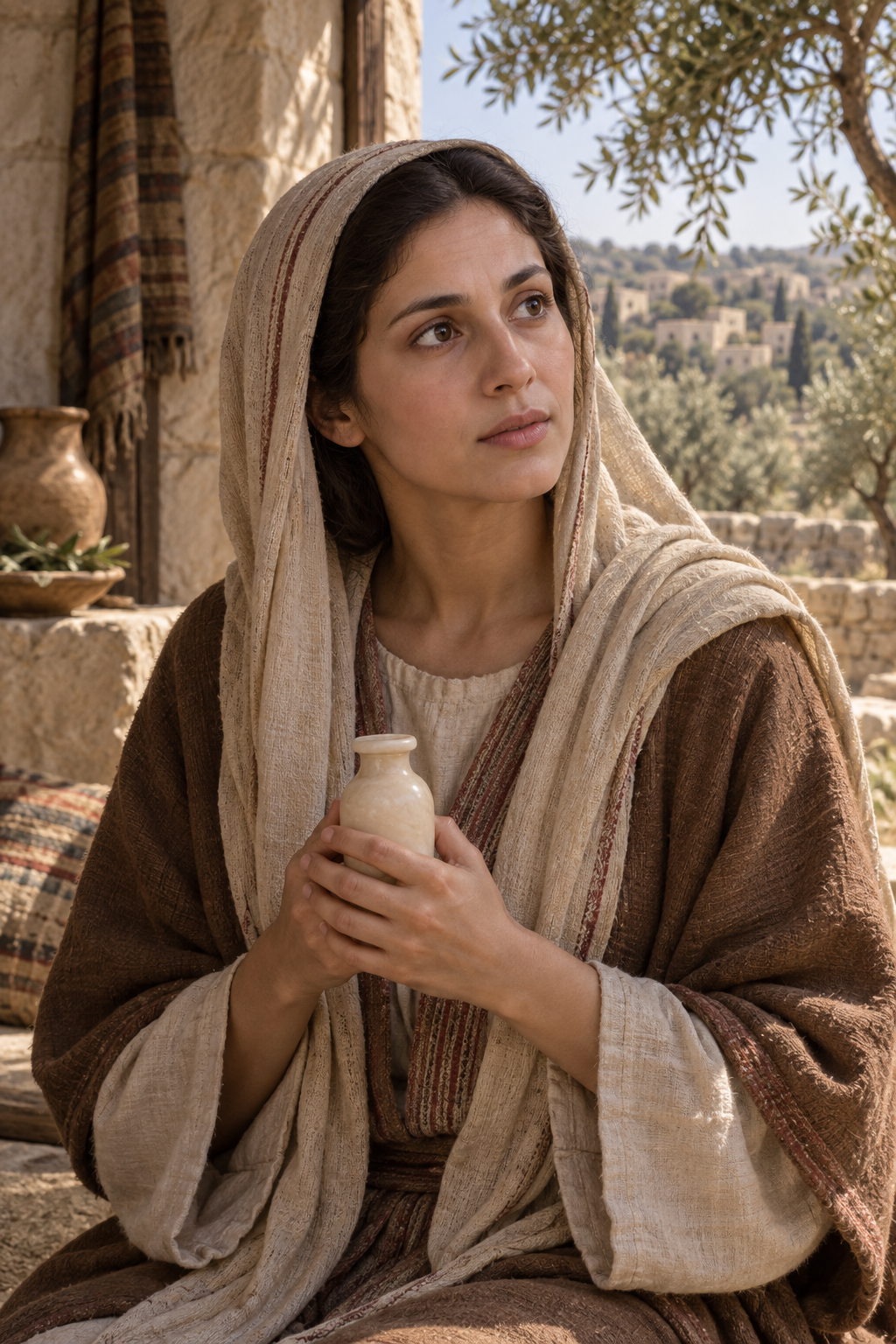
About Mary of Bethany
Mary of Bethany is a scriptural figure whose identity must be kept distinct from Mary Magdalene and from the Virgin Mary. The canonical Gospels give no birth date, occupation, marriage, death date, or independent biography. They identify her through her family, her attention to Jesus's teaching, her grief at Lazarus's death, and her anointing of Jesus at Bethany. John names Mary, Martha, and Lazarus as siblings and says that Jesus loved them. Bethany was a village near Jerusalem, but the Gospel accounts do not establish Mary's age or social position.
Luke 10 presents Mary and Martha in a household visited by Jesus. Martha is occupied with serving, while Mary sits at the Lord's feet and listens to his word. When Martha asks Jesus to send Mary to help, he says that Mary has chosen the better part and that it will not be taken from her. The passage is the canonical basis for Mary's later association with attentive discipleship and contemplation. Luke does not name Bethany in this scene, and it does not by itself identify Luke's Mary with the woman in John's later account.
John 11 identifies Mary explicitly as Lazarus's sister. When Jesus arrives after Lazarus has died, Martha goes out to meet him first. Mary remains in the house until Martha tells her privately that the Master is calling her. Mary rises quickly, comes to Jesus, falls at his feet, and says that Lazarus would not have died if Jesus had been present. She weeps, and the mourners who followed her weep as well. The narrative says that Jesus is deeply troubled and goes to the tomb. He calls Lazarus out, and the sign leads many witnesses to believe while also provoking opposition from the authorities.
John 12 places Mary at a supper in Bethany six days before Passover. Martha serves, Lazarus is present, and Mary takes costly spikenard, anoints Jesus's feet, and wipes them with her hair. Judas objects that the perfume could have been sold and the money given to the poor. Jesus tells him to leave Mary alone and connects the act with the day of his burial. The passage supplies the clearest attribute associated with Mary of Bethany: the ointment and the act of anointing. It should not be used to import the Magdalene's later patronages or penitential imagery into Mary's record.
For many centuries, the Latin West commonly conflated Mary of Bethany, Mary Magdalene, and the unnamed sinful woman of Luke 7. Gregory the Great's sixth-century homily became a major expression of that interpretation. The Greek Fathers generally distinguished the women, and the 1969 Roman calendar reform explicitly stated that the 22 July memorial concerns Mary Magdalene, not Martha's sister or the sinful woman. In 2021 the Holy See added Mary by name to the 29 July memorial of Martha, Mary, and Lazarus. That decree recognizes the traditional uncertainty rather than treating the earlier conflation as a secure historical fact.
Eastern Christian calendars commemorate Martha and Mary together on 4 June and also associate Mary with the myrrh-bearers. These are liturgical traditions, not independent evidence that Mary stood at the tomb. Later accounts place her in Cyprus or Ephesus, while Western legends attached Bethany relatives to Provençal narratives. These stories conflict with one another and are not included as historical life events. No formally documented patronage was established for Mary of Bethany in the research packet. Her association with contemplative attention comes from Luke 10 and should be described as devotional interpretation rather than an official designation.
Mary of Bethany therefore remains significant through a small, carefully bounded set of Gospel scenes. She listens, grieves, responds when called, and performs an act of costly honor that Jesus interprets within the approach of his death. A responsible record preserves those scenes, distinguishes textual attestation from later tradition, and keeps her separate from the Magdalene whose Western iconography absorbed many of the same symbols.
Wondering how to weigh the stories and sources? Learn how to read a saint biography.