Biography
Mary of the Passion
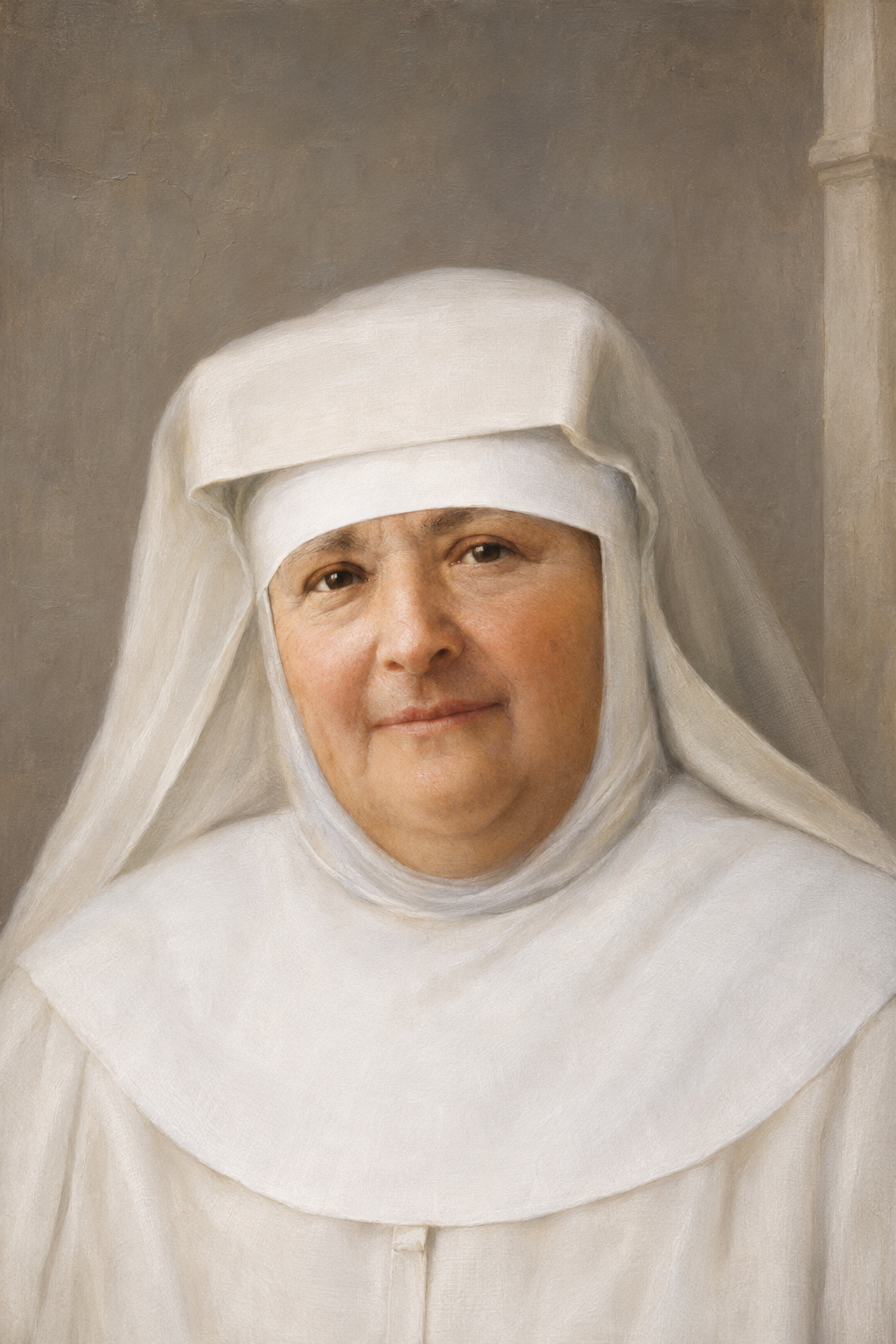
About Mary of the Passion
Hélène Marie Philippine de Chappotin de Neuville was born in Nantes, France, on 21 May 1839. She grew up in a Catholic family and felt drawn to religious life. After her mother died, she entered the Poor Clares at Nantes in December 1860. Illness forced her to leave the monastery the next year. After recovering, she joined the Society of Marie Reparatrice and received the name Mary of the Passion. The sources describe these early changes as a gradual search for a form of religious life she could sustain, not a single uninterrupted path.
In March 1865 Mary was sent to the Madurai mission in India. She served at Tuticorin, became superior there, and in July 1867 was appointed provincial superior of the three convents. She later opened a house at Ootacamund. Her responsibilities combined local religious life with oversight across a growing mission. The Franciscan Missionaries of Mary’s history dates the Ootacamund foundation to 1875, while the Vatican biography gives 1874; the sources differ by one year.
By 1876 serious disagreements had developed within the Madurai mission. Mary and other sisters left the Society of Marie Reparatrice and gathered at Ootacamund under Bishop Joseph Bardou. The Vatican biography describes the separation as the result of worsening divisions in the mission. Mary traveled to Rome in November with three sisters to seek a canonical solution. Pope Pius IX authorized the new Missionaries of Mary on 6 January 1877. Mary drafted a plan for the institute and later its constitutions, giving the new community a framework for its common life.
At Propaganda Fide’s request, Mary wrote a plan centered on universal mission and devotion to the Eucharist. The first novitiate opened at Saint-Brieuc, then moved to Les Châtelets in 1880 as the new community attracted candidates. She had to give women drawn from different houses a shared rule, a course of formation, and a direction for service. The Franciscan Missionaries of Mary’s history presents this early organizing as part of the foundation itself: a community’s ideals had to become practices that new sisters could learn and carry into future houses.
The new institute did not begin with immediate stability. Mary opened a house in Rome in 1882, entered the Third Order of Saint Francis, and in 1885 the community became known as the Franciscan Missionaries of Mary. In March 1883 Pope Leo XIII removed her from leadership after opposition arose. An inquiry later acknowledged her innocence, and she was reelected at a chapter in July 1884. The episode tested the founder’s authority while the institute was still organizing its identity and expanding beyond the Indian mission.
Mary then guided the institute through new foundations, correspondence, and the formation of its sisters. The Vatican account describes her concern for women and social questions. The Franciscan Missionaries of Mary records the sisters’ work across countries in education, health, and service to people in need. These institutional sources provide the strongest evidence for the community’s expansion, although they summarize a broad network rather than documenting every foundation in detail. Mary’s work was administrative and spiritual: she wrote, traveled, organized communities, and shaped the expectations of the women who joined.
Her correspondence shows how she connected that organization to an inner spiritual life. In letters and conference notes, she repeatedly urged the sisters toward obedience, self-offering, and conformity to Christ. An FMM publication quotes her 1886 letter asking a companion to pray that the love and desires of Christ would shape her own heart; a later letter from Saint-Brieuc to the sisters at Ootacamund blesses them with maternal tenderness. These brief extracts place her spiritual direction within relationships with particular sisters, rather than only in constitutions and administrative decisions. The Holy See biography likewise describes extensive correspondence with missionaries scattered across the world and writings for their formation.
Mary’s mission extended beyond the original Indian foundation. The institute’s official history lists foundations during her lifetime in places including Ceylon, China, Japan, Mozambique, England, Belgium, Canada, and Chile. The Holy See describes the sisters’ work in “perilous and distant” missions and records the deaths of seven members in China in 1900; they were later canonized in 2000. Mary was deeply affected by their deaths, which made the cost of the missionary ideal personal to her as founder. The same official account says she promoted women and collaborated with people working on social questions, while continuing to organize communities and write for the sisters.
Mary of the Passion died at San Remo, Italy, on 15 November 1904, after a brief illness and years of demanding work. The institute had more than two thousand sisters and dozens of houses across four continents by that time, according to the Vatican biography. Pope John Paul II beatified her on 20 October 2002. Her enduring significance is tied to the religious community she founded and to the practical ministries its sisters developed, while the sources also preserve the contested and sometimes difficult path by which that community took shape.
Wondering how to weigh the stories and sources? Learn how to read a saint biography.