Biography
Methodius of Thessalonica
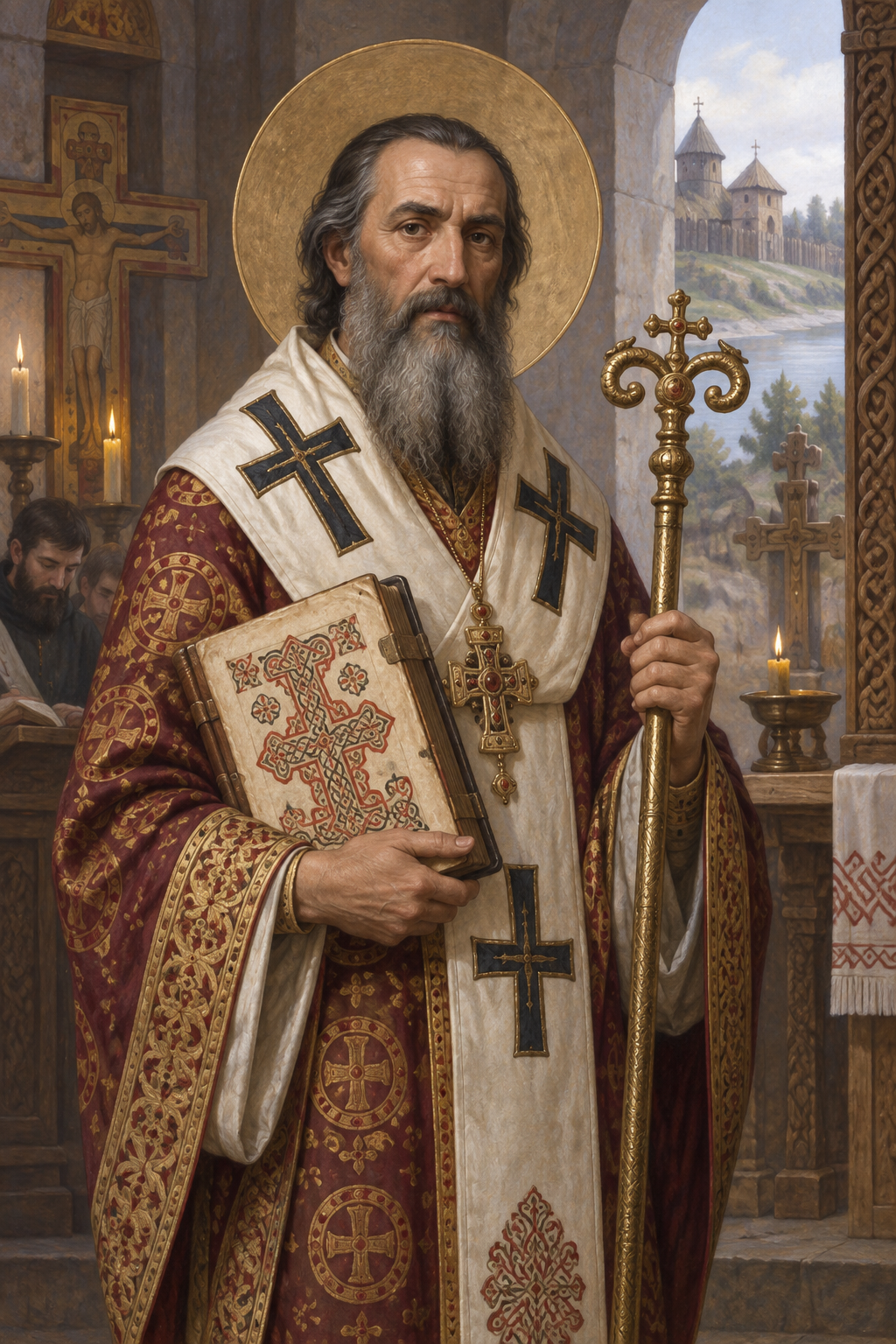
About Methodius of Thessalonica
Methodius of Thessalonica (born **Michael**, c. 815–820 – 6 April 885) was a Byzantine Greek from Thessalonica who, with his younger brother Constantine-Cyril, carried Christianity and a written liturgical language to the Slavs of Great Moravia and Pannonia, and who afterwards spent sixteen years defending that work alone. Son of a senior officer of the imperial administration, he pursued a civil career and reached the rank of *archon* or prefect in a Slavic-speaking province before withdrawing, around 840, to a monastery on Mount Olympus in Bithynia, where he took the name Methodius [S3 ¶4][S2]. In 862–863 the brothers were sent by Emperor Michael III to Moravia at the request of Prince Rastislav; they translated the Gospels and the liturgical books into Slavonic, writing them in the **Glagolitic** alphabet devised for the purpose [S2][S19]. After Cyril died in Rome in 869, Pope Adrian II ordained Methodius and sent him back as **archbishop for the territory of the ancient diocese of Pannonia**, with the title of the re-established see of **Sirmium** and the standing of papal legate to the Slav peoples [S3 ¶6][S1][S2]. The Bavarian episcopate, whose jurisdiction he was held to have invaded, seized him at a synod and imprisoned him in Swabia for between two and three years until Pope John VIII ordered his release; summoned to Rome again on a charge of heresy, he was acquitted and confirmed, and the Slavonic liturgy was permitted [S3 ¶6][S6][S1][S2]. He spent his last years translating the remainder of the Scriptures, patristic works, and the Byzantine **Nomocanon** into Slavonic [S3 ¶6][S6]. He died on 6 April 885 and was buried in the principal cathedral church of Great Moravia, a building that has never been securely identified [S2][S3 ¶6]. His designated successor Gorazd was rejected by Rome, and his disciples were driven out of Moravia, carrying the Slavonic books south into Bulgaria, where their pupils produced the Cyrillic alphabet named — inaccurately — for his brother [S2][S19]. He is honored in the East as **Equal-to-the-Apostles**, and in 1980 Pope John Paul II declared him and Cyril **co-patrons of Europe** [S8][S4].
**Name collisions and identity confusions.** Four distinct confusions have to be guarded against. First, the collision with **Methodius of Olympus** (d. c. 311), already in the catalog at ID 133: a Lycian bishop, anti-Origenist writer and martyr with no connection to the Slavs [S24]. The bare name "Methodius" in older reference works and calendars can mean either man, and the coincidence that the Thessalonican Methodius became a monk on *Mount Olympus in Bithynia* [S3 ¶4] makes the confusion actively easy — the two Olympuses are different places (Lycia in south-western Anatolia; Bithynia, modern Uludağ, in north-western Anatolia). Second, the collision on "Cyril": the catalog's Cyril of Alexandria (ID 177) and Cyril of Jerusalem (ID 178) are neither of them this saint's brother. Third, a further "Methodius" in the Byzantine record, **Methodius I, Patriarch of Constantinople** (d. 847), belongs to the same century and is sometimes confounded with him in loose lists; he is not the same person and is not in scope here. Fourth, the birth name: sources that call this saint "Michael" before c. 840 and "Methodius" after are describing one man, not two [S1][S2].
---
**1. Civil office in a Slavic province, and withdrawal to Mount Olympus (c. 835 – c. 840)** — *featured* Born Michael, the son of "a senior official of the imperial administration", he entered the same career and rose to the rank of **archon or prefect**, governing a province with a substantial Slavic population — the practical source of the brothers' command of Slavic speech [S3 ¶4]. Around 840 he broke off that career and retired to one of the monasteries at the foot of **Mount Olympus in Bithynia** (the Polychron monastery, modern Uludağ, Turkey), where he received the name Methodius [S3 ¶4][S2]. He later served as abbot there [S2]. This is the single most distinctive fact of his early life and the one most often lost when he is treated as his brother's assistant. *Confidence:* documented (the *Vitae* and *Slavorum Apostoli*); the exact province and the exact rank are **probable** rather than certain. *Sources:* S3 ¶4, S2. **2. The Moravian mission with Cyril (862–867)** In 862 Prince Rastislav of Great Moravia asked Constantinople for a teacher who could preach in the Slavs' own tongue; Emperor Michael III sent the two brothers, who arrived in 863 [S2]. They translated the Gospels and the liturgical books into Old Church Slavonic and wrote them in the **Glagolitic** alphabet created for the purpose [S2][S19]. This is the joint chapter of the story and belongs in full in the Cyril record; it is summarized here only for continuity. *Confidence:* documented. *Sources:* S2, S19. **3. Consecration as archbishop and papal legate to the Slavs (869–870)** — *featured* After Cyril's death in Rome on 14 February 869, Pope Adrian II ordained Methodius and consecrated him **archbishop for the territory of the ancient diocese of Pannonia**, giving him the ecclesiastical title of the re-established see of **Sirmium** and naming him **papal legate *ad gentes*** for the Slav peoples [S3 ¶6]. The older Catholic Encyclopedia describes the act as forming "an Archdiocese of Moravia and Pannonia" made "independent of the German Church" [S6]. He returned with authority to celebrate the Slavonic liturgy [S1][S2]. **This is the event that makes `office:Bishop` correct for Methodius and doubtful for Cyril.** *Confidence:* documented, though the exact juridical shape of the province — Sirmium, Pannonia, Moravia, or some combination — is contested between the sources. *Sources:* S3 ¶6, S6, S1, S2. **4. Deposition and imprisonment by the Bavarian bishops (870 – 873)** — *featured* The Frankish episcopate regarded the new province as an invasion of their jurisdiction. In 870 King Louis and the German bishops — **Adalwin of Salzburg** and **Ermanrich of Passau** prominent among them — summoned Methodius to a synod (New Advent places it at Ratisbon/Regensburg), declared him deposed, and shut him up in a monastery in Swabia; recent scholarship points to **Reichenau Abbey** [S6][S1][S2]. *Slavorum Apostoli* describes the charge precisely as "having invaded the episcopal jurisdiction of another" [S3 ¶6]. **The sources disagree on the length:** *Slavorum Apostoli* says two years [S3 ¶6], Wikipedia two and a half [S1][S2], and the Catholic Encyclopedia three [S6]. He was freed in 873 at the command of **Pope John VIII** and reinstated [S6][S1]. Of a fifteen-year episcopate, two to three years were spent in captivity at the hands of fellow bishops — a fact worth stating plainly rather than softening. *Confidence:* documented as to the fact; the duration and the place of confinement are **probable**. *Sources:* S3 ¶6, S6, S1, S2. **5. The Slavonic liturgy suppressed, defended at Rome, and restored (873 – c. 880)** — *featured* John VIII secured his release but initially **forbade** the use of the Slavonic liturgy [S2]. Summoned to Rome again on a charge of heresy — the retrieved sources place the hearing in 878, though
Wondering how to weigh the stories and sources? Learn how to read a saint biography.