Biography
Michael the Archangel
About Michael the Archangel
Michael the Archangel is a named heavenly figure in the books of Daniel, Jude, and Revelation. These writings do not describe a human childhood, occupation, aging, or death. They present Michael within visions and theological narratives written in different periods and genres. A careful account must therefore differ from an ordinary life story. It can identify what each text says, explain how the title archangel became attached to Michael, and describe later worship and art, but it cannot supply a continuous earthly chronology. Birth and death dates, a birthplace, and a grave would all be false categories for the evidence preserved about him.
Michael first appears by name in Daniel's final vision. A heavenly messenger tells Daniel that the prince of the kingdom of Persia resisted him until Michael, described as one of the chief princes, came to help. Later in the chapter the messenger calls Michael 'your prince.' The USCCB notes identify him here as the patron angel of Israel. The scene uses apocalyptic language in which nations have heavenly princes and earthly conflict has a cosmic dimension. It does not provide a location for Michael within the Tigris riverbank setting where Daniel receives the vision, and it does not support mapping a supernatural combat as a terrestrial journey.
Daniel 12 gives Michael another title: the great prince and guardian of Daniel's people. He arises during an unsurpassed time of distress, when those found written in the book escape and the dead awaken to differing destinies. The passage joins protection with judgment and hope, but Michael is not portrayed as the source of resurrection or salvation. His role is subordinate within the divine vision. This distinction is central to later Christian teaching about angels: the Catechism describes angels as servants and messengers of God, spiritual creatures whose activity is ordered to God's purpose rather than independent divine beings.
The Letter of Jude provides the canonical title most closely associated with Michael. Jude calls him 'the archangel' while recounting a dispute with the devil over the body of Moses. Michael does not issue a condemnation on his own authority. Instead, he says, 'May the Lord rebuke you!' Jude uses this restraint as part of a warning against arrogant speech. The episode draws on a tradition outside the surviving Hebrew Scriptures, so its narrative setting cannot be reconstructed or plotted on a map. Within Jude's argument, Michael's action demonstrates disciplined reliance on divine judgment rather than a contest of personal pride.
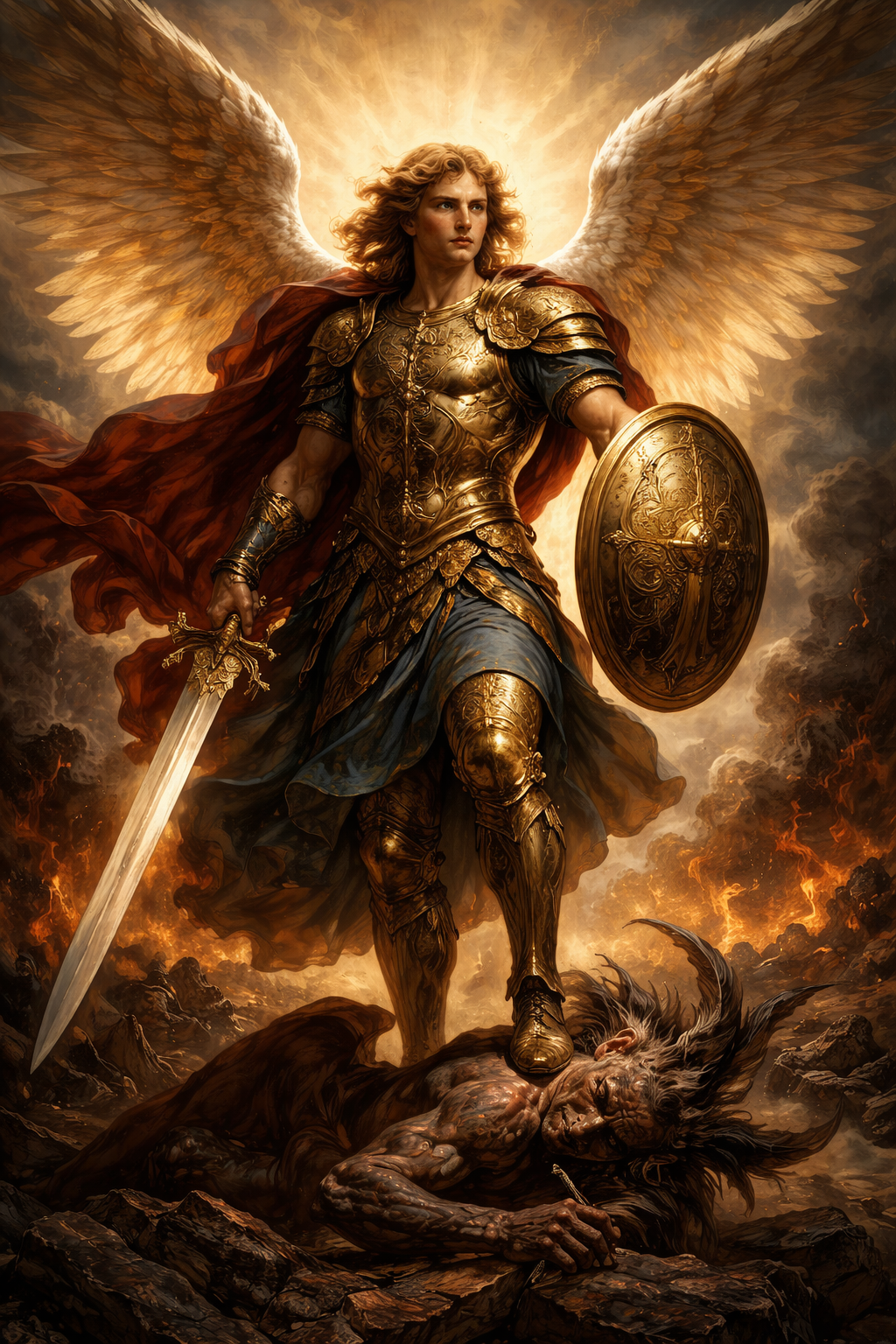
Revelation 12 presents the most influential martial image. In an apocalyptic vision, war breaks out in heaven; Michael and his angels fight the dragon and its angels. The dragon, identified as the Devil and Satan, is expelled. The chapter then announces that salvation, power, God's kingdom, and the authority of God's anointed have come. Michael leads the heavenly host, but the hymn attributes victory to God and to the Lamb's blood and the witnesses' testimony. The scene is symbolic theology, not a report of a battle at a geographic site. Swords, spears, armor, and a dragon beneath Michael's feet are later artistic ways of making this vision visible.
Taken together, the canonical passages establish a stable identity without erasing their differences. Daniel calls Michael a chief prince and guardian associated with Israel. Jude alone explicitly calls him the archangel and depicts his restraint in the dispute concerning Moses. Revelation shows him commanding angels against the dragon. Scripture does not number him among seven named archangels, describe the color of his wings, place scales in his hands, or narrate appearances at medieval shrines. Those details belong to later theological, liturgical, artistic, or local traditions. They may be meaningful within the communities that received them, but they require their own labels and sources.
Christian liturgy developed distinct commemorations. The Roman Catholic Church celebrates Michael with Gabriel and Raphael on September 29. The Vatican's directory on popular piety also records longstanding shrines dedicated to Michael, including Mont-Saint-Michel, the Sacra di San Michele, and Monte Sant'Angelo on Gargano. It treats such places as expressions of devotion that developed through centuries, not as proof that the events in Daniel, Jude, or Revelation occurred there. The Orthodox Church in America observes the Synaxis of Michael and the other bodiless powers on November 8, presenting him as leader of the heavenly hosts within Eastern Christian reception.
Later devotion expanded Michael's protective associations. Christian art often gives him armor or a weapon because of Revelation's combat, while scales evoke traditions about judgment and care at death. The Vatican directory notes prayers for angelic assistance, protection, and accompaniment of the dying, yet these collective beliefs should not be retrojected as additional episodes in Michael's scriptural appearances. The existing artwork is modern AI-generated devotional illustration, not a portrait or archaeological likeness. Michael remains significant as a scriptural figure whose narrated actions join protection, leadership, restraint, and obedience while directing attention away from created power toward God's authority.
Wondering how to weigh the stories and sources? Learn how to read a saint biography.