Biography
Moses
About Moses
Exodus introduces Moses within a story about Israelite forced labor and a royal order to kill newborn Hebrew boys. It identifies his parents as members of the tribe of Levi but does not name them until a later genealogy. His mother hides him for three months, places him in a papyrus basket among the Nile reeds, and stations his sister nearby. Pharaoh's daughter finds the child, has compassion on him, and eventually raises him as her son after his own mother nurses him. The text explains his Egyptian name through a Hebrew wordplay about drawing him from the water. These are claims of the biblical narrative; no contemporary Egyptian record independently documents Moses or supplies calendar years for his life.
As an adult, Moses sees an Egyptian beating a Hebrew and kills the Egyptian after looking around to see that no one is present. When the killing becomes known, Moses flees Pharaoh and settles in Midian. There he defends the daughters of a priest from shepherds, receives a home, and marries Zipporah. Exodus calls Zipporah's father Reuel in this scene; elsewhere the family connection is associated with Jethro, and the differing names should not be silently harmonized. Moses becomes a shepherd and names his son Gershom in language that remembers life as an alien. The episode combines resistance to abuse with lethal violence and exile, resisting a portrait of uncomplicated heroism.
While tending the flock near Horeb, called the mountain of God in Exodus, Moses encounters a bush burning without being consumed. The voice from the bush identifies itself with Abraham, Isaac, and Jacob and commissions Moses to bring the Israelites out of Egypt. Moses repeatedly objects: he asks who he is, requests a divine name, anticipates disbelief, and says he is slow of speech. The narrative answers each objection with promises, signs, and the appointment of Aaron as spokesman. Moses finally returns toward Egypt with his family. Horeb or Sinai cannot be identified with certainty from the text, so the event can be mapped only as an unlocated traditional region.
Exodus then places Moses and Aaron before Pharaoh in a prolonged contest over Israel's release. The Passover chapter links departure with a household meal, blood on doorposts, the death of Egyptian firstborn, and annual remembrance. The narrative says the Israelites leave after this final plague. At the sea, Pharaoh's forces pursue them, Moses tells the frightened people to stand firm, and the waters open for Israel before returning over the Egyptian army. The Hebrew place-name is often rendered Reed Sea, and the text does not permit a precise crossing point or route. These episodes are foundational to Jewish memory and Christian reception, but their miraculous details and chronology remain traditional rather than independently documented history.
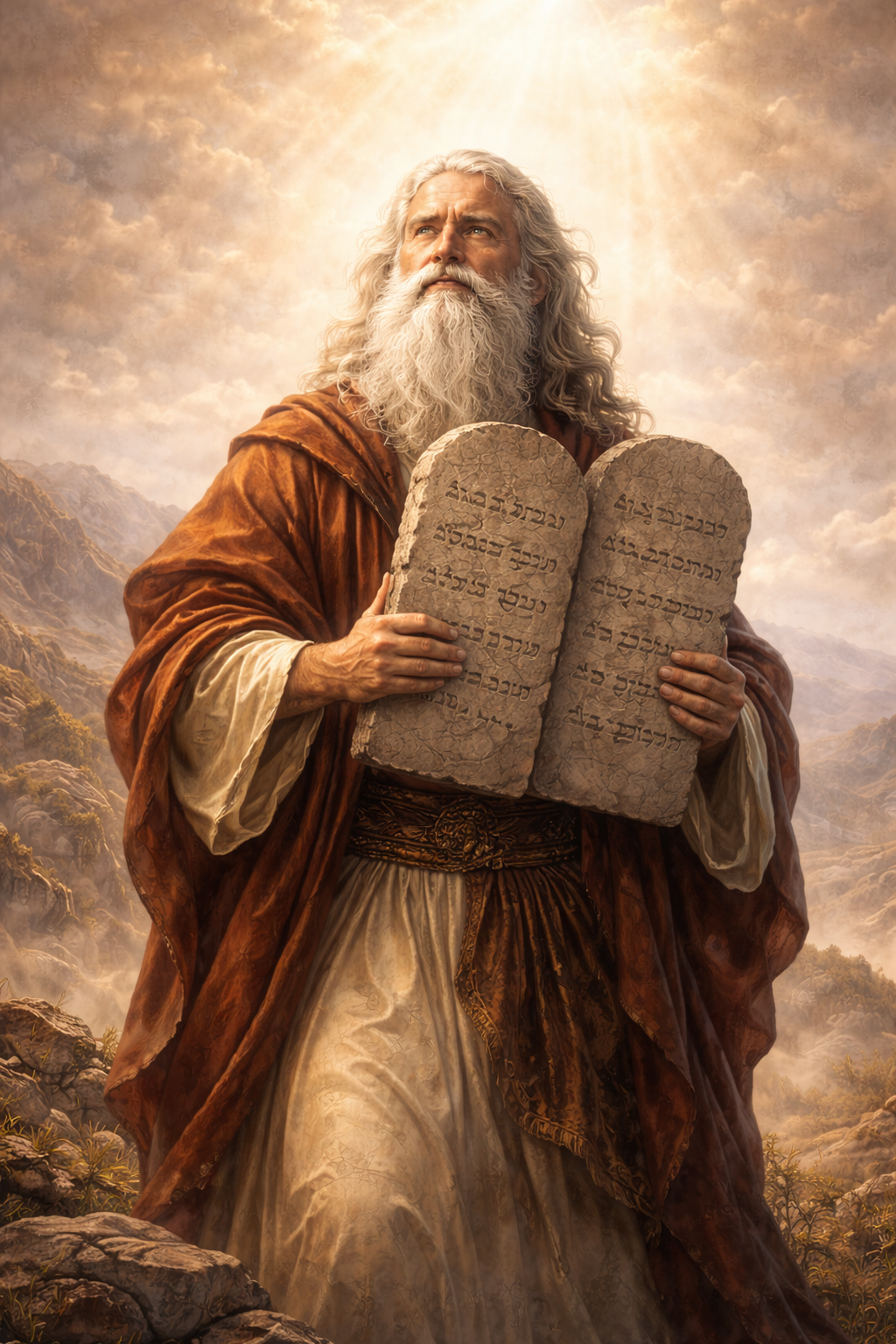
At Sinai, Exodus portrays Moses moving between the people and the mountain as Israel enters a covenant. The people hear the commandments prohibiting other gods, murder, adultery, theft, false witness, and coveting, while also requiring Sabbath rest and honor for parents. Moses acts as mediator when the people fear direct encounter. The narrative later describes detailed covenant laws and ritual instructions; it should not be compressed into the claim that Moses personally wrote every later line of the Pentateuch. Modern scholarship distinguishes the literary formation of these books from the Moses portrayed within them. The packet therefore records lawgiver and prophet as traditional titles, not as proof of single authorship.
The golden-calf episode exposes both Moses's fierce anger and his persistent intercession. While Moses is on the mountain, Aaron fashions a calf and the people worship it. Moses pleads that Israel not be destroyed, invoking the promises to Abraham, Isaac, and Israel. He then descends, breaks the tablets, destroys the calf, confronts Aaron, and orders action that the narrative says brings deadly violence within the camp. He returns to seek forgiveness for the people and later receives replacement tablets. The account supports prayerful advocacy but also requires candor about anger, punishment, and contested leadership.
Numbers preserves conflicts involving Moses's own family and authority. When Miriam and Aaron speak against him, the narrative says Miriam becomes afflicted while Aaron does not. Moses responds with the brief plea, “Please, not this! Please, heal her!” and the community waits during her exclusion. The unequal consequence has generated difficult questions that a responsible biography should not conceal. The scene nevertheless gives a concise, attributable example of Moses interceding for someone who had challenged him. It also keeps Miriam and Aaron visible as leaders and relatives rather than reducing them to assistants.
At Meribah, after the community lacks water, Moses and Aaron are instructed to speak to a rock. Moses instead addresses the people harshly and strikes the rock twice; water comes out, but the narrative says the leaders failed to manifest God's holiness. Moses is therefore told that he will not lead the assembly into the promised land. This consequence is part of the biblical portrait and prevents claims that every act of his leadership was exemplary. Later, when Moses learns that his death is approaching, he asks that a leader be appointed so the community will not be left without a shepherd. Joshua is commissioned before the assembly.
Deuteronomy presents Moses transferring leadership, speaking publicly to Israel, and commissioning Joshua to be strong and resolute. Its final chapter places him on Mount Nebo, where he views the land across the Jordan. It assigns him an age of 120, reports his death in Moab, and says that his burial place was unknown. Those age and place statements belong to the narrative and do not justify inherited dates such as 1525 or 1405 BCE. Nebo is a named regional setting, but the packet does not claim an exact viewpoint or grave. The text closes by remembering Moses as a prophet known face to face and associated with signs before Pharaoh.
Later Christian Scripture places Moses with Elijah at Jesus' transfiguration, documenting a major strand of Christian reception rather than another event in Moses's earthly chronology. Eastern Orthodox churches commemorate the Holy Prophet and God-seer Moses on September 4; the OCA life repeats traditional dates that this packet does not adopt as historical. Moses remains significant across Jewish and Christian traditions as liberator, mediator, lawgiver, intercessor, and prophet. The scriptural portrait is morally complex: he resists oppression, hesitates before vocation, advocates for the people, shares leadership, acts violently, loses his temper, and prepares a successor. That complexity makes careful attribution more faithful than either skeptical dismissal or devotional perfection.
Wondering how to weigh the stories and sources? Learn how to read a saint biography.
Prayers for Moses
Moses's prayer for Miriam
Please, not this! Please, heal her!