Biography
Nicholas the Pilgrim
About Nicholas the Pilgrim
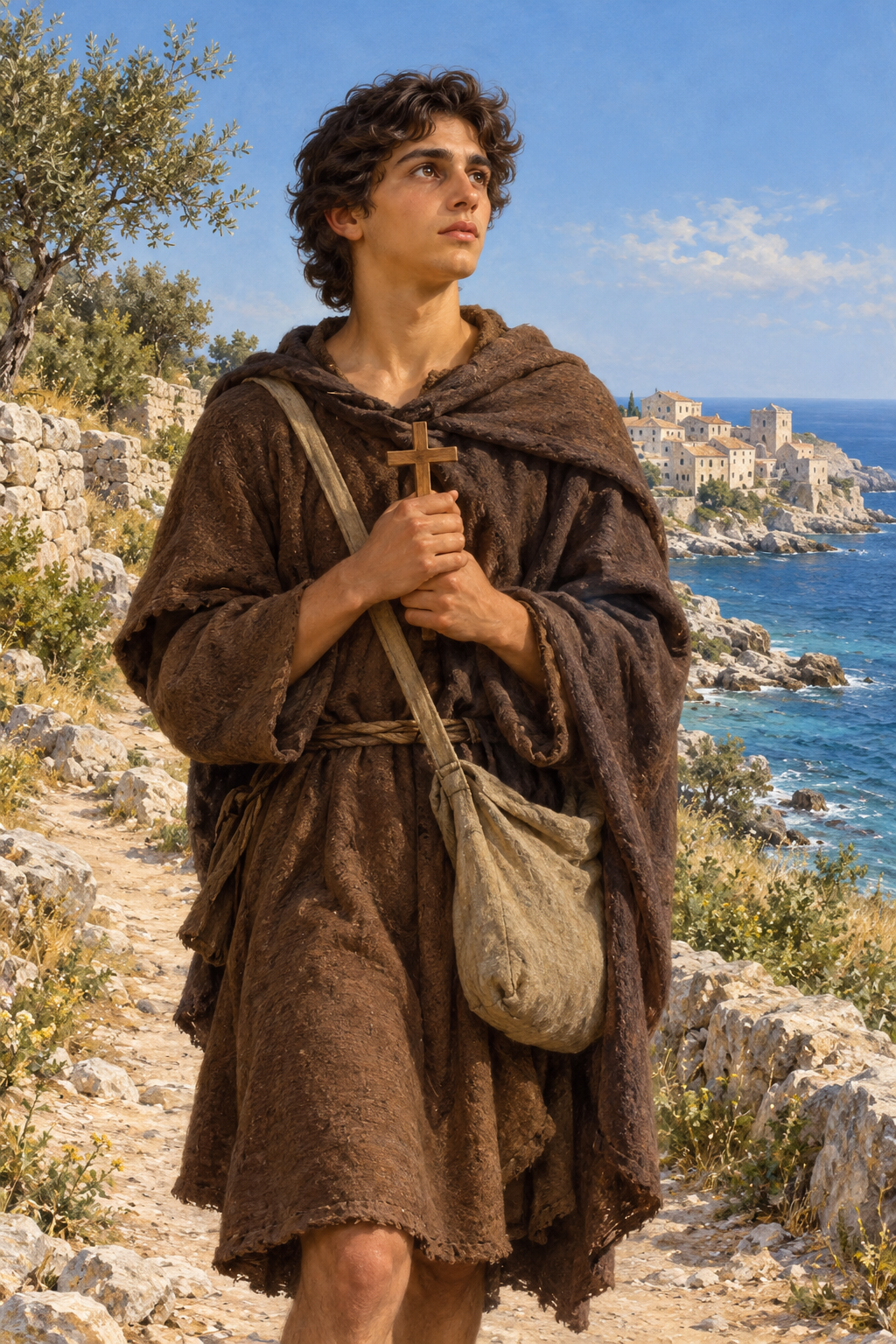
Nicholas the Pilgrim was a young Greek whose short journey through southern Italy left a lasting memory in Trani. Born at Steiri in 1075, he traveled with the intention of reaching Rome. He arrived at Trani on May 20, 1094, and died there on June 2. He was only nineteen. His repeated prayer, Kyrie eleison, meaning “Lord, have mercy,” became the distinctive feature of his remembrance.
His behavior could be difficult for those around him to understand. Frederick Lauritzen places him within the Byzantine tradition of holy fools and wandering religious figures. His time at the monastery of Hosios Loukas belongs to that background, although his later life was that of a pilgrim rather than an officeholder. The tradition presents an unsettled young man whose prayer accompanied his movements from place to place.
The archdiocese’s account describes a harsh reception at Taranto, where the bishop had him whipped because of his persistent cries. At Trani, Nicholas drew children around him, offered fruit and encouraged them to repeat his prayer. Archbishop Bisantius questioned him, recognized a religious purpose in his unusual behavior and allowed him to remain. Nicholas soon became ill and died. The contrast between punishment and welcome forms a central part of the Church’s account of his last days.
The surviving writings do not all tell the same part of his story. Antonio Borrelli distinguishes the account of his Greek life associated with his companion Bartholomew, Adelferius’s narrative of his arrival and death, and Amandus’s account of his recognition and the movement of his remains. These texts preserve different stages of his memory. A later Italian life also described another transfer of the body. They should be read as religious narratives with particular purposes, rather than as a single contemporary diary.
Amy Devenney’s study examines how those purposes shaped the miracle stories. Adelferius emphasized healings resembling those in the Gospels, presenting Nicholas as worthy of veneration. The account helped establish the reputation of someone who had spent only a short time in the city and whom many adults had regarded as mentally disturbed. That description records a medieval reaction; it does not provide grounds for a modern diagnosis. Devenney also places the promotion of his cult within Trani’s competition with nearby Bari for ecclesiastical standing.
Amandus wrote later, when the shrine was already established. His stories gave greater attention to the rescue of seaborne pilgrims. Devenney interprets this emphasis as an effort to draw travelers to Trani’s shrine, in a port through which pilgrims and crusaders passed. The reported rescues belong to the history of devotion, not independently verified voyages. The shift in emphasis helps explain why later remembrance includes concerns that reach beyond the young man’s own brief life.
Recognition came while the relationship between local bishops and papal authority in declaring saints was still developing. The archdiocese dates Nicholas’s canonization to 1099, after Urban II authorized Bisantius to act. Older summaries sometimes give 1098. The same diocesan account records the transfer of his remains to the basilica in 1142 and his inclusion in the Roman Martyrology in 1748. These later acts helped give a durable public form to the devotion that began at his death.
His remembrance has also encouraged contact between Catholic and Orthodox Christians. A diocesan chronology records exchanges between Trani and communities in Greece, including the naming of a square at Steiri in 2010. In November 2013, Bishop Siluan announced Nicholas as protector of the young people of the Romanian Orthodox Diocese of Italy. That patronage has a defined community and should not be expanded into an unsupported claim that he is patron of every young person.
The same chronology describes more than ceremonial visits. In 2012, representatives from Trani met religious leaders in Greece and discussed social relationships and vocational training for young people. Remembering Nicholas provided a reason to build those contacts. His journey between Greece and Italy could therefore be recalled through practical cooperation, as well as through worship and commemorative events.
A different dedication places his name within education. On January 12, 2001, Archbishop Giovan Battista Pichierri placed Trani’s Institute of Religious Sciences under Nicholas’s protection. The decree followed the institute council’s favorable recommendation and described the saint’s relevance to theological inquiry and church life. It explicitly named him as patron of both the city and the archdiocese.
The continuing devotion reaches beyond historical study. Vatican News reported plans for the 2023 patronal celebrations to bring the relics of Nicholas and Francis of Assisi to Trani’s men’s and women’s prisons. A Greek Orthodox delegation also participated in the wider celebration. In the accompanying interview, Friar Guglielmo Spirito emphasized Nicholas’s simple, repeated request for mercy and its significance across Christian divisions. The young traveler’s memory thus invites attention to prayer, hospitality and the ways a community receives someone it finds difficult to understand.
Wondering how to weigh the stories and sources? Learn how to read a saint biography.