Biography
Nimatullah Kassab
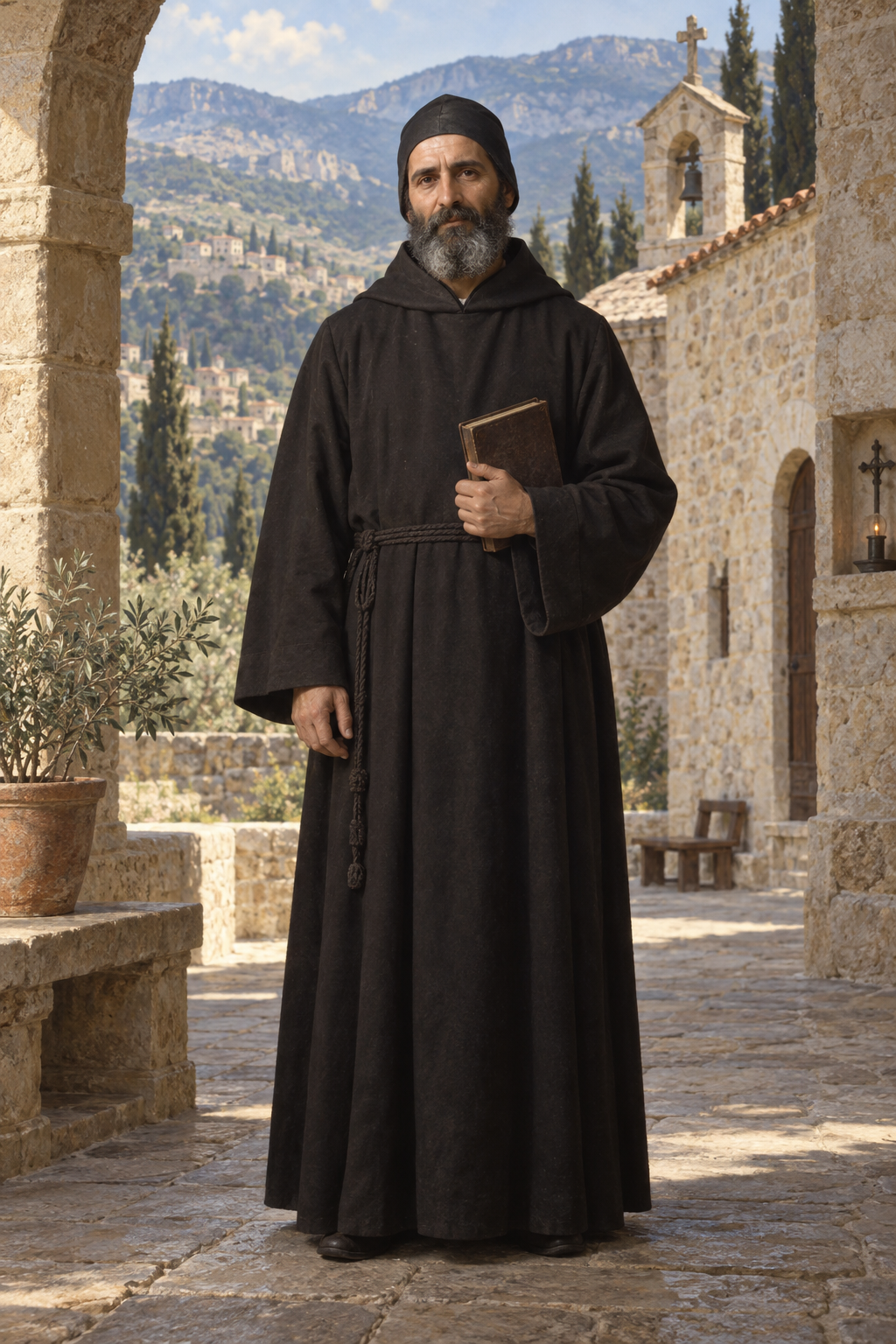
About Nimatullah Kassab
Youssef Kassab was born in 1808 in Hardin, Lebanon.
As a boy, Youssef attended the monastery school at Saint Anthony in Houb. The New Catholic Encyclopedia says he studied Arabic, Syriac, and mathematics and lived with his maternal grandfather, Youssef Ra’ad, a Maronite priest, while serving at Mass. That early schooling gave him a grounding in the languages and worship of his church before he joined the Lebanese Maronite Order.
Maronite Heritage places his earlier studies at Houb from 1816 to 1822 and his entry into the novitiate at Qozhaya in November 1828.
The Vatican biography says that, as assistant general, he urged monks to study at the Jesuit college in Ghazir.
He grew up in a Maronite Christian family and later entered the Lebanese Maronite Order, a monastic community rooted in the Syriac Christian tradition.
In 1828, at about twenty years of age, he entered the Lebanese Maronite Order.
He began his novitiate at Saint Anthony’s monastery in Qozhaya, where he learned communal prayer and manual work.
Nimatullah made his religious profession on 14 November 1830.
He was then sent to the monastery of Saints Cyprian and Justina at Kfifan to study philosophy and theology.
The Vatican biography dates his ordination to 25 December 1833.
The Vatican biography says that he became director of the scholasticate and taught moral theology for much of his remaining life.
He also accepted administrative service. The New Catholic Encyclopedia records three terms as assistant general of the Order and service as administrator at the monastery of Our Lady of Tamiche. Although his superiors considered him a recognized spiritual teacher, he declined appointment as abbot general. The choice reflects the distinction in the sources between accepting duties assigned by the community and seeking higher office for himself.
During civil conflicts in 1840 and 1845, Nimatullah suffered with his people. His brother Elisha invited him to a hermitage, but the Vatican biography reports that he preferred the shared discipline of community life.
The source accounts also portray him as living simply with his fellow monks and as continuing to teach while responsible for the scholasticate.
Administrative and scholarly work did not displace ordinary tasks. NCE says that alongside teaching and formation he bound books, sewed monastic habits, and performed parish duties around Kfifan. The combination of intellectual work and practical service helps explain why later biographies remember him not only as a teacher but also as a monk involved in the everyday needs of his house and its neighbors.
A further local Maronite account identifies Sharbel Makhlouf among the students formed at Kfifan, placing their teacher-pupil relationship in the years 1853–1858. It also records that Nimatullah was elected assistant general three times, in 1845, 1850, and 1856, while continuing to teach and bind books. This local account is used here for those institutional details only; its claims about miracles and the condition of his remains are not repeated.
Maronite Heritage gives three assistant-general terms as 1845–48, 1850–53, and 1856–58, and says that he continued teaching and bookbinding while serving in administration. The New Catholic Encyclopedia independently describes the same three terms and his refusal of the abbot-general post. Their accounts place his authority in service to the Order’s formation and monasteries, rather than in a separate public career.
At his beatification, John Paul II summarized the qualities for which the Maronite community remembered him: rigorous asceticism, extended prayer before the Blessed Sacrament, concern for theological research, and mercy toward his fellow monks. The homily sets these practices within his monastic life and the trials he endured. It is a contemporary ecclesial appraisal, not a neutral diary of daily routines, so this account reports those qualities as the Church’s public description of him.
At the 2004 canonization, John Paul II again described Nimatullah as a man of prayer devoted to the Eucharist. The pope emphasized his self-giving to the Lord and the way he welcomed and encouraged his fellow monks. These remarks document the qualities highlighted in the canonization liturgy and the continuing place of his example in the Maronite Order; they are kept distinct from the dated events of his life.
In December 1858, while teaching at Kfifan, Nimatullah became seriously ill.
It states that he died on 14 December 1858, aged fifty, at the monastery.
The beatification decree states that his cause began in 1926 at the Maronite Patriarchal Curia of Antioch, and that John Paul II beatified him in Rome on 10 May 1998.
He was canonized by the same pope on 16 May 2004.
The Vatican canonization list names him among those canonized on 16 May 2004.
His liturgical day is 14 December, the date of death.
Wondering how to weigh the stories and sources? Learn how to read a saint biography.