Biography
Osmund
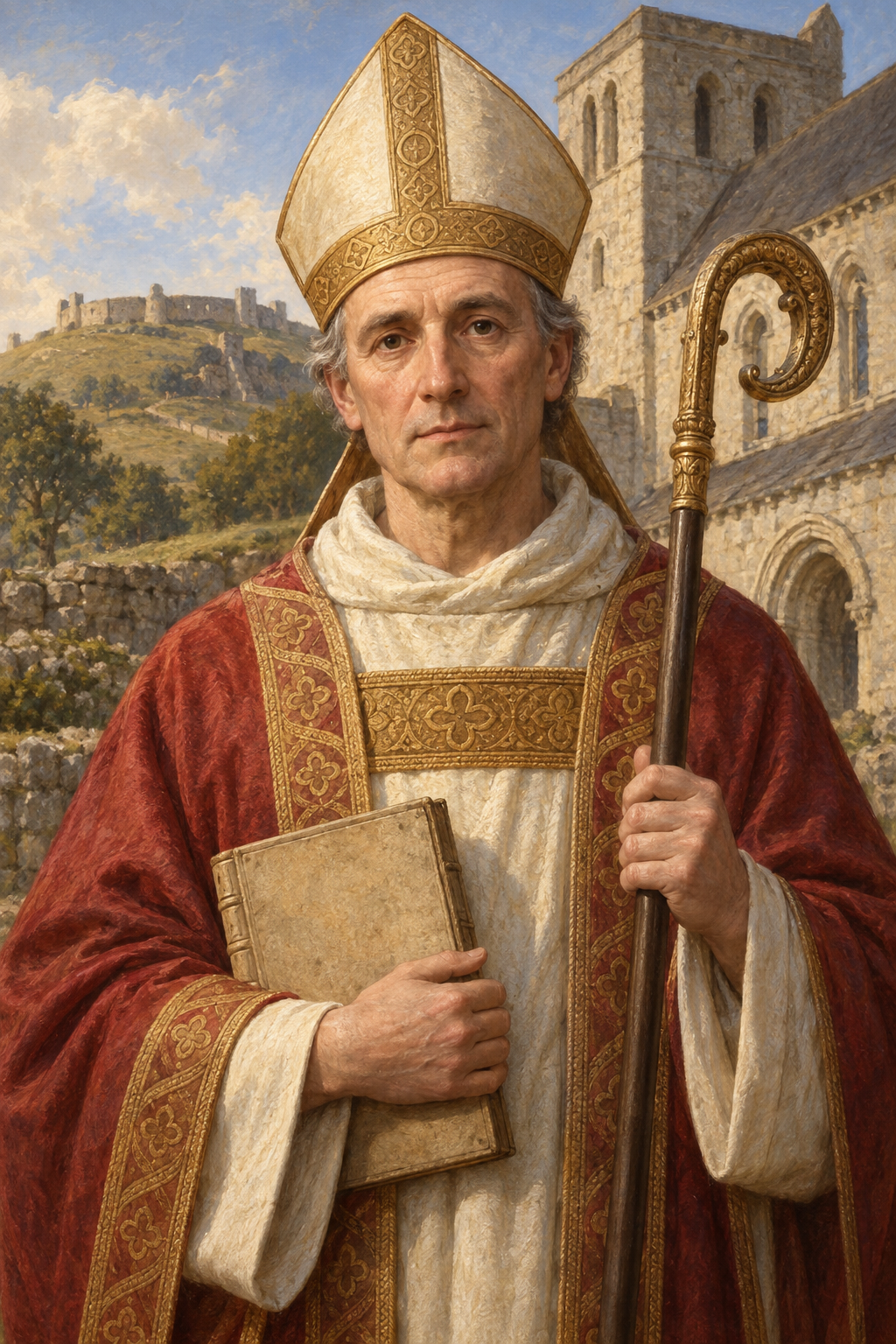
About Osmund
Osmund served as bishop of Salisbury at Old Sarum from 1078 until his death in 1099. His birth year is unknown. Later documents gave him aristocratic relatives and an earldom, but a historical review notes that his own foundation charter identified him simply as bishop. Claims about his early family therefore need caution. His clearest surviving work concerns the cathedral community he led, the charter that supported it, and the forms of worship that developed around it.The Salisbury see had been moved to Old Sarum after the Council of London in 1075. Herman was bishop during the first stage of that move, and Osmund succeeded him. The cathedral stood beside a royal stronghold on a hill, a setting that joined the work of a bishop to a powerful political center. English Heritage describes Osmund as central to completing the first cathedral and shaping its organization. Those are substantial, documented contributions without requiring the claim that he designed every part of the building himself. English Heritage places the cathedral in the northwestern part of the fortified enclosure, with a precinct for the canons and the bishop’s palace to its north. The layout puts the cathedral beside the seat of royal administration, where clergy also served as literate officials. The site continued to change after Osmund: his successor Roger enlarged the first cathedral, and Bishop Jocelyn later fitted out the expanded building and gave it a new west front. These later stages matter when viewing the surviving ruins. They prevent every stone, room, and practice at Old Sarum from being assigned to Osmund’s own years.Osmund's 1091 foundation charter assigned resources to the cathedral. Salisbury Cathedral describes this as the means by which a community of canons could grow around the church. The charter is more direct evidence for his episcopal work than late stories about noble ancestry. It shows a bishop providing durable support for common worship and administration. The cathedral archive still keeps a register containing charters and rules associated with Osmund, although the volume was assembled with later material. Its name should not be mistaken for proof that he wrote or compiled every item in it.The chapter at Old Sarum had defined offices and responsibilities. An older historical account names a dean, precentor, chancellor, treasurer, and canons, and describes their work in worship, learning, and the care of the diocese. Those offices helped the community outlast one bishop's lifetime. English Heritage identifies Osmund's charter and Institutio among the primary documents for this period. The organization of the cathedral, rather than a single memorable miracle, is the strongest reason that his name remained attached to Salisbury's early history.Osmund has also long been associated with the Use of Sarum, a collection of practices for cathedral worship. The association needs precise wording. Salisbury Cathedral explains that the Use developed after his death; English Heritage likewise describes several forms of the Customary assembled and revised over time. His own rules and the foundation he gave the community mattered to that history, yet the later liturgical collection was not a book composed in its final form by one man. The surviving sources show an evolving institutional tradition, with Osmund at its early stage.Medieval writers remembered Osmund as attentive to books and religious discipline. Kingsford's historical biography cites William of Malmesbury for the account that the bishop collected books and sometimes worked on them himself. This is a later witness to his character, not a contemporary diary. It fits the broader setting of a cathedral with a chancellor and a developing culture of study, but it should not be turned into an invented daily routine. The surviving charters and institutional records tell more about his public work than about his private thoughts.Osmund died in 1099 and was first buried at Old Sarum. His birth year and exact place of death remain unestablished by the sources used here. The cathedral community moved to a new site in the thirteenth century, and a record of the move says the remains of Osmund and two later bishops were carried to the new cathedral in 1226. This transfer shows that his memory belonged to the cathedral's identity as it left the hilltop. The date of the movement of remains should not be confused with his death or canonization.Pope Calixtus III announced Osmund's canonization in 1457, long after the bishop's lifetime and after generations had worshipped at the new cathedral. The cathedral records later shrines and the destruction of one during the Reformation. An older Roman martyrology remembers him on December 4 as a bishop and confessor. A Salisbury Catholic parish still keeps that day and calls him its city's patron. The enduring evidence of his life lies chiefly in the cathedral and chapter he helped establish, while the later devotion records how Salisbury continued to remember its early bishop.
Wondering how to weigh the stories and sources? Learn how to read a saint biography.