Biography
Oswald of Northumbria
About Oswald of Northumbria
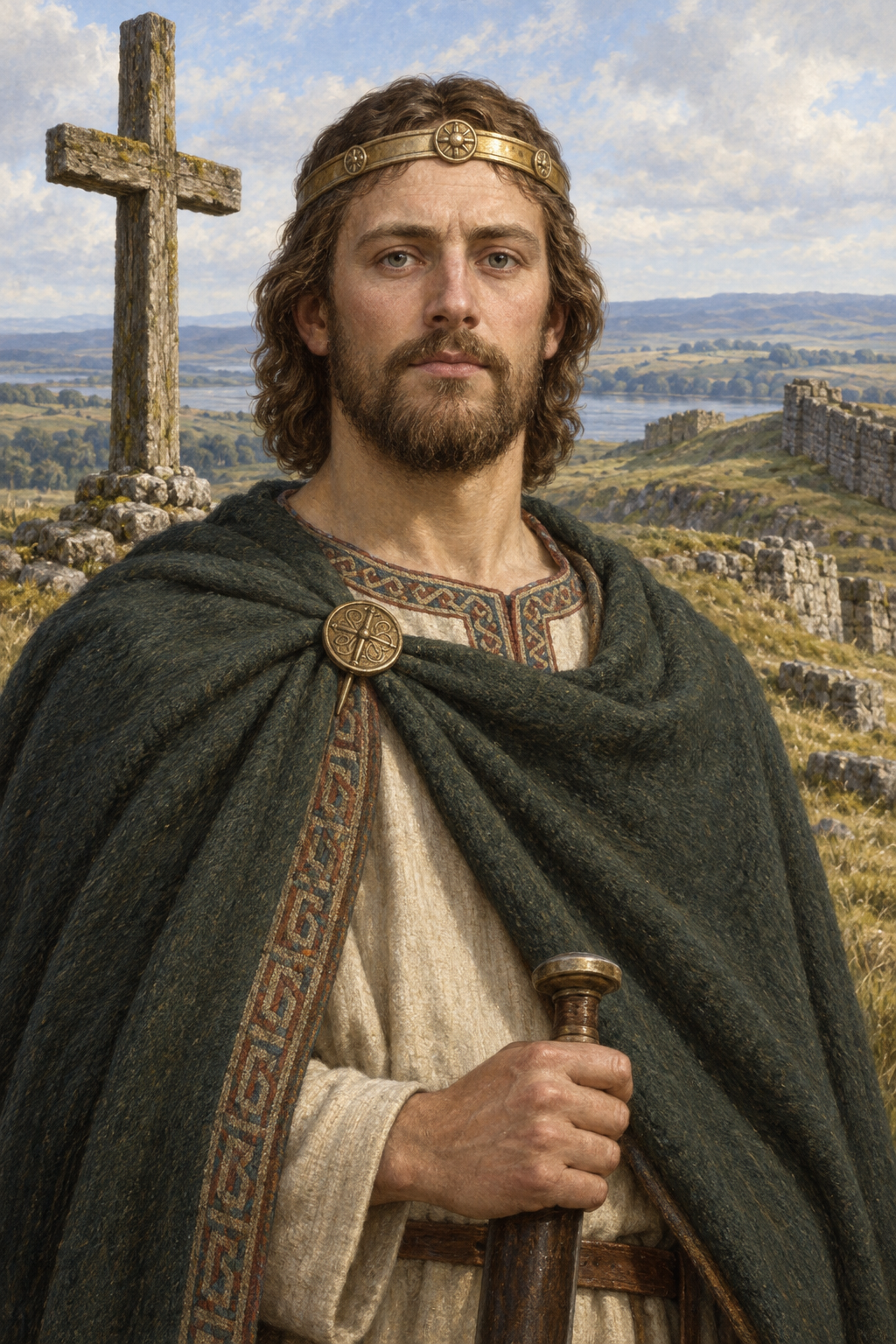
Oswald ruled Northumbria in the seventh century, when political power and the spread of Christianity were closely joined. Bede, a Northumbrian monk writing within the following century, is the principal early narrator of his life. Bede says Oswald was a son of Æthelfrith and had lived in exile among the Scots or Picts while Edwin ruled. There he and other exiles received baptism. When Edwin died and the kingdom was divided and disturbed by war, Oswald returned to lead the Bernicians. Bede tells this history as a Christian account of kingship, so his judgments about divine favor need to be read as his interpretation, alongside the events he records.The most familiar scene in Bede's account comes before Oswald's victory over the British ruler Cadwallon. Bede says Oswald raised a wooden cross near the Roman wall, held it steady while it was fixed in the ground, and called his soldiers to pray. The place became known as Heavenfield. Bede also reports healings attributed to the cross and describes a church and annual observance there in his own time. The cross episode speaks to how early Northumbrian Christians remembered the king's return. The reported cures belong to that devotional testimony, not to an independently confirmed medical record. Later accounts place the battle in 634, while Bede's translated chapter heading uses 635; this profile need not fix its day or year.After his victory, Oswald sought a bishop from the community in which he had known Christianity during exile. Bede says Aidan came to Northumbria and was given Lindisfarne as his episcopal center. Oswald helped him speak to the English court because the bishop did not yet know the English language and the king knew the language of the monks. Bede also records gifts of land and money for churches and monasteries. English Heritage independently identifies Aidan's Lindisfarne foundation in 635 as under Oswald's patronage. Oswald's role was therefore more than that of a distant sponsor: the early witness makes him a participant in communicating the new mission. This does not make him a bishop or the sole agent of conversion.The mission also brought practices that differed from those then followed by church leaders farther south, particularly the calculation of Easter. Bede admired Aidan's charity and preaching while criticizing the calendar that Aidan had learned. That tension matters in telling Oswald's story. It shows a Christian ruler building links with a monastic tradition available to him, rather than choosing between later labels for separate churches. Bede's account is also selective: it tells more about the religious meaning he saw in the kingdom than about the ordinary labor of its people. It is best evidence for the partnership between king and bishop, not a complete record of every conversion or every decision of government.Bede says Oswald joined the divided regions of Bernicia and Deira and exercised influence beyond them. He presents the king as generous to strangers and the poor. In one Easter story, a servant reported people waiting for alms while Oswald and Aidan were at a meal. Oswald ordered food and the silver dish that held it to be distributed. Aidan then blessed his hand; Bede joins this account to a later relic tradition. The story is an early witness to the charitable image attached to Oswald, but its dialogue and miraculous ending remain Bede's reported narrative. It does not establish a regular daily practice or a complete picture of royal resources.Oswald also appears in Bede's account of the West Saxon king Cynegils's baptism. Bede says he stood as sponsor to Cynegils and married his daughter, binding a religious event to a political alliance. That episode places Northumbrian Christian kingship in a wider English setting. It should not be turned into an assumption that Oswald directed the West Saxon mission; Bede attributes the preaching there to Bishop Birinus. The difference between sponsorship and preaching gives a more precise picture of Oswald's work. A ruler could give support and public standing to a mission while religious teachers carried out its instruction.Oswald was killed fighting the Mercian king Penda at Maserfield. The year is often given as 642, although Durham Cathedral gives 641 or 642, and the modern identification of Maserfield remains debated. His name became attached to reported healings at the battlefield and to relics remembered at Bamburgh and Lindisfarne. Bede describes such traditions in the years after the king's death. These passages are evidence that a cult formed early; they do not make every healing report independently demonstrable. Durham Cathedral describes the later journey of Oswald's head with Cuthbert's community, eventually to Durham. The story of the relics is part of the history of his veneration, distinct from the history of his reign.The Orthodox Church in America commemorates Oswald on August 5 and separately notes a June 20 translation of relics. An older Roman martyrology likewise names him on August 5 and directs readers to Bede's life. The March 20 page formerly linked to this profile is for Cuthbert: it mentions Oswald's head in Cuthbert's coffin and itself identifies August 5 as Oswald's day. A mention within another saint's life cannot establish Oswald's feast. His birth year and exact death place remain uncertain, while the historical and devotional record is clear that his patronage of Aidan's mission and the early memory of his kingship shaped Northumbrian Christianity.
Wondering how to weigh the stories and sources? Learn how to read a saint biography.