Biography
Pamphilus of Caesarea
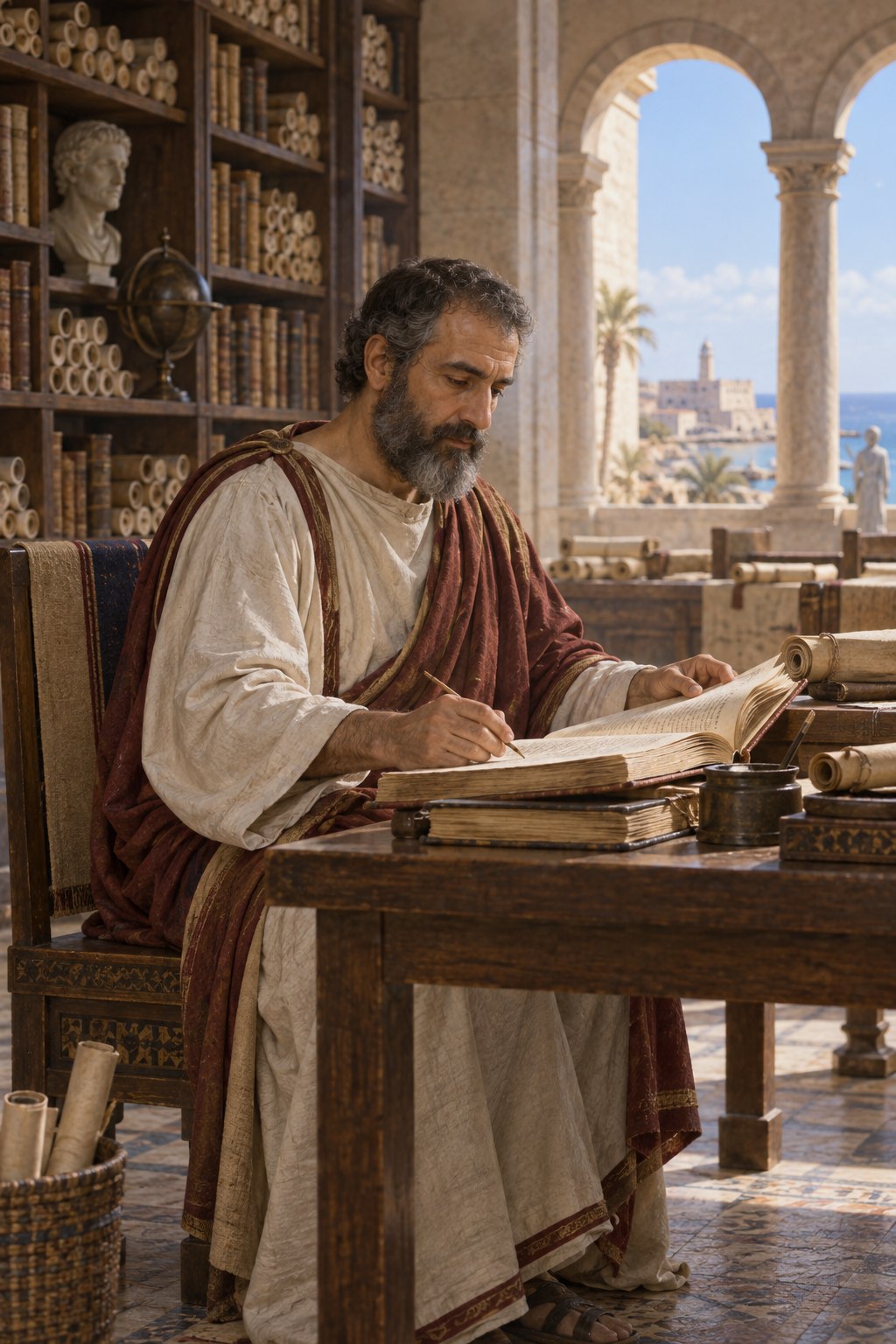
About Pamphilus of Caesarea
Pamphilus is known through a mixture of unusually close testimony and later reconstruction. Eusebius of Caesarea knew him, calls him a presbyter of that church, and says he had written a three-book Life of Pamphilus; that biography has not survived. Eusebius’s extant Church History and Martyrs of Palestine preserve only parts of the story. Jerome later referred to Pamphilus’s scholarly work, and modern historians have used these scattered witnesses to reconstruct the setting of his activity. The distinction matters: we have a strong outline of his public role, but not a continuous autobiography or independent account of every episode.The Catholic Encyclopedia’s synthesis, drawing on Eusebius’s Martyrs of Palestine and later witnesses, places Pamphilus’s family in Beirut and says that he received a good education before settling at Caesarea. It reports that he gave away his property to the poor and studied in Alexandria under Pierius. These details are plausible reconstructions from late antique literary testimony, rather than facts preserved in a contemporary civic record. The more secure point is his later position: Eusebius names him among the church’s presbyters, and describes him as a teacher whose learning and way of life drew a circle of students.Pamphilus’s most durable work was collaborative and material. He organized a library and school at Caesarea, where Christian readers could study Scripture and earlier theological writing. Modern scholarship describes this library as a project for gathering and preserving the works of Origen, whose teaching had already made Caesarea an important center of Christian learning. Jerome later said Pamphilus copied much of Origen’s work by hand and recalled the Caesarean collection as a resource. The library itself is lost, and its exact scale cannot be recovered from these notices, but its influence survives indirectly in the texts and scholarly networks associated with it.The same sources associate the library with careful biblical copying. Pamphilus and his associates compared and corrected manuscripts rather than merely accumulating books. The University of California Press study notes that Eusebius learned to copy manuscripts in this environment and later worked with Pamphilus on an apology for Origen. Jerome also remembered Pamphilus supplying poor students with necessities and giving them copies of Scripture. The narrative presents scholarly work as a shared church service: teaching, the circulation of books, and aid to readers all belonged to the same enterprise. It does not permit a reliable list of every student or manuscript Pamphilus handled.Pamphilus also wrote in defense of Origen. The surviving first book of the Apology for Origen is preserved only in a Latin translation made by Rufinus; the work is generally understood to have been composed with Eusebius, who added a further book. Its method was scholarly: it answered criticisms of Origen by citing his writings and arguing for their doctrinal soundness. The source history is complicated by later disputes over authorship and translation, so it is safer to call this a joint project than to assign every sentence to Pamphilus alone. His own treatises are otherwise lost.Persecution interrupted this work. Eusebius’s Martyrs of Palestine says that Pamphilus and companions had been imprisoned for two years before they were brought before the governor at Caesarea. Eusebius depicts Pamphilus as remaining steadfast and describes a younger member of his household, Porphyry, who asked that the prisoners’ bodies receive burial. The account is a near-contemporary Christian memorial written by Pamphilus’s friend; its speeches and dramatic details should be read as Eusebius’s presentation, not as a verbatim court transcript. Still, the broad facts of imprisonment and execution are central to the source’s narrative.The surviving chronology places Pamphilus’s death in 310, after his imprisonment began in 307. Eusebius’s narrative centers on his death with companions at Caesarea; modern scholarship notes that the older conventional date of 309 does not fit the two-year imprisonment chronology. This account therefore uses an approximate year rather than a day-level date. Later calendars keep separate commemorations for the group and for Pamphilus in different traditions, so the old catalog feast date has not been carried over automatically. His historical importance rests less on a detailed passion story than on the connection among Caesarean teaching, manuscript preservation, Christian charity, and martyrdom.Eusebius’s account also places Pamphilus within a wider network of Christian learners. The Catholic Encyclopedia, following Eusebius, identifies Apphianus and Aedesius as disciples who suffered during the same persecution. Their stories should not be folded into Pamphilus’s biography as though he directed every act they undertook; rather, they indicate how his teaching and personal example were remembered by later authors. The same source reports that Pamphilus distributed Scripture to people with limited means, including women devoted to study. Because these details come through a lost biography quoted by Jerome, they are evidence for the tradition around his school and charity, not a complete independent record of individual pupils.The afterlife of Pamphilus’s work is clearest in the fact that later readers continued to use the Caesarean collection. Jerome consulted manuscripts associated with the library and remembered Pamphilus as a copyist; Eusebius’s own historical writing drew upon a scholarly environment that Pamphilus had helped build. The collection did not survive intact, and its final fate is uncertain. What remains is a traceable chain of preservation: teachers collected and corrected texts, students copied them, and later authors cited or used those copies. This record makes Pamphilus significant not only as an individual martyr but as a contributor to the material infrastructure through which Christian literature was transmitted.
Wondering how to weigh the stories and sources? Learn how to read a saint biography.