Biography
Paola Elisabetta Cerioli
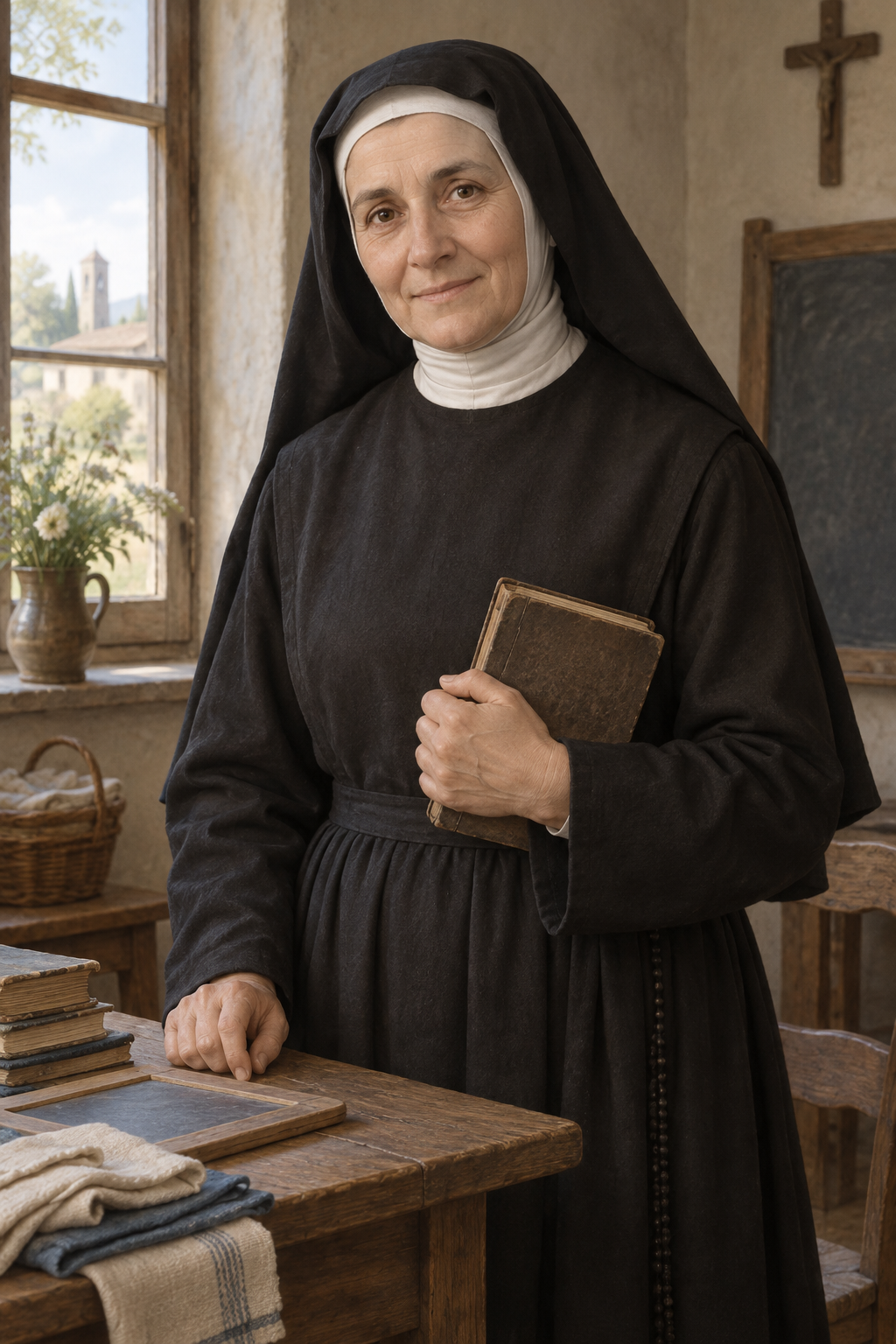
About Paola Elisabetta Cerioli
Paola Elisabetta Cerioli was born Costanza Cerioli in Soncino, in the province of Cremona, on 28 January 1816. Her family owned land and belonged to the local nobility. Historian Andrea Camilletti calls her the youngest of sixteen children and names her parents, Francesco Cerioli and Francesca Corniani. She attended a school run by Visitandine sisters at Alzano Lombardo. Such education gave a landowner's daughter opportunities many countryside children lacked. Her later work would focus on those children, but that outcome was not visible in childhood. Her life first followed the expectations of her household.
Costanza married Gaetano Busecchi at nineteen. Their four children died, as did her husband. The remembered words of son Carlo belong to devotional tradition, not a contemporary transcript.
The *New Catholic Encyclopedia* places Gaetano's death in 1854, after Carlo died earlier that year. It describes Costanza directing her wealth toward charitable work as she faced widowhood. She began helping poor families and receiving children into her home. Her resources made these actions possible, but her decisions also challenged the expected use of a landowner's estate. The story should not be made effortless: she had lost her husband and children, and her new work required both money and a change in the use of her house. A private residence was becoming a place of care.
The founding sisters' account describes Costanza opening her house in Comonte to two orphaned girls. The welcome led toward a commitment to rural children. A house, food, clothing, and adult attention were needed before any institute existed. The first guests changed what her estate was for. The sisters' account records resistance from family and acquaintances. Her project grew within those social constraints. Costanza's resources gave her freedom to act, but the direction she chose was shaped by children who needed a home and the women who came to help her.
The sisters' history places her work amid hardship in nineteenth-century rural Lombardy, as industrialization and urban growth changed the countryside. It describes her visits to sick and poor neighbors, then her plan for a rural school for girls around Comonte. Girls who entered her house needed more than shelter; they needed learning that could be used in their families and farms. Cerioli's response joined care with practical education. Her resources came from a privileged family, while the children she served were exposed to a different economy. The institute was a response to social conditions as well as to her own bereavement.
On 8 December 1857, Cerioli and women who had joined her established the Sisters of the Holy Family at Comonte. She later took the name Paola Elisabetta. The new community looked to the family of Jesus, Mary, and Joseph as a religious model, and its daily work centered on children whose own families could not support them. The founding did not begin the work from nothing: a house was already open, children had been received, and collaborators had gathered. An institute provided a lasting structure for that care. Official records date the sisters' foundation to 1857 and later recognize the men's branch as a related but distinct undertaking.
BeWeB describes an agricultural school attached to the girls' refuge. Cerioli wrote a short agricultural catechism in 1861, using brief questions and answers to teach general farming knowledge with religious meanings. The account says it was intended for girls who would return to their households and work in gardens and grain cultivation. That detail makes her educational purpose specific. She did not simply take children away from rural life; she tried to equip them for it. The source also notes that the sisters' own labor was integral to the institute, earning them a popular association with farming. The visible institution depended on daily work and instruction.
The chronology of Cerioli's work with boys is less settled than the sisters' foundation. Historian Andrea Camilletti says a male institution opened at Villa Campagna in 1861 with help from Giovanni Capponi. He describes later activity there in 1862 and 1863. Church accounts name 4 November 1863 for the men's institute. These may be different stages, but the sources do not explain the difference. The shared purpose is clearer than the day: care and education for rural children. Building the male work extended what had begun with girls at Comonte, and Capponi's part shows why its history cannot be credited to Cerioli alone.
Cerioli died at Comonte di Seriate, in the Bergamo area, on 24 December 1865. She was forty-nine. The formal canonization letter gives the place and date, and records that Pius XII beatified her in 1950. John Paul II canonized her on 16 May 2004. The rites express a Catholic judgment about her life, while the institutions she left offer a public measure of her work: organized care and education for children facing family loss and rural poverty. Her story includes marriage, motherhood, widowhood, and religious leadership. None of those parts should be reduced to a preparation for the next.
At the canonization, John Paul II spoke of Cerioli's attention to the strength and stability of families. His homily interpreted the Holy Family as her model; it did not make her work less practical. The orphanage, agricultural lessons, and two communities answered needs that could be seen in homes and fields. Her legacy remains concrete in the idea that care for children includes belonging, learning, and the resources to live. The people who joined her made that work durable after her death. The account is therefore also a history of collective labor, shaped by one woman's decision to open her home and organize others around the children it welcomed.
Wondering how to weigh the stories and sources? Learn how to read a saint biography.