Biography
Paul Chong Ha-sang
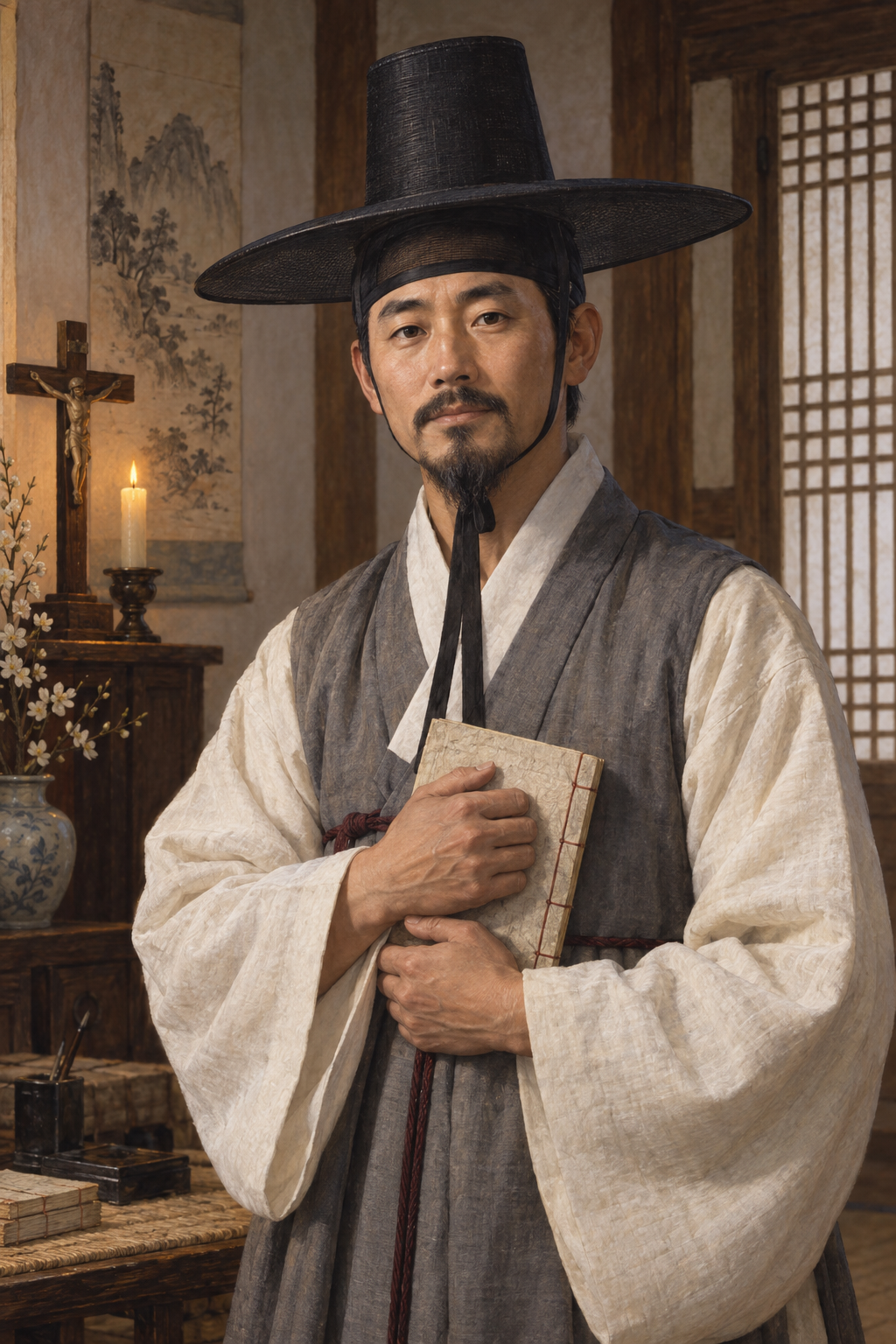
About Paul Chong Ha-sang
Paul Chong Ha-sang (Korean: 정하상, hanja 丁夏祥; b. 1794 or 1795, d. 1839) was a Korean **layman** — a catechist, church organizer and clandestine envoy — who held the proscribed Catholic community of Joseon Korea together through the four decades between the Sinyu Persecution of 1801, in which his father and elder brother were killed, and the Gihae Persecution of 1839, in which he, his mother and his sister died [S1][S7][S12][S17]. He was orphaned at about seven [S1][S12]. Attaching himself as a servant to an official interpreter on the annual Korean tribute embassies to Beijing, he crossed into China repeatedly — nine times, by one account — to beg the Bishop of Peking for priests, and in 1825 joined in a written appeal to the Pope asking for an ecclesiastical jurisdiction of Korea's own [S1][S7][S12][S16]. The **Vicariate Apostolic of Korea was erected on 9 September 1831**, detached from the Diocese of Peking, with Barthélemy Bruguière named its first vicar apostolic on the same day [S6][S7][S17]. When Bishop Laurent Imbert finally reached Korea, he taught Chong Ha-sang Latin and theology and was preparing him for ordination when the 1839 persecution broke out [S12][S17]. Arrested, Chong Ha-sang presented the authorities with a written defence of Christianity — the *Sang-jae-sang-seo* (상재상서), "Letter to the Prime Minister" — and was executed at about the age of 45, bound to a cross mounted on a cart [S7][S12]. He was beatified in 1925 by Pius XI and canonized on 6 May 1984 by John Paul II in Seoul, as one of the 103 Korean Martyrs [S4][S8][S12].
**Name collisions and identity confusions.** Three are consequential. First and most serious, **he is routinely conflated with St. Andrew Kim Tae-gon** (1821–1846), with whom he shares a memorial title; Andrew Kim was a priest and was martyred seven years later in a different persecution, and the two men's biographies must be kept strictly apart. Second, **he is confused with his own father, St. Chong Yak-jong (Augustine, 1760–1801)**, who is himself a beatified martyr — beatified 16 August 2014 by Pope Francis, with a feast on the same 20 September — and who was the author of the *Jugyo Yoji*, the first Catholic catechism written in the Korean alphabet [S14]. Father and son are distinct records. Third, **his uncle Chong Yak-yong (Tasan, 1762–1836)**, the most celebrated Silhak scholar of the Joseon dynasty, is frequently described in devotional literature as a Catholic; the scholarly position is that there is "no documentary proof" he was baptized and that he actively distanced himself from the faith [S15]. Do not record Tasan as a Catholic. Finally, his mother **St. Cecilia Yu So-sa** and sister **St. Elizabeth Chong Chong-hye** are separately canonized members of the same group of 103 and require their own records if the catalog ever carries them [S7][S17].
**1. Orphaned by the Sinyu Persecution of 1801 — 1801, at about age seven** *(featured)* His father, Chong Yak-jong (Augustine), a leading figure of the first generation of Korean Catholics and author of the first catechism composed in the Korean alphabet, was executed at Seosomun on 8 April 1801, aged 41 [S14]. Paul's elder brother died with him [S1][S12]. Vatican News states that the boy was seven at the time and that the double loss made him aware from the beginning of what the faith cost in Joseon Korea [S1]. The widow and surviving children were spared and withdrew to the countryside [S12]. *Confidence: documented for the father's execution and date [S14]; probable for the brother and for Paul's age at the time [S1][S12].* **2. Repeated clandestine journeys to Beijing — from roughly 1816 onward, into the 1820s and 1830s** *(featured)* Chong Ha-sang attached himself as a servant to an official interpreter attached to the annual Korean tribute embassy to Beijing — an unglamorous position that was also one of the very few legal ways for a Korean to leave the country [S1][S12]. Using it, he crossed repeatedly into China, reportedly **nine times**, to petition the Bishop of Peking to send priests to the priestless Korean Church [S7][S12]. He did not act alone: he is named alongside Augustine Yu Chin-gil and Charles Cho Shin-chol as the men who "made several visits to Beijing in order to find ways of introducing missionaries into Korea" [S16]. *Confidence: documented that he travelled repeatedly to Beijing for this purpose [S1][S12][S16]; probable for the figure of nine journeys, which rests on a single devotional source [S7].* **3. The 1825 appeal to the Pope and the erection of the Vicariate Apostolic of Korea — 1825 to 9 September 1831** *(featured)* Finding the Bishop of Peking unable or unwilling to supply Korea's need, Chong Ha-sang and his companions went over his head: in 1825 they sent a written appeal to the Pope, forwarded through the Bishop of Beijing, asking that Korea be given an ecclesiastical jurisdiction and clergy of its own [S1][S12]. On **9 September 1831 the Vicariate Apostolic of Korea was erected, detached from the Diocese of Peking**, and Barthélemy Bruguière of the Paris Foreign Missions Society was named its first vicar apostolic the same day [S6]; two devotional sources independently give the same date and attribute the outcome to the Korean laity's petitions [S7][S17]. **Get the mechanism right:** this was the *erection of a missionary vicariate*, not the creation of a diocese, and the causal claim that the Korean laymen's petitions produced it is the Korean Church's own account of the matter rather than a documented finding of the Roman decree. *Confidence: documented for the erection and its date [S6]; documented for the 1825 appeal [S1][S12]; probable, and devotional in origin, for the direct causal link between the two.* **4. Instruction under Bishop Imbert and preparation for the priesthood — 1836 to 1839** *(featured)* When French missionaries finally entered Korea, St. Laurent Imbert — appointed vicar apostolic on 26 April 1836 [S6] — took Chong Ha-sang as a student, teaching him Latin and theology and preparing him for ordination [S12][S17]. Two further sources describe him as a seminarian at the time of his death [S7][S11]. **He was never ordained**; the 1839 persecution intervened [S12]. Throughout this period and for the decades before it, his actual work was that of a **lay catechist and organizer**, reassembling the scattered Christians after 1801 and keeping them in the faith by example and by writing [S7][S8]. *Confidence: documented for the instruction under Imbert and the failure to reach ordination [S12][S17]; documented for Imbert's appointment date [S6].* **5. The *Sang-jae-sang-seo* — a written defence of Christianity presented to the government, 1839** *(featured)* Under arrest, Chong Ha-sang put his case in writing rather than merely enduring interrogation. He composed the ***Sang-jae-sang-seo*** (상재상서), conventionally rendered "Letter to the Prime Minister" — an apologia addressed to the highest civil authority arguing that the Catholic religion was no threat to the Korean state [S7]. The Wikipedia-derived account describes the same act without naming the work: he "gave the judge
Wondering how to weigh the stories and sources? Learn how to read a saint biography.