Biography
Paul of the Cross
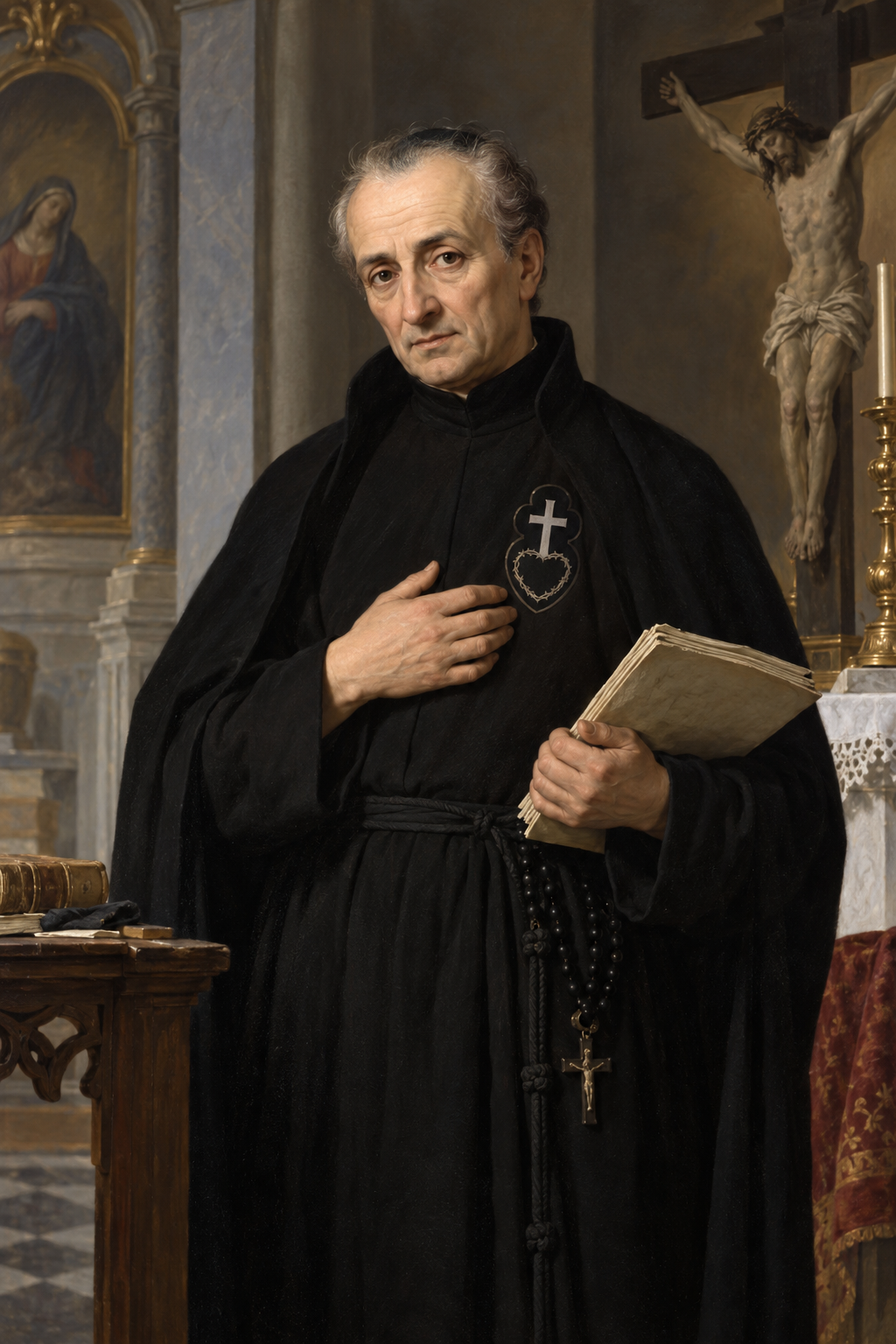
About Paul of the Cross
**Paolo Francesco Danei**, in religion **Paolo della Croce** and in English **Paul of the Cross**, was an Italian priest, preacher of popular missions, spiritual director and mystical writer, and the founder of the **Congregation of the Passion of Jesus Christ** (the **Passionists**, C.P.) and of the enclosed **Passionist Nuns**. He was born on **3 January 1694** at **Ovada** — today in the Province of Alessandria in Piedmont, but in 1694 under the **Republic of Genoa** [S2][S5][S6] (see `## Dates and places` for the conflict with sources that say "Piedmont" or "Duchy of Savoy") — to **Luca Danei** and **Anna Maria Massari**, a large and pious family of modest and declining means [S6]. His vocation is dated by the *Dizionario Biografico degli Italiani* to **1713**, at Cremolino, under the impression of a carnival-season sermon [S6]; in 1715 he briefly enlisted in response to a papal appeal against the Turks [S6][S23]. In the autumn of **1720** the bishop of Alessandria, **Francesco Maria Arborio di Gattinara**, clothed him in a black habit (22 November 1720 per [S3]), and in a retreat in a cell at Castellazzo between late November 1720 and **1 January 1721** he wrote the Rule of the community he intended to found [S1][S4]. He was ordained priest by **Benedict XIII** in **St Peter's Basilica on 7 June 1727** [S1][S6].
The rest of his life is the history of the Congregation. The first canonically established retreat house was opened on **Monte Argentario** in Tuscany in **1737** [S1][S4]; **Benedict XIV** approved the Rule by rescript on **15 May 1741** [S2][S3][S6] and by Brief on **18 April 1746** [S6]; Paul and three companions professed simple vows and first wore the Passionist Sign on **11 June 1741** [S3][S4]; he was elected **superior general at the first general chapter on 10 April 1747** [S2][S5][S22]; **Clement XIV** approved the Rules solemnly by the bull *Supremi apostolatus* on **15–16 November 1769**, giving the Congregation the full standing of a religious institute [S3][S4][S6]; the enclosed **Passionist Nuns** were founded at **Corneto** (modern **Tarquinia**) on **3 May 1771** with **Ven. Maria Crocifissa Costantini** [S2][S3]; in **1773** the Congregation received the complex of **Santi Giovanni e Paolo** on the Caelian in Rome [S6]; and **Pius VI** approved the last revision of the Rule by the bull *Praeclara virtutum exempla* on **15 September 1775** [S6], a month before Paul died there on **18 October 1775** [S1][S2][S5][S6]. He left an unusually large body of writing for a figure of his kind: **more than two thousand letters**, most of them letters of spiritual direction, survive [S1][S22], together with a spiritual diary, the Rules and Constitutions, and a treatise on "mystical death" [S6]. He was **beatified by Pius IX** (1 October 1852 or 1 May 1853 — contested, see above) and **canonised by Pius IX on 29 June 1867** [S1][S2][S5][S7].
**On identity.** Four mechanical hazards apply, and three of them are severe. First, **"Paul" alone is useless as a key** — the catalog already holds Paul the Apostle at ID 56, and the backlog holds Paul VI and Paul Chong Ha-sang. Second, **"of the Cross" is not a discriminator either**: John of the Cross (ID 104) shares the construction, shares the association with spiritual darkness, and is far better known in English-language spirituality. Any search index that tokenises on "Cross" will collide. Third, **he is routinely confused with his own congregation's later members** — Vincent Strambi (1745–1824), Gabriel Possenti, Gemma Galgani, Dominic Barberi and Charles of Mount Argus are all Passionists with their own cults; Strambi in particular is the man who wrote the first life of Paul and is often the actual source behind statements attributed to "the Passionists" [S17][S19]. Fourth, **the "Passionist Sisters" are not his foundation**. The contemplative **Passionist Nuns** at Corneto/Tarquinia (1771) are his [S2][S3]; the active **Sisters of the Cross and Passion**, founded in 1852 by Fr Gaudentius Rossi with Elizabeth Prout in England, are a different institute that postdates him by three-quarters of a century [S4]. Devotional pages merge the two freely; the record should not.
` §2 and `## Open questions`. > **(2) The beatification date is genuinely contested and the dossier does not resolve it.** The 1911 *Catholic Encyclopedia* gives **1 October 1852** [S5] and the body text of English Wikipedia repeats it [S1]. The Dicastery for the Causes of Saints' own page [S7], Italian Wikipedia [S2] and the English Wikipedia **infobox** [S1] give **1 May 1853**. The likeliest reconciliation — a decree in October 1852 and the ceremony in St Peter's in May 1853 — is **a hypothesis, not a finding**. Do not silently pick one. See `## Date canonized`. > **(3) The prolonged spiritual desolation is reported here as he and his tradition described it, and is not a condition to imitate.** The widely repeated figure of a **45-year** "dark night" was found in this pass only in an **uncited** sentence on Wikipedia [S24]. It is not established. What *is* documented is that he wrote a treatise titled *Trattato della morte mistica* (c. 1760) [S6] and that his earliest printed biography describes him "tormented with doubts, scruples, and temptations" while others thought him serene [S18]. The catalog must not present desolation as an achievement or a devotional goal, and must not retrospectively diagnose it as a psychiatric condition. It is his own account of his interior life. > **(4) The state of the remains is not established.** Italian Wikipedia records only that his mortal remains have been kept in a chapel of the Basilica of SS. Giovanni e Paolo, Rome, **since 25 April 1880** [S2]. **No source reached here describes the body as incorrupt, nor as a wax or silver effigy.** Do not import either claim. A single fetch of the Passionist historical museum page appeared to mention a death mask; **a second, verbatim-quotation fetch of the same page did not contain the word** and the claim is treated as a summariser artefact. See `## Open questions`. > **(5) Collisions — this is the highest-risk field in the record.** **Paul the Apostle is catalog ID 56 and is a completely different person** (first century, Tarsus; not a founder of anything called the Passionists). **Paul VI** and **Paul Chong Ha-sang** are separate entries in this same backlog and must not be merged with him or with each other. **John of the Cross (catalog ID 104)** is a different man in a different century and a different order — a sixteenth-century Spanish Carmelite, Doctor of the Church — whose name is the same in form ("*X* of the Cross") and who is also associated with the "dark night". The two are constantly conflated in exactly the place this dossier is weakest. Further afield, guard against **Paul of Thebes** (the first hermit), **Paul of Samosata** (a condemned third-century bishop — the New Advent article at `/cathen/11589a.htm` is *his*, not this man's [S28]), **Paul Miki**, and **Vincent Strambi** (his disciple and first biographer, himself a canonised Passionist [S19]).
Wondering how to weigh the stories and sources? Learn how to read a saint biography.