Biography
Paul VI
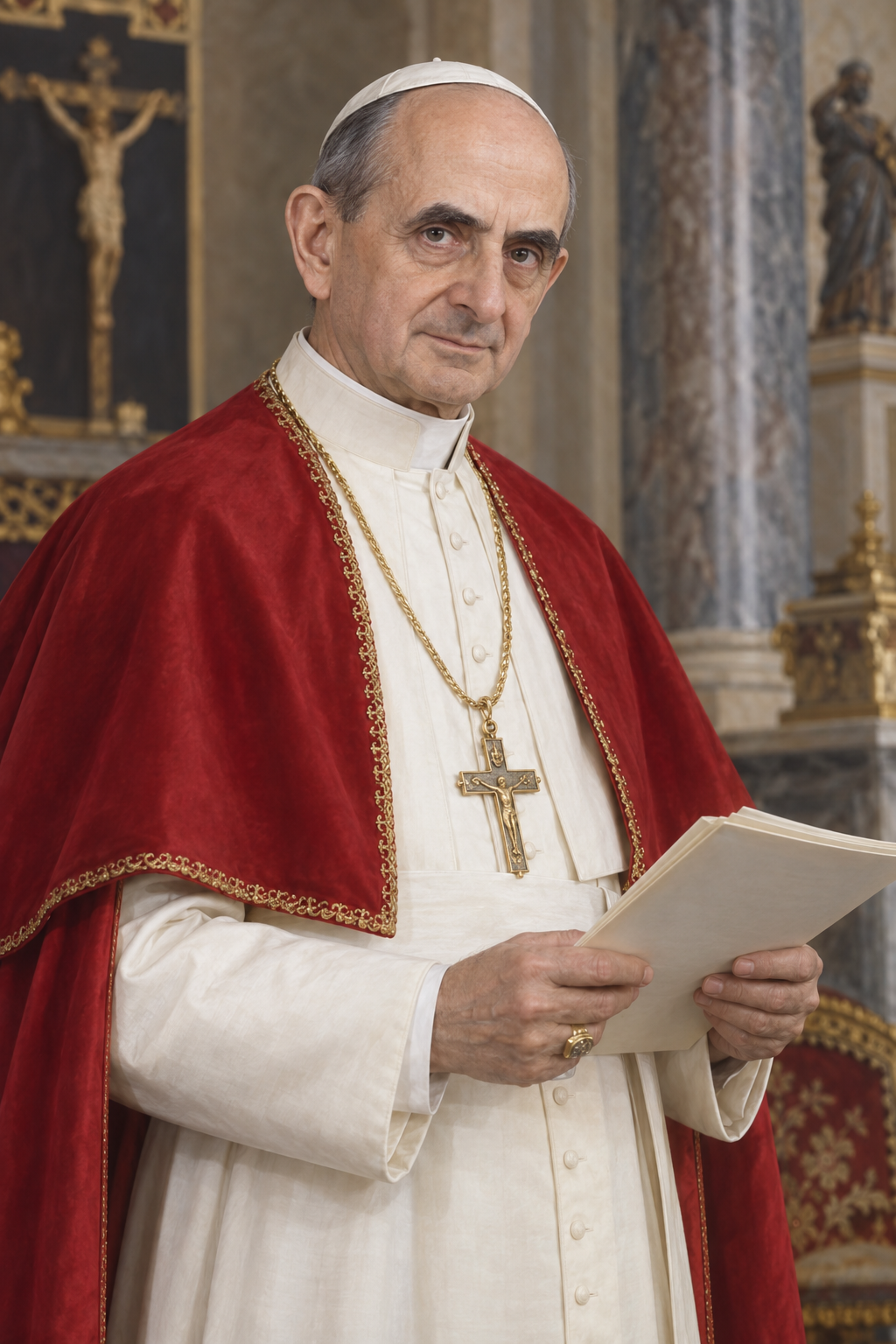
About Paul VI
`. > **(f) The portrait must be a likeness, not a reconstruction.** He is one of the most photographed and filmed human beings of the twentieth century. Any "devotional reconstruction" of his face would be an error. See `## Historical depiction`, and read the note there about depicting him **crowned**, which is not a neutral choice.
---
**1. Election and coronation; the last crowned pope (21 and 30 June 1963) — featured** *Confidence: documented.* Montini was elected on 21 June 1963, seven months into the Second Vatican Council and two and a half weeks after the death of John XXIII [S1][S26]. He was crowned on 30 June 1963 with a tiara given by the people of Milan, in the traditional rite — obeisance of the cardinals, the *sedia gestatoria*, the burning flax and the words *sic transit gloria mundi*, and the imposition of the triple crown [S20][S21]. **He is the last pope to have undergone that rite**; John Paul I replaced it with an inauguration Mass and no successor has been crowned [S21]. Within eighteen months he had abandoned the tiara himself (event 3).
**2. The Council: reconvened, concluded, implemented (29 September 1963 – 8 December 1965, and after) — featured** *Confidence: documented.* He reconvened the Council for its second session on 29 September 1963 and closed it on 8 December 1965 [S1]. The last three of its four sessions, and all sixteen of its promulgated documents in their final form, belong to his pontificate. He then spent thirteen years implementing it through legislative acts: the Synod of Bishops (15 September 1965) [S11], the reform of the Roman Curia in *Regimini Ecclesiae Universae* (15 August 1967) [S12], the reform of the papal household in *Pontificalis Domus* (28 March 1968) [S13], the revised calendar (14 February 1969) [S2], the revised Missal (3 April 1969) [S9], the suppression of the minor orders and the institution of the lay ministries of lector and acolyte in *Ministeria Quaedam* (15 August 1972) [S13], and the conclave legislation of *Ingravescentem Aetatem* (20 November 1970) and *Romano Pontifici Eligendo* (1 October 1975) [S12][S13]. **CONTESTED:** whether this body of legislation faithfully executed the Council or exceeded it is precisely the question at issue between his defenders and his traditionalist critics. The catalog should state the acts and their dates — which are not in dispute — and describe the argument as an argument. Sources: [S1][S2][S9][S11][S12][S13]
**3. Renunciation of the tiara (1964; exact day unverified) — featured** *Confidence: documented as to the act and year; the day is unverified.* Near the end of the Council's third session in 1964, Paul VI came down from the papal throne in St Peter's and laid his tiara on the altar, "as a sign of the renunciation of human glory and power" [S20]. The crown was subsequently sold and the proceeds given to the poor; it was bought by American Catholics and is displayed today in Memorial Hall at the Basilica of the National Shrine of the Immaculate Conception in Washington, DC [S20]. The gesture was of a piece with a series of suppressions: he abolished the *flabella* (the ceremonial ostrich-feather fans), the tufted papal fascia and the hood of the mozzetta [S22], and reorganised the papal court out of existence in *Pontificalis Domus* [S13]. **This event is the reason the depiction section below carries a warning** — see `## Historical depiction`. Sources: [S13][S20][S21][S22]
**4. Lifting the anathemas of 1054 with Patriarch Athenagoras I (7 December 1965) — featured** *Confidence: documented.* Paul VI had met the Ecumenical Patriarch Athenagoras I in Jerusalem in January 1964, during his first journey outside Italy — the first meeting of a pope and an ecumenical patriarch in over five centuries [S1][S28]. On 7 December 1965, the day before the Council closed, the two issued a joint declaration in which they "regret and remove both from memory and from the midst of the Church the sentences of excommunication" of 1054 and "commit these excommunications to oblivion," together regretting "the offensive words, the reproaches without foundation, and the reprehensible gestures" of that period [S10]. The declaration was read simultaneously in St Peter's and at the Phanar. **It did not restore communion and it produced no Orthodox calendar commemoration of Paul VI** (see `## Feast days by tradition`), but it is the single most consequential ecumenical act of his pontificate. Sources: [S1][S10][S28]
**5. *Humanae Vitae* and its reception (25 July 1968) — featured** *Confidence: documented as to the act; CONTESTED as to its meaning and effect.* After a papal commission on birth regulation — begun under John XXIII with six members and enlarged by Paul VI to some fifty-eight — submitted a majority report in 1966 favouring a change of teaching and a minority report opposing one, Paul VI decided against the majority and issued *Humanae Vitae* on 25 July 1968 [S8][S24]. The encyclical excludes as unlawful "any action which either before, at the moment of, or after sexual intercourse, is specifically intended to prevent procreation" [S8]. The reception split along visible lines. **Critics:** the theologian Charles Curran led a dissenting statement within two days of publication, arguing that spouses could in some circumstances responsibly judge contraception permissible; the Canadian bishops' *Winnipeg Statement* of 27 September 1968 held that Catholics unable to accept the teaching should not be regarded as cut off from the Church; Cardinal Suenens questioned whether the manner of the decision honoured the Council's teaching on collegiality [S24]. **Defenders:** the teaching was reaffirmed by John Paul II and developed in his catechesis later known as the Theology of the Body [S24]; Paul VI is reported to have said that in twenty years they would call him a prophet [S1]. The catalog should **name the parties and report the positions**, and should not resolve the question. Sources: [S8][S24][S1]
**6. The Manila attack and the great journeys (1964–1970; attack 27 November 1970)** *Confidence: documented.* He was the first pope to fly and the first to reach six continents [S1]. The Holy See's own list gives the Holy Land (1964), India (1964), New York and the United Nations (1965), Fátima (1967), Istanbul, Ephesus and Smyrna (1967), Bogotá (1968), Geneva and the ILO (1969), Uganda (1969), and the long 1970 journey through West Asia, Oceania and Australia [S28][S29]. On 27 November 1970, on arrival at Manila airport, a man with a knife attempted to kill him and was stopped by his private secretary, Pasquale Macchi [S1]. He made no further international journey after 1970 [S29]. His address to the UN General Assembly on 4 October 1965 — the first by a pope — is the best-remembered moment of the series [S29]. Sources: [S1][S28][S29]
---
Wondering how to weigh the stories and sources? Learn how to read a saint biography.