Biography
Paulinus of Nola
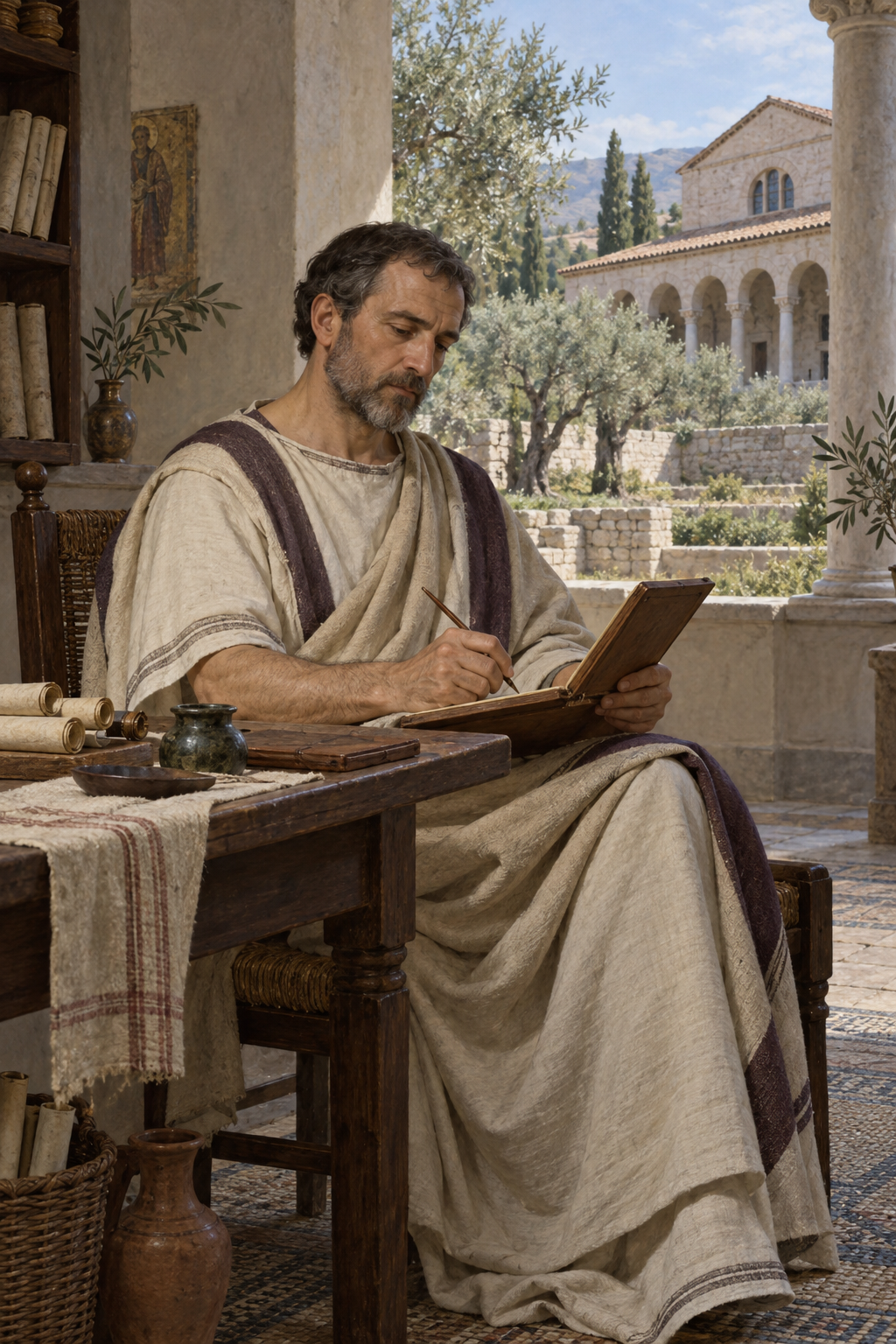
About Paulinus of Nola
Paulinus was born at Bordeaux, in Roman Gaul, around 354, into an influential Gallo-Roman family. His education was entrusted to the poet Ausonius, whose literary influence is visible in Paulinus’s later writing. Paulinus followed a public career and governed the province of Campania, where he encountered the cult of Felix, a martyr whose shrine stood near Nola. The surviving record is unusually rich because Paulinus wrote extensively and maintained correspondence with contemporaries. His own letters and poems sit alongside later church histories, allowing modern readers to compare a self-presented voice with the later memory of a bishop and saint.His transition from public office to Christian asceticism unfolded over several years rather than in a single moment. Paulinus married Therasia, a Christian woman from Spain; later accounts say they lost their infant son after eight days. The couple’s grief and spiritual searching became part of the traditional explanation for their withdrawal, but the secure evidence is the life they chose afterward. Paulinus was baptized at Bordeaux by Bishop Delphinus, according to the historical synthesis, and he later described his conversion and spiritual friendships in correspondence. Pope Benedict XVI emphasizes how his teacher Ausonius reacted to his decision to give his wealth to the poor and turn away from conventional ambition.Around 394 or 395, while in Barcelona, Paulinus was ordained presbyter. He then moved with Therasia to Nola and made the sanctuary of Felix the center of their religious life. The decision linked personal devotion to a public ministry: Paulinus improved access to the shrine, built a hospital, and contributed to churches and water infrastructure. The exact sequence and scale of these projects come mainly from literary witnesses, including Paulinus’s own letter to Sulpicius Severus. In that letter he describes the basilicas, porticoes, inscriptions, paintings, and devotional spaces he had constructed. It offers first-person evidence for a patron who treated architecture and art as teaching tools for pilgrims.Paulinus’s choice of Nola shaped his identity. He wrote annual poems for the feast of Felix, praising the martyr while explaining his own devotion to Christ. These poems are not neutral chronicles: they are literary and devotional works composed for a recurring festival. Yet they preserve concrete information about pilgrimage, the shrine, and the community that gathered there. The Vatican account notes that Paulinus enlarged the sanctuary and designed its paintings as visual catechesis. The poems and buildings therefore joined two forms of communication: carefully crafted Latin verse for readers and public images for visitors who might not have had access to books.His election as bishop came around 409, after the previous bishop’s death. The Holy See’s account describes a pastor attentive to poor people, whom Paulinus welcomed into the monastic community and called his “masters.” That phrase, preserved through references to his own letters and poems, captures how charity informed both his household and pastoral leadership. He continued to live within an ascetic community while serving the local church. The surviving sources do not support every later story about his activities, but they show a bishop whose spiritual practice included hospitality, care for the poor, liturgical life, and sustained engagement with scripture.His circle of correspondence connected communities across the western Mediterranean. Paulinus wrote to Augustine, Jerome, Ambrose, Sulpicius Severus, and other bishops and ascetics. In a surviving letter with Therasia to Augustine, the couple address him as a spiritual brother and describe Christian friendship as a bond that persists across physical distance. Such language is theological, but it also supplies direct evidence for Paulinus’s household, literary relationships, and the circulation of ideas between Nola and North Africa. His surviving correspondence is a window onto networks of late antique Christian life rather than simply a record of private devotion.Paulinus died at Nola on June 22, 431, after about two decades as bishop. His reputation rests on several intersecting legacies: an aristocrat’s rejection of a public career, an ascetic’s devotion to Felix, a bishop’s service to the poor, and a poet’s surviving work. The sources do not require the later legendary image of a wonder-worker to make his historical significance clear. His own writing remains the strongest evidence for his thought, while the Vatican and scholarly accounts help place that writing within the social and religious world of late Roman Italy.The surviving record also shows a more complicated relationship to his former literary world than a simple rejection of poetry. Ausonius’s criticism survives in the form of poems addressed to Paulinus, while Paulinus answered through verse and correspondence. Later Christian poems did not erase his classical education; they redirected its forms toward scripture, martyr commemoration, and theological reflection. The Vatican audience summarizes that change as a new poetic inspiration rather than the abandonment of his literary craft. Because both the early exchange and later works are literary compositions, they reveal how Paulinus and his correspondents framed his conversion, but they should not be read as unfiltered transcripts of private feeling.Paulinus’s letters also help correct the impression that his retreat was purely solitary. Letter 6 to Augustine is jointly signed by Paulinus and Therasia, and its plural voice presents their household as part of an extended network of spiritual kinship. Other letters describe exchanges of books, visits, buildings, and prayers among people separated by long distances. The Oxford summary emphasizes that Paulinus’s social connections and education were decisive both in his earlier public career and in his later church life. His correspondence is therefore evidence not only of theological ideas but also of practical relationships: messengers carried letters, friends shared texts, and communities learned about one another through writing.
Wondering how to weigh the stories and sources? Learn how to read a saint biography.