Biography
Pope John I
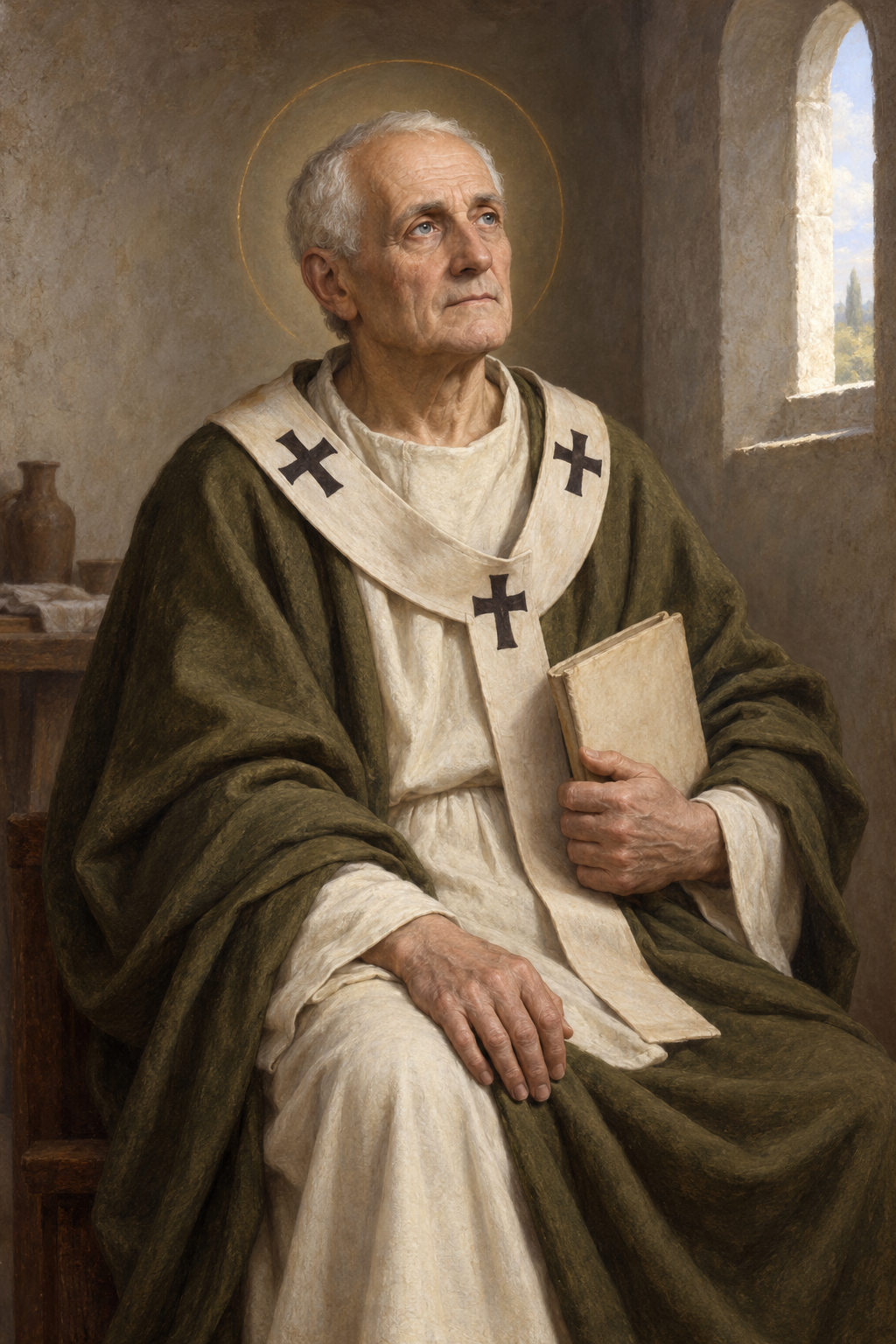
About Pope John I
John I was born in Tuscany and became bishop of Rome on 13 August 523. His pontificate ended with his death on 18 May 526. He is remembered as a martyr whose final months were shaped by a diplomatic mission between the Gothic king of Italy and the emperor at Constantinople.
His earlier career is difficult to reconstruct. A deacon named John appears in Roman church documents before his election, but scholars disagree over which notices concern the future pope. Sardella considers possible connections with the Laurentian disputes and with Boethius, while keeping the identification uncertain. The surviving evidence does not give a continuous account of his childhood or his entry into ministry.
He inherited a church recently reconciled with Constantinople under Hormisdas. Political and religious divisions remained. Theoderic ruled Italy and professed Arian Christianity, while Emperor Justin supported the faith of Chalcedon. The emperor’s measures against Eastern Arians included the transfer of their churches to Catholic use. These measures threatened to disturb relations between two rulers whose religious commitments differed.
Theoderic had previously permitted Catholic worship within his own kingdom. Now he sought relief for fellow Arians in the East and threatened consequences for Catholics in Italy if the emperor refused. John was required to lead an embassy to Constantinople. His responsibility was therefore unusually difficult: he was sent by a ruler whose beliefs he did not share, to negotiate with an emperor who shared his own.
The anonymous history known as the Excerpta Valesiana describes a limit John placed on the commission. Theoderic wanted people who had entered Catholic communion to be restored to the Arians. The pope refused to promise this or to present that demand to the emperor, although he agreed to seek other concessions. The account presents his refusal as a firm stand within a mission he still undertook.
He did not travel alone. The same history names bishops and prominent senators among his companions, including Ecclesius of Ravenna and the senators Theodorus and Inportunus. The king arranged their departure by sea. Their reception was honourable: Justin received the Roman bishop with exceptional respect and agreed to the requests except the reversal of conversions to Catholic Christianity.
In Constantinople, John also took a leading part in worship. Clugnet’s historical account describes his celebration of Easter in the Latin rite at the great church of Saint Sophia. The visit expressed the renewed communion of the two sees. It also placed him visibly beside the Eastern emperor, a circumstance that made the mission politically sensitive when he returned to Italy.
Later historians differed in how they explained his achievement. Barmby notes that some writers, anxious to avoid any appearance of a pope supporting heresy, portrayed John as opposing the concessions. Other accounts affirm that he obtained relief for the Arians. The mission can therefore be understood without supposing that he adopted their doctrine: seeking better treatment for people and accepting their beliefs were different matters.
The vivid dialogue with Theoderic also requires care. Tamás Kovács points to the anonymous writer’s use of biblical patterns in presenting the encounter. The narrative casts the pope as faithful and the king as a persecutor. It preserves an important early account of the conflict, but its dramatic speeches cannot simply be treated as a verbatim record of the conversation.
Kovács also places the episode within a divided Italian political world. Senators did not all follow one policy, and their alignments had been complicated by earlier church disputes. The anonymous history’s sharply opposed portraits of ruler and victims simplify that setting. John’s final mission belonged to relationships between the Roman church, senatorial society and Gothic government that had developed over many years.
Other evidence concerns worship and church buildings. A dispute over the calculation of Easter brought John’s officials into contact with Dionysius Exiguus. Sardella cautions that the pope’s final response to their recommendation is unknown. The papal biography also associates his pontificate with work at Roman cemeteries, including those of Nereus and Achilleus, Commodilla and Priscilla. The wording suggests restoration of an existing shrine in some cases rather than the construction of an entirely new church.
A small material survival carries his name. The Vatican Museums’ collection guide identifies a fragment of lead piping inscribed with Pope John I’s name. It does not assign the fragment to a specific building project. Alongside the written accounts, the object preserves a modest trace of his pontificate.
On his return, John was imprisoned at Ravenna. Already worn by travel and subjected to privation, he died there soon afterward. The journey had not secured everything Theoderic wanted, and the honours shown in the East offered no protection against the king’s hostility.
The anonymous history reports devotion to him immediately after death. It tells of a healing during his funeral procession and of people taking pieces of his clothing as relics. These are reports of the early cult, not independently verified medical events. His body was taken to Rome and buried at Saint Peter’s. The Catholic calendar now commemorates him on 18 May.
Wondering how to weigh the stories and sources? Learn how to read a saint biography.