Biography
Praxedes
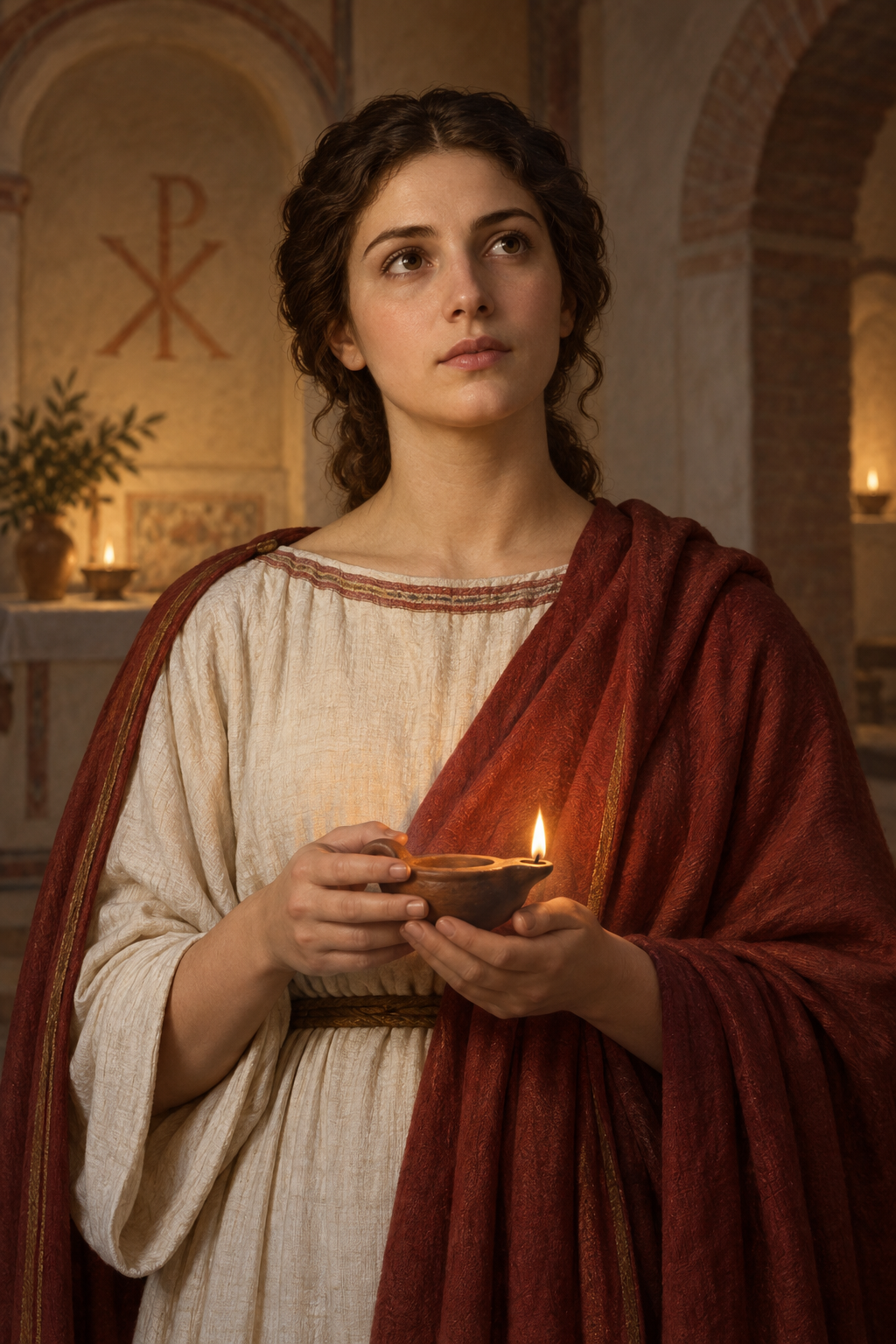
About Praxedes
The historical Praxedes is difficult to separate from the legends later attached to her name. The Catholic Encyclopedia describes her as a Roman martyr of an unknown era and points to early topographical guides that name a martyr Praxedis in the catacomb of Priscilla. Those seventh-century itineraries are evidence that Christians in Rome knew and venerated a martyr by that name. They do not supply a birth date, family history, or account of her death. The early record is therefore important, but it is much smaller than the familiar story told in later devotional lives.The name also became attached to a church in Rome, the titulus Praxedis. The Catholic Encyclopedia notes that a church bearing this title existed by late antiquity and that the veneration of Praxedes became especially associated with it. This is evidence for the development of a Roman cult and for the historical importance of the church community. It does not by itself show that Praxedes personally founded the church or lived in the building. The title and its memory grew over time, and the surviving record requires care when moving from a place of worship to claims about a founder’s individual life.Later hagiography connected Praxedes with Pudentiana and with a Roman senator named Pudens. In this story, Pudens was converted by Peter, and the sisters cared for persecuted Christians and martyrs. The Catholic Encyclopedia cautions that these family relationships belong to later legend; the medieval narrative explains the origins of two Roman church titles by linking them to a single family. Modern scholarship on Santa Prassede likewise investigates the interplay among the foundation story, liturgical memory, and the ninth-century church’s mosaic program. These stories remain part of the devotional history of Praxedes, but they should be labeled as tradition rather than presented as documented biography.The source record does not reliably establish a precise date for Praxedes’s martyrdom. Her cult commemorates her as a martyr, but the exact era and circumstances remain unknown. A liturgical date is not a death date. The Catholic memorial is July 21, which Vatican News uses in its current saint-of-the-day entry; older local records differ in how early the day appears in the martyrologies. This account therefore preserves the July 21 observance without assigning a year to her death or repeating dramatic details from a later passion as if they were contemporary testimony.Praxedes remains significant because her name became woven into the religious topography of Rome. The catacomb guide, the titular church, later liturgical calendars, and the church’s surviving art all preserve stages in the memory of this martyr. Those layers should not be flattened into one eyewitness narrative: some record historical worship, while others reflect medieval efforts to explain a sacred place. No secure date, birthplace, or personal relatives are entered in this draft. The portrait is an imaginative devotional interpretation and does not illustrate the legendary family story as a verified event.
Wondering how to weigh the stories and sources? Learn how to read a saint biography.