Biography
Rainerius
About Rainerius
Rainerius, called Ranieri in Italian, belonged to the world of twelfth-century Pisa. The modern scholarly account places his birth in the city around 1115 and names his parents as Glandolfo and Mingarda. Their home was in Chinzica, the urban district south of the Arno. A priest named Enrico is remembered as his teacher in childhood. The family was connected with commerce, a setting that helps explain Rainerius’s first recorded adult undertaking: around 1135 he sailed toward the Holy Land with merchandise belonging both to himself and his business associates. The name Scacceri is often attached to him, but the scholarly biographer warns that the family surname is attested in Pisa only much later and is unreliable for his own lifetime.
Rainerius’s turn toward religious life seems to have begun before he left Pisa. The account reports that he had already begun fasting. A later hagiographic Life gives a spiritual catalyst: an encounter with Alberto Leccapecora, a lay religious living near the Benedictine monks of San Vito. The detail belongs to the saint’s received biography, not to an independently contemporary record. The available evidence does not require that episode to explain his choice. It does show a young merchant who eventually abandoned commercial gain and embraced ascetic practice.
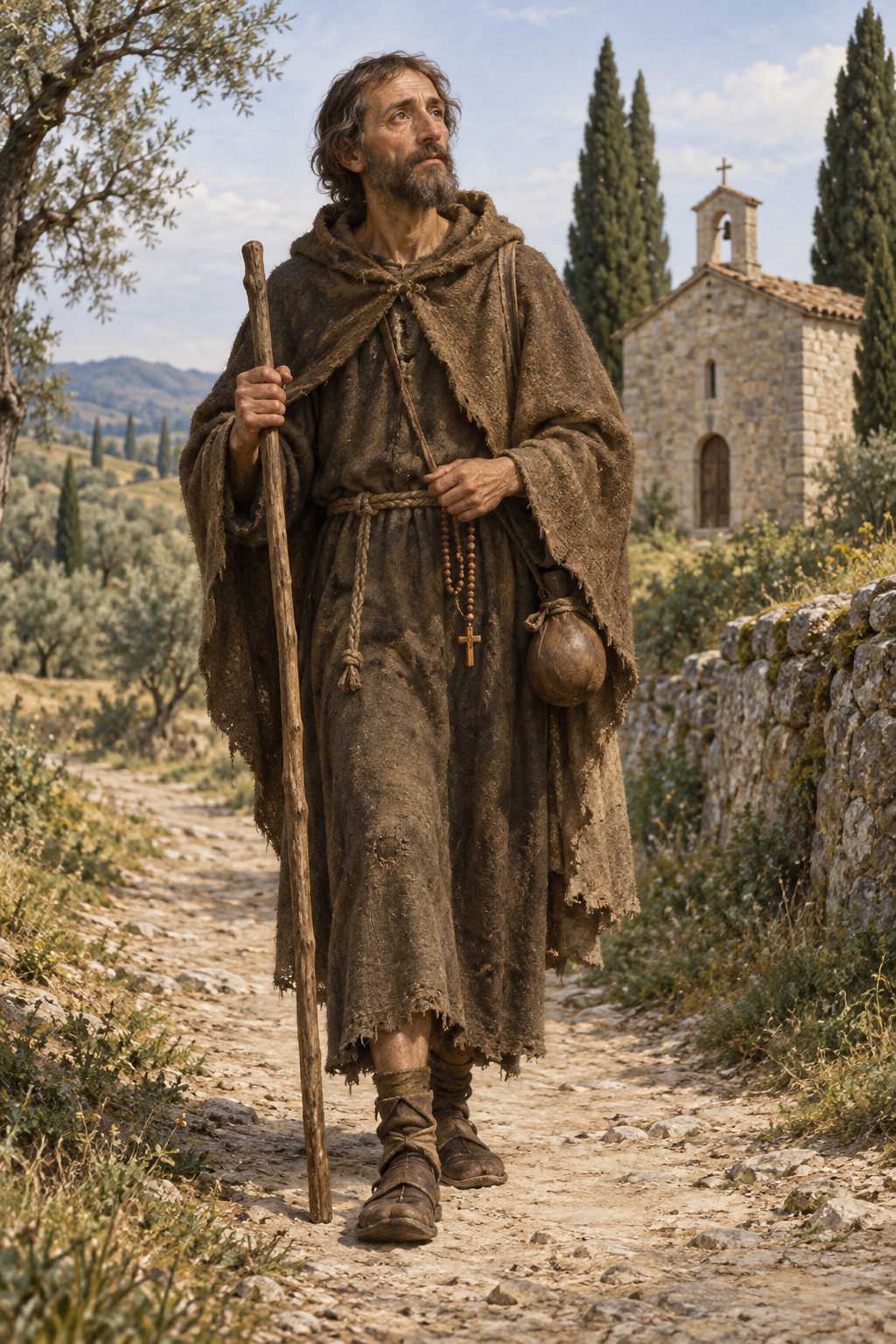
His change of life took place in the Holy Land. After working for a time as a merchant in coastal locations, he gave his share of the goods back to his partners. A Good Friday pilgrimage brought him to Jerusalem and the chapel of Golgotha. There, according to the Life, he exchanged his ordinary clothing for a rough penitential garment. He stayed briefly with hermits who lived near the city walls, then moved to the household of a religious woman and spent his days praying at the Church of the Holy Sepulchre. The narrative’s account of why he left the hermits—that they opposed his refusal to drink wine—is explicitly part of the hagiographic story, not a securely verified dispute.
The same Life describes Rainerius’s austerity in Jerusalem. For a period he ate little beyond poor-quality bread and drank water. The account says that this strict pattern lasted about seven years, after which he modestly broadened his diet. During those years, he made pilgrimages to places connected with biblical narratives, including Hebron, Nazareth, Bethlehem, the Mount of Temptation, and Mount Tabor. These details give the outline of the spiritual itinerary preserved by the medieval biographer; the exact duration and daily routine are known through that source rather than through administrative records.
Around 1153 or 1154, Rainerius returned to Pisa by ship. He settled first at the Victorine monastery of Sant’Andrea in Chinzica, where his mother was buried. About a year later, at Pentecost according to the narrative, visitors began gathering to hear him exhort people to conversion and penance. His preaching was a public activity by a layman rather than the work of an ordained priest. The biographical study reports a growing local following. It also records that people brought bread and, more often, vessels of water for him to bless. The name “of the water” became attached to him in Pisa. Claims that blessed water or bread healed illness belong to the miracle tradition. They are important to the history of his cult, but this account does not present the supernatural effects as independently established historical fact.
Rainerius later moved to the monastery of San Vito, near the setting associated with the beginning of his religious life. He continued as a layman. Two cathedral canons, Guido Ciprinella and Benincasa, became closely connected with him; further companions may have joined them. Rainerius died at San Vito on June 17, 1160. His body was promptly carried to the cathedral and buried after funeral rites led by Archbishop Villano. This date and the immediate burial are among the firmest points in the account, which draws on the first record of his death and cult.
Rainerius’s reputation grew quickly in Pisa. In the months after his death, cathedral canons recorded miracles attributed to him during life and, especially, after death. The collection was completed at the first anniversary of his death, and an initial Life was written at about the same time. These early materials are historically valuable because they show how his community remembered and honored him. They also have a devotional purpose: reports of miracles are evidence of the cult, not neutral clinical records. The initial Life has not survived in its original form.
In 1165, Benincasa rewrote the Life. This was not simply a stylistic update. Mauro Ronzani’s modern analysis connects the new version with the political and ecclesiastical divisions of Pisa. The city was contesting papal authority in favor of Emperor Frederick I Barbarossa and rival popes. Benincasa aligned with that political course, while Archbishop Villano and much of the cathedral chapter did not. The rewritten Life presented Rainerius as a uniquely Christ-like figure and powerful exorcist, and it recast the people around him in ways that served this argument. For example, it depicted Guido as a betrayer like Judas, although the scholarly account explains that Guido remained alongside Rainerius until his death and helped promote the cult with Benincasa for at least a year. These divergences make it especially important to distinguish the contemporary community’s commemoration from the later author’s political theology.
The political uses of Rainerius’s cult changed as Pisa’s allegiance shifted. After the city returned to recognize Pope Alexander III in 1170 and recalled Villano, the exorcist-centered cult lost much of its immediate political significance. Over time, local devotion returned to the penitent preacher and to miracles associated with blessed water at his tomb. In the thirteenth century, his reputation as a protector of sailors gained force, and Pisa’s communal statute of 1287 made June 17 a civic holiday. His tomb was later given a monumental form in the cathedral, and episodes from his Life appeared in the Camposanto fresco cycle.
Rainerius never received formal canonization by the Apostolic See. The Congregation of Rites authorized his cult in 1664, and he eventually became the principal patron of Pisa and its diocese. His story remains a useful example of how local sainthood could develop through civic memory, a near-contemporary cult, successive written Lives, images, and public ritual. The historical record supports a merchant who became a lay preacher and ascetic, his death in Pisa in 1160, and the early growth of devotion around him. It also lets readers see where later miracle narratives and political reinterpretation begin.
Wondering how to weigh the stories and sources? Learn how to read a saint biography.