Biography
Ralph Adams Cram
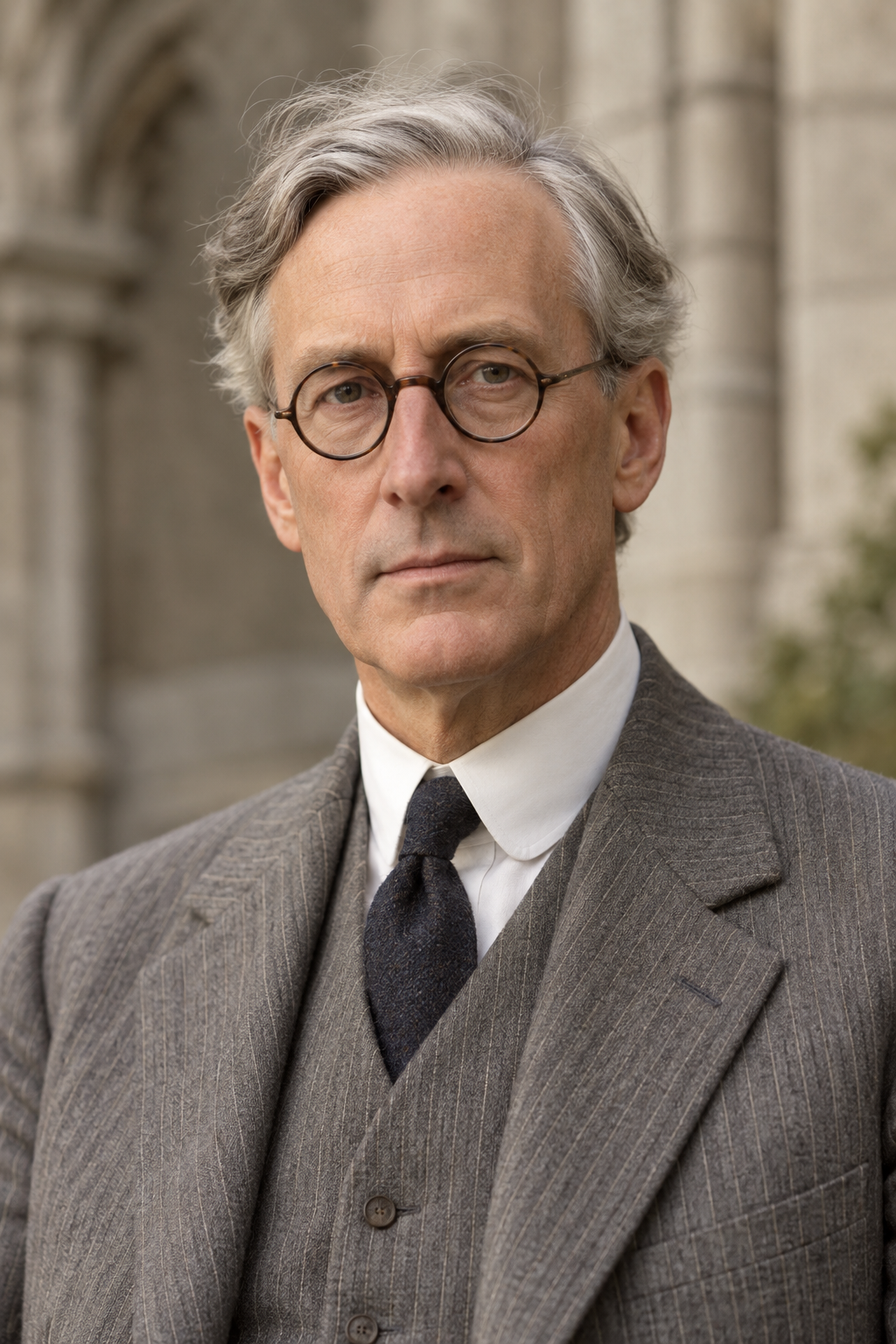
About Ralph Adams Cram
Ralph Adams Cram designed churches and college buildings that gave medieval Gothic architecture a renewed presence in American life. He grew up as the son of a Unitarian minister and trained in a Boston architectural office after high school. Travel in Europe deepened his interest in historic buildings and the ideas of John Ruskin. His choice of church architecture combined artistic preference, religious conviction, and the practical prospects of a specialized practice. He also taught architectural philosophy at the Massachusetts Institute of Technology and wrote books and articles. Teaching and writing extended his influence beyond the buildings commissioned from his office.
A Christmas visit to Rome helped change his religious life. Architectural historian Michael J. Lewis describes the impact of worship at Saint Peter’s on Cram’s movement toward Episcopalianism. His later buildings expressed an Anglo-Catholic interest in the relationship between worship and architecture. Lewis also emphasizes that Cram’s office worked through collaboration. Cram developed plans and the broad arrangement of masses, while his partner Bertram Goodhue shaped surfaces and silhouettes. Their different strengths contributed to the firm’s work; the buildings should not be understood as the achievement of one man alone.
The commission for West Point expanded the practice and required an office in New York, where Goodhue worked while Cram remained in Boston. Their partnership ended in 1913. Lewis notes that Cram continued to recognize Goodhue’s originality. He also delegated design to colleagues when a commission called for a style outside his own strongest preferences. The practice’s work was more varied than the label Gothic revivalist might suggest.
At the Cathedral of Saint John the Divine, Cram faced an unusually complicated task. Earlier architects had already built part of the church in a mixture of Romanesque and Byzantine forms. Appointed Cathedral Architect in 1916 after serving as a consultant, he had to join a new Gothic nave to that existing structure. The cathedral’s account describes his adaptations: a recessed gallery increased the apparent height of the central space, and six-part vaulting helped accommodate its great breadth. The design answered particular structural conditions as well as his historical preferences.
Other projects required different responses to place. North Carolina State University’s architectural history records a Colonial-style house in Hillsborough and churches for several congregations. At Saint Paul’s in Winston-Salem, the design followed a hillside, with sections stepping down the slope. The same account identifies Goodhue as the principal designer of the firm’s Trinity Church in Asheville and William H. Lord as the local architect responsible to its vestry. Such details preserve the contributions of the people who translated a national practice’s designs into local buildings.
Cram’s medieval interests also shaped his social criticism. In a memorial tribute, fellow architect William Adams Delano described his vision of communities organized around crafts, religious life, and a shared sense of beauty. Delano recalled Cram as an engaging conversationalist whose persuasive speech helped his career. He also noticed a contradiction: Cram criticized businessmen and industrialists while accepting their financial support for the buildings he wanted to create. Delano’s tribute offers an acquaintance’s interpretation, rather than an unqualified account of Cram’s motives.
His political writing contained more troubling judgments. In his 1936 essay The End of Democracy, Cram rejected universal suffrage and political equality, idealizing medieval hierarchy and the original American Constitution. He approvingly cited arguments against equal educational and electoral rights. His own comparisons placed Indigenous Australians far below celebrated historical figures, expressing a racist hierarchy of human worth. He nevertheless defended equality before courts and attacked wealth obtained through monopoly rather than merit. He also rejected totalitarian government and state socialism, seeking an alternative founded on independent livelihoods and spiritual freedom. These positions cannot be reduced to a preference for old architectural forms. He argued that ownership of land or a small craft business could protect independence from concentrated economic power. Yet his proposed opportunities remained sharply unequal: he believed that many students should not continue beyond the early stages of secondary education.
His private life also resists a simple portrait. Margaret Brucia’s research into the letters of Julia Gardiner Gayley and her daughter describes a friendship with Cram that ended painfully in 1920. The correspondence preserves a copied letter in which he sought the return of earlier letters and expressed contrition. Brucia explicitly leaves the full nature of the relationship unresolved. The surviving exchanges should not be treated as proof of every speculation about his marriage or intentions.
Cram attended the cathedral’s dedication in November 1941. Much of his design remained unfinished at his death.
He died in a Boston hospital on September 22, 1942, after a two-week illness, according to a contemporary United Press notice.
Trinity Parish in Newton, Massachusetts, lists him with Richard Upjohn and John LaFarge in its December 16 saints calendar. This documents local Anglican remembrance of his architectural contribution.
Wondering how to weigh the stories and sources? Learn how to read a saint biography.