Biography
Raphael the Archangel
About Raphael the Archangel
Raphael is the named angel whose mission organizes the Book of Tobit's story of prayer, travel, marriage, deliverance, and healing. The book explains his name as meaning that God has healed, tying identity to service rather than to a human family line. Catholic teaching describes angels as spiritual, non-corporeal beings and says that angel names an office of divine service rather than a bodily nature. Raphael therefore has no recoverable human birth, death, sex, canonization, ethnicity, or physical appearance for a civil-style biography to record.
The USCCB introduction dates Tobit probably to the early second century BC, says its author and place of composition are unknown, and regards Aramaic as the likely original language. It calls the work a religious novel written for instruction and edification, despite narrative details that resemble historical reporting. Fragments in Aramaic and Hebrew from Qumran, together with several Greek and Latin recensions, show that the text itself has a complex transmission history. The cities and journeys in Raphael's story are consequently preserved here as literary settings, not converted into a dated itinerary or mapped residence. Roman Catholic and most Orthodox traditions receive Tobit as Scripture, while many Protestant canons place it among the Apocrypha, so Raphael's reception is not identical across Christianity.
Within the narrative, Tobit in Nineveh and Sarah in Ecbatana each pray from severe distress, and both prayers are heard before Raphael appears to either household. Raphael is sent to restore Tobit's sight, free Sarah from Asmodeus, and make possible her marriage to Tobiah. Matthew Goff identifies providence as a key message of the book: divine help arrives through turns whose meaning the characters do not immediately discern. Phillip Muñoa reads Raphael as an angelic mediator within Second Temple Jewish thought, bringing hope, healing, and liberation to suffering Israelites.
Tobiah first encounters Raphael as an apparently ordinary young Israelite who knows the routes to Media, without recognizing that his proposed guide is an angel. Raphael gives the working identity Azariah, accepts the role of paid companion, and travels within the story before disclosing who he is. Catherine Vialle emphasizes the gap between the reader's knowledge and the characters' limited viewpoint, a delay that gives the intervention its theological force. This hidden service matters: Raphael guides and instructs without using visible splendor to compel trust or displace Tobiah's own choices. The disguise also prevents readers from treating every apparently ordinary companion as an angel; its function belongs to this carefully constructed plot and its final disclosure.
At the Tigris, Raphael tells the frightened Tobiah how to seize a fish and preserve organs that the narrative later connects with Sarah's deliverance and Tobit's healing. At Ecbatana he guides Tobiah toward marriage with Sarah, while Tobiah and Sarah themselves pray together for mercy and protection. The story then has Raphael pursue and bind Asmodeus, an episode Župarić examines within Tobit's traditional language of angels and demons. The sequence portrays help as cooperation among prayer, instruction, courage, and action; it is not evidence for a reproducible medical or exorcistic technique.
On the return to Nineveh, Raphael instructs Tobiah to apply the fish gall, and the narrative says Tobit then recovers his sight. When Tobit and Tobiah offer payment, Raphael instead reveals that he presented their prayers, was sent by God, and belongs among seven attending angels. Raphael directs praise and thanksgiving toward God and refuses to turn the mission into self-display. Francis Macatangay argues that Raphael's command to praise God and write the events down makes the book itself a public witness to divine works.
Raphael's character is thus defined less by visual majesty than by attentive accompaniment: he listens to a mission, learns the road with a family, and supplies timely guidance. The narrative still preserves human agency, because Tobiah travels, chooses, prays, marries, applies the remedy, returns home, and recounts what happened. Catholic doctrine places such angelic service within God's saving plan and describes angels as servants and messengers rather than independent powers. That frame guards against superstition: Raphael's story can encourage prayer and practical care without assigning every success or setback to an unseen being. His final instruction to record what happened also turns private rescue into accountable testimony, so memory, praise, and ethical action remain connected rather than merely wondrous.
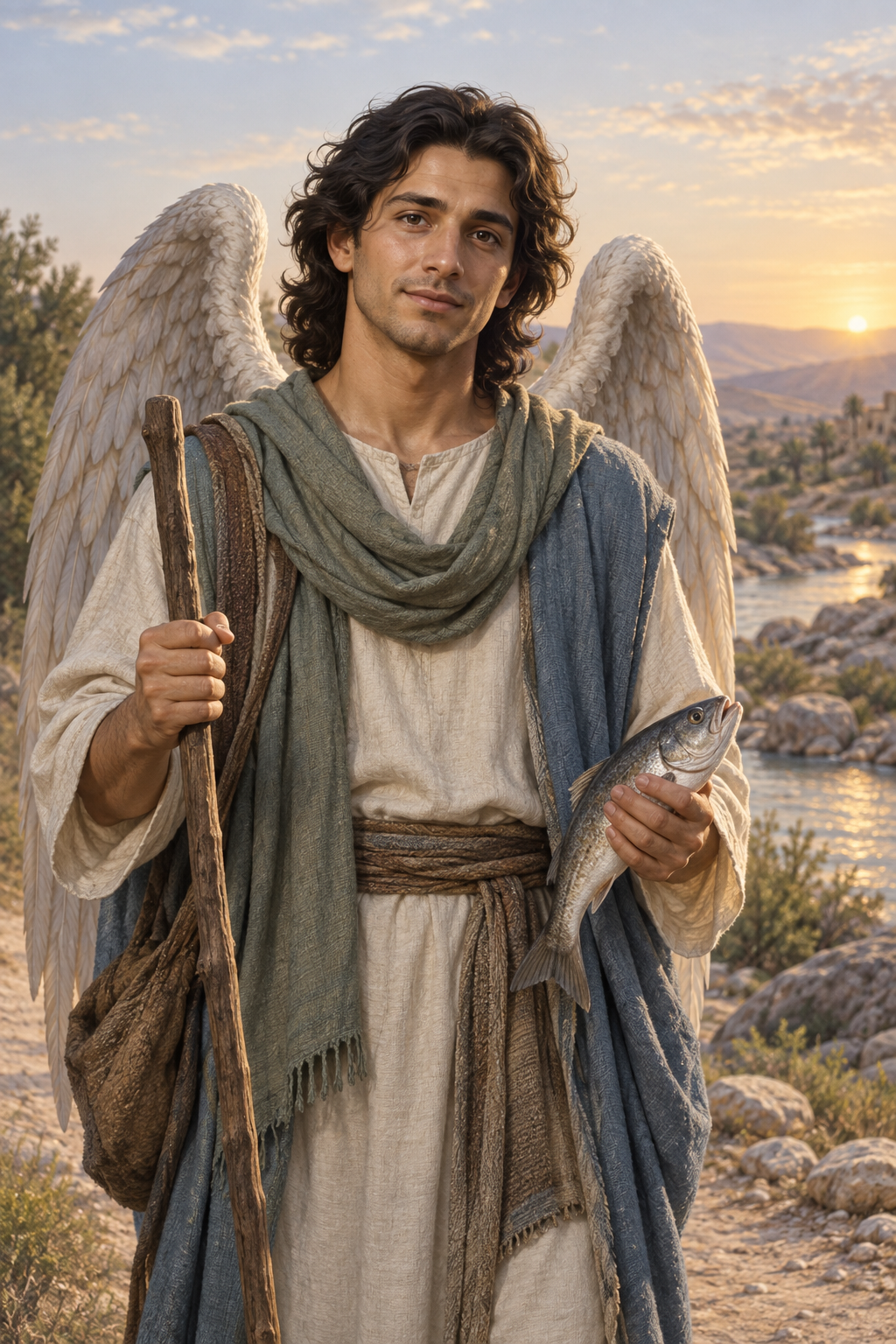
The Catholic Church's liturgy remembers Raphael by name, and the current United States calendar joins him with Michael and Gabriel on September 29 at the rank of Feast. Christian artists have long translated the literary companion into visible symbols: traveler clothing and staff, a fish, medicine imagery, youthful human form, and wings. The Uffizi notes that wings are an inherited iconographic element, while Tobias, the fish, and a medicine jar visually identify Raphael's guardianship and healing role. Those conventions explain this page's artwork but do not document Raphael's appearance; his enduring portrait remains one of service that accompanies, heals, and redirects gratitude to God.
Wondering how to weigh the stories and sources? Learn how to read a saint biography.