Biography
Remigius of Reims
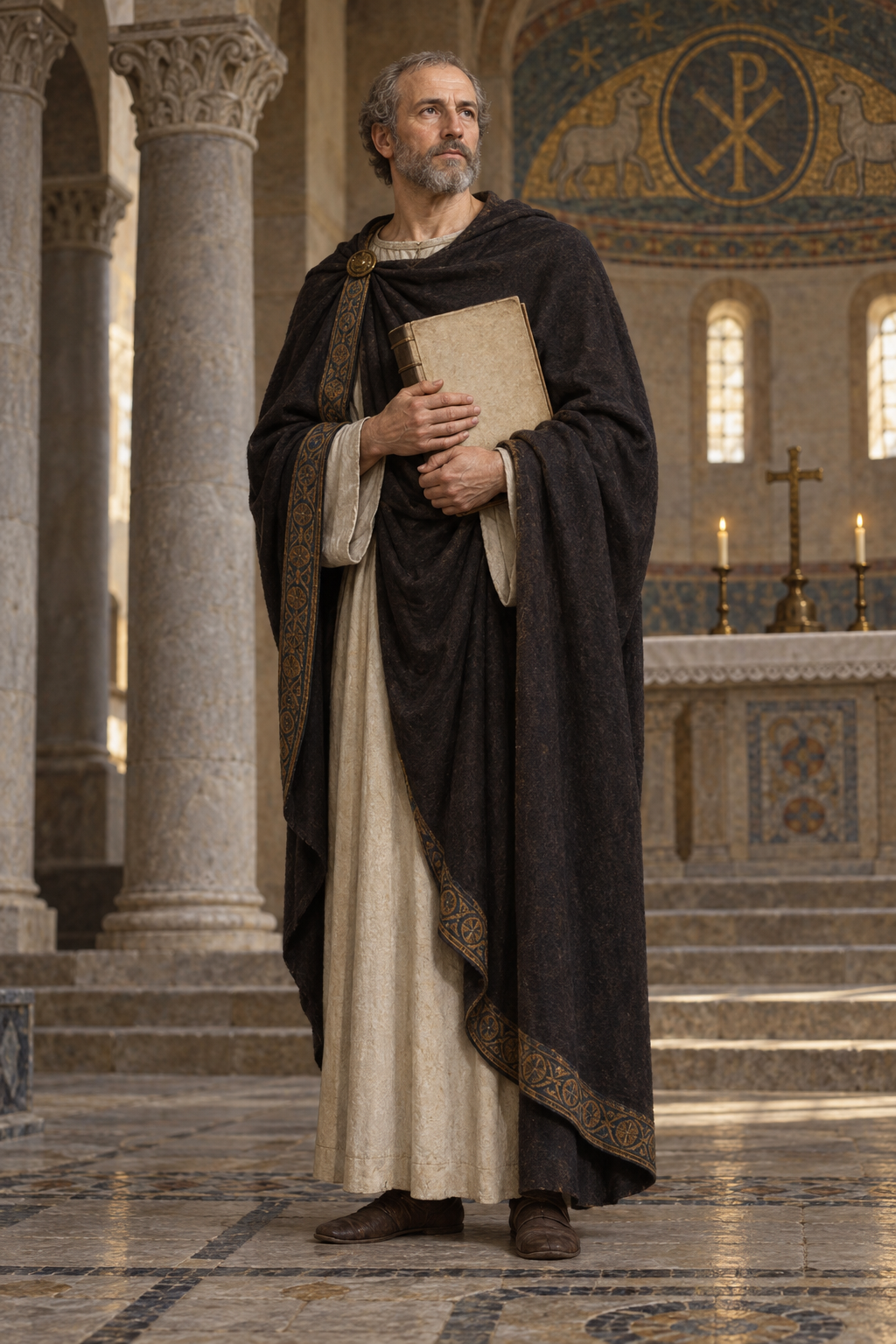
About Remigius of Reims
Remigius, known in French as Rémi, was bishop of Reims during the period when Frankish rulers were consolidating authority in northern Gaul. His life is important both for his own episcopal work and for the later story that connected Reims with the conversion of Clovis and the baptism of Frankish kings. The evidence must be read in layers: a small amount of sixth-century writing, a near-contemporary historian’s account, later hagiography, and the much later political memory of the city.
Gregory of Tours, writing in the sixth century, describes Remigius as the bishop whom Clotilda asked to instruct Clovis in Christian teaching. Gregory places this episode after Clovis’s victory over the Alamanni, in a conversion narrative shaped by religious interpretation. In Gregory’s version, the king first hesitates because he worries about how his followers will react; the people then acclaim the God preached by Remigius, and the bishop prepares the baptism. Gregory says that the king was baptized by Remigius and that more than three thousand of his soldiers followed. This is the earliest substantial narrative connecting the bishop to Clovis’s baptism. It is an important witness to the memory of the event, but it is not a transcript or a contemporary eyewitness account.
The date and place of the baptism cannot be treated as certain. Gregory does not provide a calendar date in this passage. Later traditions identify Reims and December 496, but scholarly discussion has questioned both the chronology and how directly Remigius’s role can be recovered from the surviving accounts. The archaeological authority for Reims reports that foundations of an early baptistery beside the cathedral were found in 1994 and associates the city with the later memory of Clovis’s baptism. The existence of a baptistery demonstrates the setting of Christian worship at Reims; it cannot on its own prove that Clovis was baptized there. This biography therefore refers to Remigius’s role as Gregory’s account, rather than assigning a precise date.
Gregory’s story also includes the vessel of Soissons. He narrates how a sacred vessel taken during the sack of a church was requested by Remigius; when a soldier broke it, Clovis later killed the man. Gregory’s account presents this episode to illustrate the bishop’s relationship with the king and the king’s power. The story became famous in later retellings. Since Gregory is its narrative witness and later versions embellish it, it is best described as an episode in the historian’s account rather than an independently verified incident.
Remigius’s activity was not limited to Clovis. The Catholic Encyclopedia reports that the bishop established or supported new sees and churches in the Frankish territories, and that he participated in regional ecclesiastical affairs. It records a synod held by Remigius in 517, during which a bishop with Arian beliefs was said to have been reconciled to Catholic teaching. It also reports that Remigius consecrated Medardus, later bishop of Noyon, in 530. These details come through later ecclesiastical sources and should be read with appropriate caution, but they portray a bishop engaged in organizing church life beyond the royal court.
The written record associated with Remigius is small. Several letters survive, including correspondence connected to Clovis and a defense of his handling of a priest named Claudius. The latter episode shows that his decisions could be challenged by fellow bishops. According to the Catholic Encyclopedia, Remigius defended his lenient treatment of Claudius in a reasoned reply that remained extant. Some other documents later attributed to Remigius have been judged spurious, including a supposed papal appointment as vicar over Clovis’s kingdom. Modern summaries of his life should therefore distinguish preserved correspondence from texts composed or reworked in later centuries.
Remigius died at Reims in 533, according to the traditional date reported by the Catholic Encyclopedia, and was buried in the city. His tomb became the center of a local cult. The archaeological history of Reims describes a basilica established near the tomb in the sixth century and an early burial community around it. That evidence shows that veneration at the site became an important part of the city’s Christian landscape. It does not establish the miracle stories that later grew around the saint.
The most influential later phase of Remigius’s memory came under Hincmar, archbishop of Reims in the ninth century. Hincmar expanded the saint’s Life and promoted the legend of the Holy Ampulla, a vessel said to have descended from heaven with oil for Clovis’s baptism. The story helped connect Reims’s archbishops to royal anointing and strengthened the city’s political standing. The French archaeological institute explicitly identifies Hincmar as the promoter of this legend. It is a significant part of medieval memory, but it is not evidence that a miraculous vessel appeared at the baptism. The account of the saint’s life here excludes the legend from the historical narrative while explaining its later influence.
Remigius remains closely associated with Reims because of the long-lasting cult at his tomb and the city’s role in royal and ecclesiastical history. The strongest responsible picture is of a bishop remembered by Gregory as an important adviser to Clovis, active in church affairs, and honored at Reims after his death. Later writers enlarged that memory to explain the city’s religious authority. Keeping these stages distinct allows the historical evidence, the church’s traditions, and the political legends to be understood without confusing one with another.
Wondering how to weigh the stories and sources? Learn how to read a saint biography.