Biography
Roger Williams
About Roger Williams
Roger Williams helped establish Providence as a refuge from religious coercion. Born in London around 1603, he studied at Cambridge and was ordained in the Church of England in 1629. He arrived in Massachusetts with his wife, Mary, in 1631. His disagreements with colonial authorities went beyond forms of worship: he challenged the government’s power to enforce religious belief and the assumption that English claims alone entitled settlers to Indigenous land. Banished from Massachusetts in 1635, he fled in the winter of 1636.
His survival depended on Indigenous people. Narragansett historian Lorén Spears emphasizes the shelter, practical knowledge, and permission to settle that Native communities provided. Their assistance made possible the settlement that became Providence. Spears also cautions against treating later images of Williams and the Narragansett as straightforward records of equal friendship. English understandings of ownership did not necessarily match Indigenous understandings of land use. A welcome offered to an exile could become part of a colonial claim with consequences far beyond that first encounter.
Williams had already declined a teaching position at the Boston church because he thought its separation from the Church of England incomplete. At Plymouth he supported himself through farming and trade while learning local languages. His religious convictions brought repeated conflict, but they also shaped his plans for a community in which disagreement need not lead to banishment. A civil compact adopted in Providence in 1637 confined the government’s authority to civil affairs. Other settlements developed their own agreements, and Rhode Island’s formation was the work of many people, rather than a single founder.
His own affiliations changed. After helping establish a Baptist congregation in Providence, he withdrew from organized church membership while continuing to seek a true Christian church.
The Bloudy Tenent of Persecution, published in 1644, explains why religious liberty mattered to him as a Christian. In its opening propositions, Williams rejected the idea that Christ required the bloodshed caused by religious persecution. Civil officers, he argued, were responsible for civil government, not for ruling the spiritual life. He extended protection to people whose beliefs he considered false, including non-Christians. This was not a declaration that all religions were equally true. It was an argument that persuasion belonged to religious teaching, while force could not produce faithful conviction. He also warned that enforced religious uniformity fostered hypocrisy and civil conflict.
His writing about language had a different but related purpose. In the address opening A Key into the Language of America, Williams said he had assembled his materials at sea to preserve what he had learned. Published in 1643, the book was intended to help English readers communicate with Native people. He acknowledged differences among local languages and dialects, while presenting communication as a possible means of spreading Christianity. The work therefore records sustained learning across cultures, but also the religious and colonial assumptions of its author. He also distinguished names imposed by English speakers from names Native people used for themselves. That attention preserved differences which colonial labels could obscure, even though his account continued to describe other cultures through the categories and expectations of an English Christian.
Brown University’s Native Languages Research Guide credits Narragansett translators and interpreters with helping Williams produce the book. Their contribution is essential to understanding it: the knowledge it preserves did not originate with the English writer alone. A history centered only on his linguistic abilities would leave out the people who made those abilities possible.
In England, The Bloudy Tenent met official resistance: Parliament ordered copies burned. Williams continued pursuing legal protection for the settlements across the Atlantic. Their independence faced pressure from Massachusetts and Connecticut, whose claims threatened their territory as well as their religious arrangements. A charter could protect a vulnerable community as well as state an ideal.
His political work also depended on collaborators. John Clarke remained in England after Williams returned to Rhode Island and obtained the royal charter in 1663. Williams served as the colony’s chief officer from 1654 to 1658.
The limits of his commitment to freedom are especially clear in the history of Indigenous enslavement. Historian Margaret Ellen Newell describes his doubts about enslaving women and children after the Pequot War, followed by his acceptance of such enslavement as a means of weakening an enemy. He suggested tribute or limited terms of service as alternatives, but did not reject coercive labor itself. In October 1676, following King Philip’s War, he presided over the distribution of proceeds from captive sales in Providence. These actions belong in the same account as his defense of conscience; religious liberty did not prevent him from participating in colonial violence.
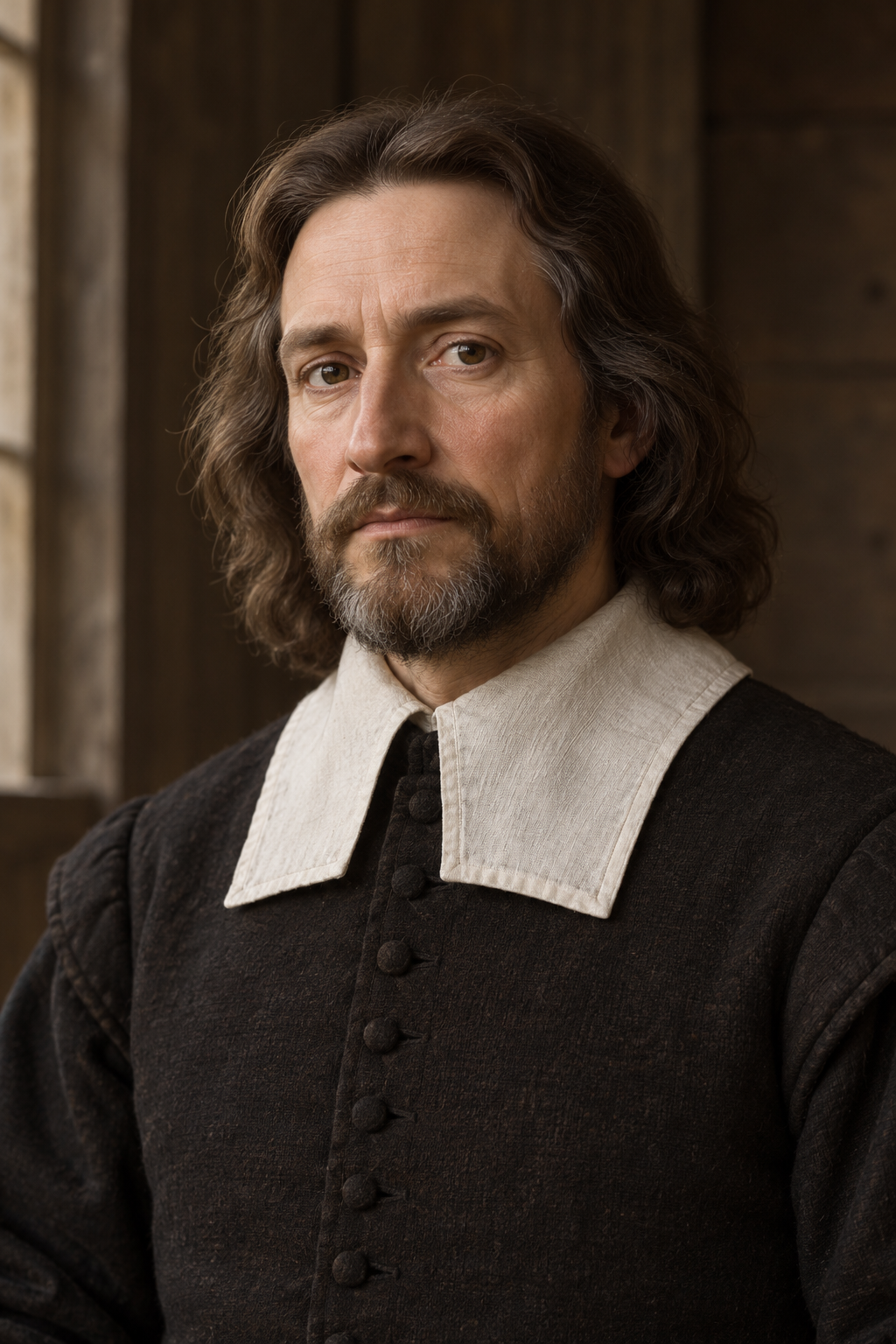
Williams died in Providence in 1683. Neither his exact death date nor a verified lifetime portrait is known.
The Episcopal Church commemorates him with Anne Hutchinson on February 5.
Wondering how to weigh the stories and sources? Learn how to read a saint biography.