Biography
Rosa Venerini
About Rosa Venerini
Rosa Venerini was born in Viterbo on February 9, 1656. The Holy See biography names her father, Goffredo, as a physician at Viterbo's Grand Hospital, and her mother as Marzia Zampichetti.
Rosa's early education formed both intelligence and Christian practice. The public page should present her as a lay woman with a serious educational and spiritual vocation, not as a generic school founder.
Her family setting matters because she was not beginning from an empty page. The daughter of a physician had access to formation, responsibility, and a civic world in which education and Christian practice could meet. The final page should use those facts without making social status the center.
In 1676 she briefly entered the Dominican monastery of Saint Catherine. She returned home after her father's sudden death. Later family losses, including her brother Domenico and her mother, shaped the circumstances in which her mission developed.
This interrupted Dominican discernment should be handled gently. It was not a failed vocation in a dismissive sense. It was part of the path by which Rosa returned to a home setting and eventually discovered a different form of apostolic service.
In May 1684 Rosa began gathering local girls and women in her home for the rosary. This should be described as both prayer and instruction. The movement toward schools began in a domestic setting, with catechesis and human formation close together.
Those home gatherings are the bridge between private devotion and public work. They show that Rosa's educational mission grew from concrete encounters with girls and women who needed formation, not from an abstract theory of schooling.
On August 30, 1685, with Bishop Urbano Sacchetti's approval and two collaborators, Rosa opened her first school. The page should avoid broad claims about being "first" unless a final source supports the exact wording. The reviewed sources are enough for the date and foundation.
The two collaborators should not disappear from the story. Naming the approved school as a shared beginning keeps the profile honest: Rosa led the mission, but she did not teach as an isolated heroine.
From 1692 to 1694 she opened schools in Montefiascone and nearby villages around Lake Bolsena. That expansion shows practical persistence. It also keeps the profile from treating the Viterbo school as a single isolated achievement.
The Lake Bolsena expansion should be written as a careful chronology, not as a map of conquest. Each new school meant teachers, families, local acceptance, resources, and the repeated labor of forming girls in Christian life.
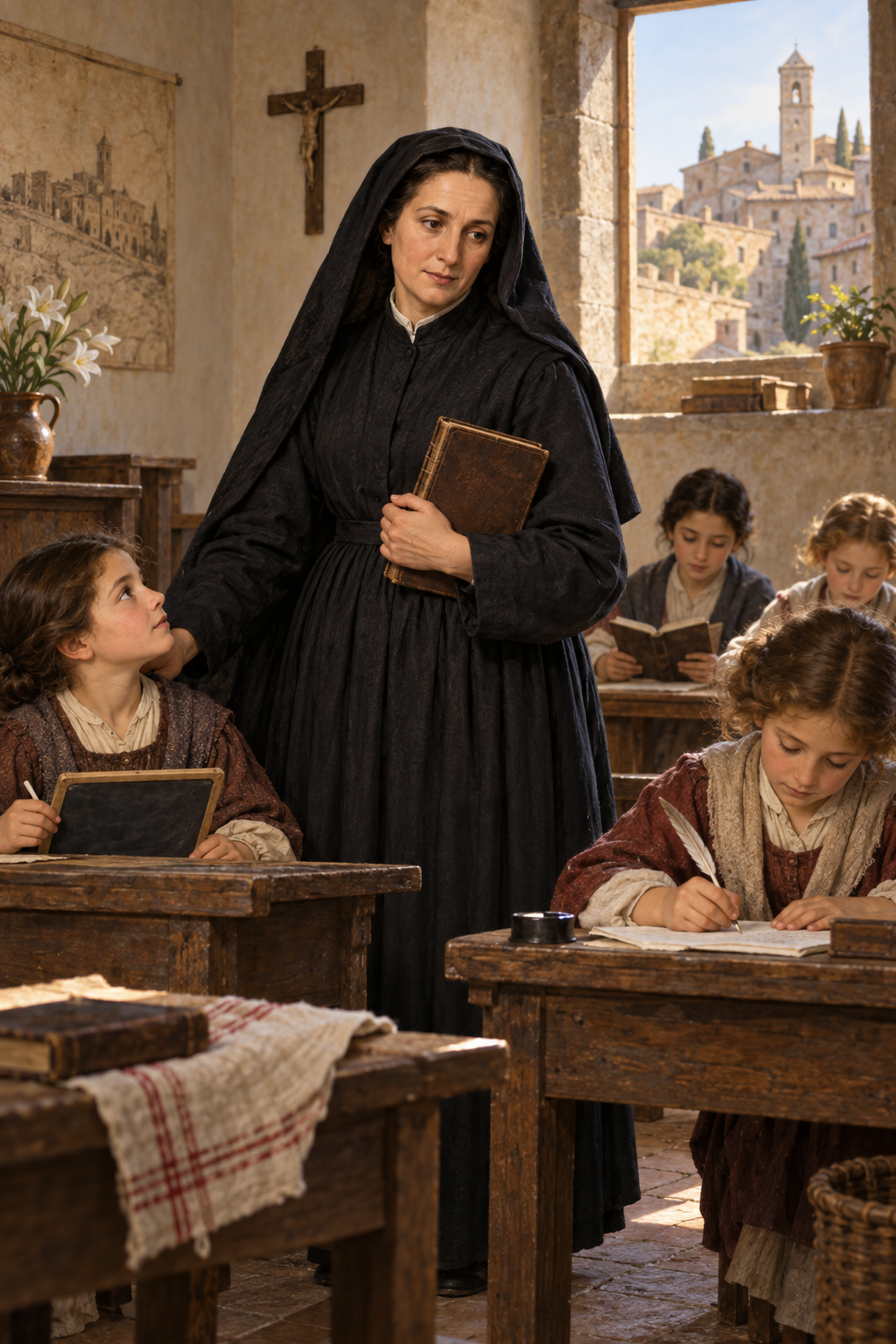
Her educational mission centered on girls and young women who needed Christian formation and basic instruction. The page should avoid anachronistic school language, but it can show the concrete tools of books, slates, catechesis, and patient teaching.
Rosa opened a school in Rome on December 8, 1713. Clement XI visited in 1716. This papal visit belongs in the biography because it shows ecclesial recognition without making the story merely institutional.
Rome also gives the later life a concrete setting. The public page can connect the Roman school and Clement XI's visit with the San Marco house where Rosa died, giving readers a clear final chapter.
The final profile should keep the school chronology precise: Viterbo home gatherings, first school with episcopal approval, Montefiascone expansion, Rome school, and death at San Marco. That order gives the reader a clear path through the life.
Rosa died at the San Marco house in Rome on May 7, 1728. The Dicastery profile records her beatification in 1952 and canonization by Benedict XVI on October 15, 2006, with May 7 as her memorial.
Her witness is best framed as Christian education carried by a lay woman who discerned, returned home, taught, organized collaborators, and opened schools where girls could be formed in faith and learning. It should stay grounded and avoid inflated educational claims.
This groundedness is especially important because education pages can easily become slogan-heavy. Rosa's page should instead use dates, places, people, and classroom objects: Viterbo, Bishop Sacchetti, two collaborators, Montefiascone, Lake Bolsena, Rome, books, slates, and patient instruction.
The final devotional tone should be modest and usable. Rosa's sanctity is not only that she opened schools, but that she recognized a need, gathered learners, sought ecclesial approval, worked with collaborators, and kept teaching across decades. That pattern can invite readers to practice patient instruction in ordinary rooms, not only admire a historic founder from a distance.
It also keeps the profile faithful to the sources: strong enough to honor her educational courage, restrained enough to leave disputed or exaggerated claims aside.
Her classroom holiness remains concrete, daily.
Artwork should show Rosa in modest dark dress and veil in a simple Viterbo schoolroom, with book, slate, quill, benches, and girls learning as restrained attributes. Avoid rendered text, logos, halos, modern props, exaggerated first school symbolism, and exact-likeness claims.
Wondering how to weigh the stories and sources? Learn how to read a saint biography.