Biography
Rose of Lima
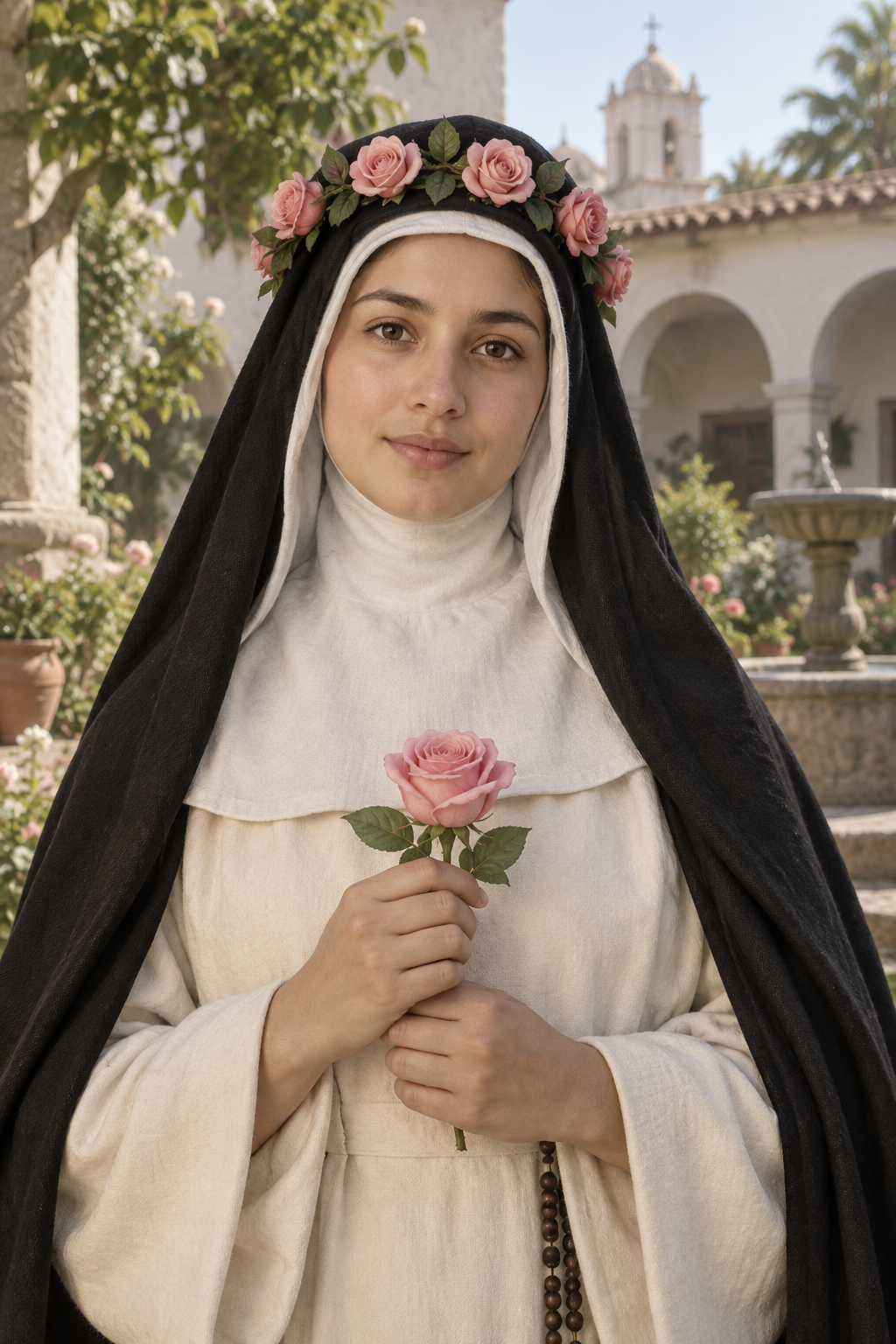
About Rose of Lima
Rose of Lima lived her religious vocation amid the work and needs of a household. Born in Lima on April 20, 1586, she became known for prayer, service and a determination not to marry. Her parents did not welcome that decision, and neither family expectations nor the wishes of friends made her chosen life easy. She continued living at home, earning money through embroidery and the flowers she grew. Work with a needle and work in the garden helped support the family even as she sought a more secluded life of prayer.
As a child she had been called Isabel Flores de Oliva. Part of her childhood was spent with her family in Quives, outside Lima. Catherine of Siena's example helped shape her decision to dedicate herself to God. Catherine's example joined religious dedication to life outside an enclosed convent. Rose's attraction to the Dominicans did not mean that she could simply enter a local community of nuns: the Dominican monastery she hoped for did not yet exist in Lima.
In 1606 she joined the Dominican Third Order as a laywoman. She made a small retreat in the family garden, where she could spend long periods in prayer. The Dominican profile also remembers her teaching music to children and contributing to the household through sewing and gardening. Her wish for silence did not remove the need to earn a living or respond to other people. A life centered on contemplation still included lessons, practical work and care for the sick.
Her determination to remain unmarried appears strongly in the devotional tradition. The older Catholic Encyclopedia describes a prolonged struggle to win her parents' consent. It also remembers her brother helping her build the garden retreat. These accounts place her religious choices inside family relationships that could be difficult as well as supportive. Her attraction to solitude was not the same as having no one around her: the household remained the setting for work, disagreements and the gradual acceptance of the path she had chosen.
Rose's penances were severe. Traditional accounts describe fasting and practices intended to unite her suffering with Christ's. They also describe periods of inward distress, alongside experiences she understood as divine consolation. Her spirituality cannot responsibly be presented as a set of bodily hardships for readers to copy. Within her religious world, these practices expressed a longing for God and concern for others, but the accounts also make clear how demanding she found them.
The people she helped included women whose lives were marked by poverty and servitude. Historian Rafael Sanchez-Concha describes her setting aside room at home for sick people, with her family's permission. Among those received were servants, enslaved women and women without resources. She offered religious encouragement as well as bodily care. The same study describes her desire for missionaries to reach Indigenous communities, a desire shaped by the Catholic commitments and assumptions of colonial Peru. Her concern took practical form nearby, even though she did not herself become a traveling missionary.
In a later interpretation of her life, Carlos Castillo places this service against the inequalities of colonial society. His study contrasts the wealth of Lima with the mistreatment of Indigenous and Black people. He sees Rose's response as an effort to recognize Christ in people whose suffering prosperous society could ignore. That reading draws attention to the social setting of her devotion: she prayed within a divided city, not apart from the lives of its inhabitants. Her care for vulnerable neighbors belongs beside her better-known desire for contemplation.
As her health failed, Rose received care herself. She lived with the official Gonzalo de la Maza and his wife, Maria de Uzategui, in a household where strong bonds of affection developed. She helped with the religious education of their daughters and still sought opportunities to comfort sick enslaved people there. Her last illness brought friends and attendants close to her. The municipal history records her asking a friend for a spiritual song near the end of her life. She died in Lima on August 24, 1617.
The accounts of her final months include an experience described as mystical marriage with Christ. De Cos places it in 1617 and recounts her joyful acceptance of what she understood as Christ's invitation. This belongs to the testimony about her religious experience, not to an independently observable meeting. The language of marriage expressed the intimacy with God toward which her prayer had been directed.
The Church beatified Rose in 1668 and canonized her in 1671. She became the first person born in the Americas to be canonized. Her memory subsequently reached well beyond Peru. In a letter marking the four-hundredth anniversary of her death, Pope Francis recalled her devotion and named her patron of both Americas, the Philippines and the West Indies. The scope of that patronage reflects the wide reception of a woman whose own life had remained rooted in Peru.
Wondering how to weigh the stories and sources? Learn how to read a saint biography.
Prayers for Rose of Lima
Rose of Lima: sourced prayer excerpt
Pray for us, St. Rose, That we may be made worthy of the promises of Christ.