Biography
Rose of Viterbo
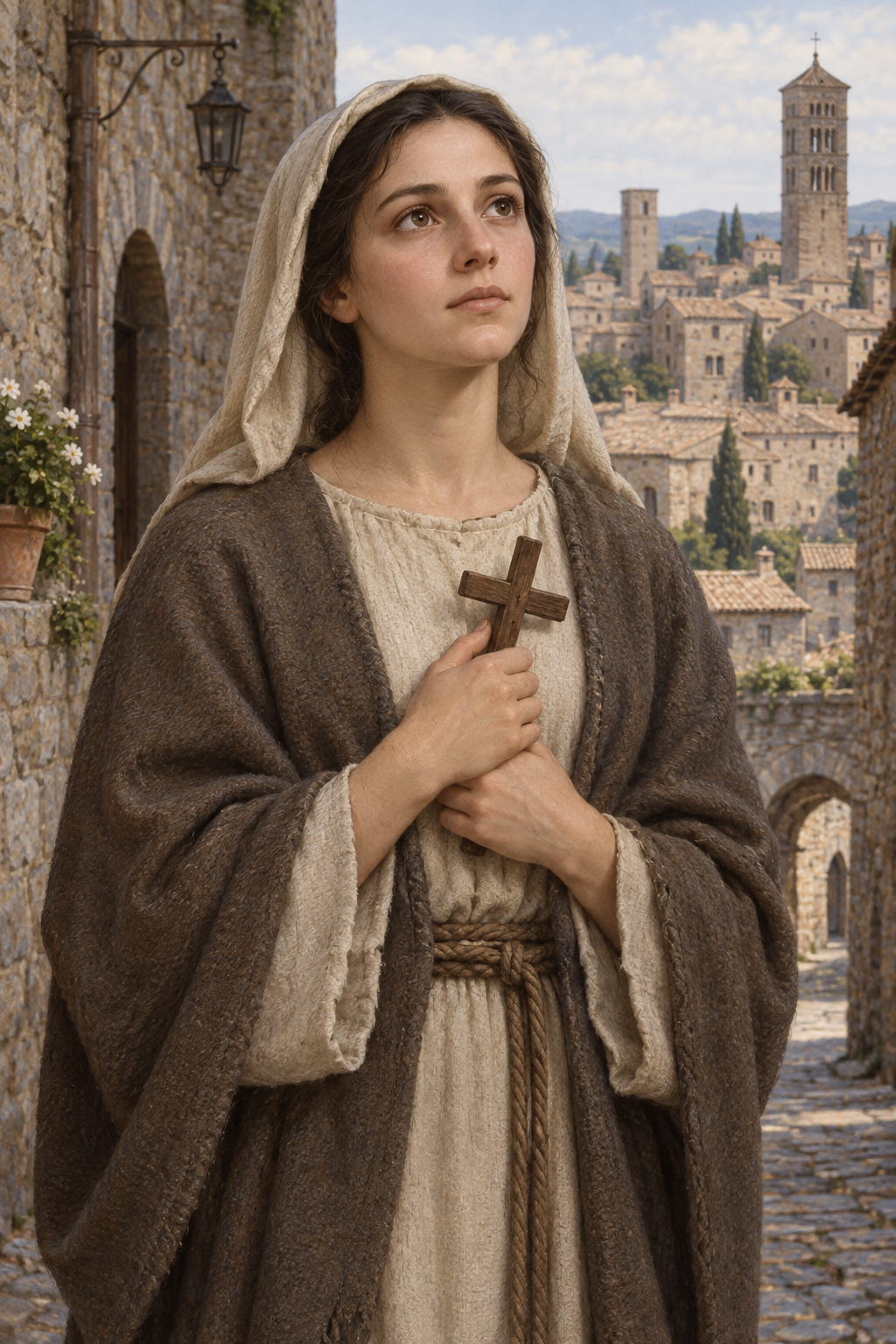
About Rose of Viterbo
Rose was born in Viterbo around 1233, probably in a modest household in the parish of Santa Maria in Poggio. Her parents' names are given in a much later deposition and remain probable rather than certain. The most careful reconstruction comes from Maurizio Ulturale's entry in the Dizionario Biografico degli Italiani, which compares the surviving medieval narratives with papal documents. The precise year of Rose's death is not stated in a contemporary record, but the early sources place her at a young age. The biography uses 1251 as the most likely year, not a day-specific date. Devotional narratives sometimes sharpen this uncertain chronology.The sources for Rose are unusually important to her biography. Vita I is a fragmentary narrative written soon after the middle of the thirteenth century; its beginning and ending are lost. Treccani considers it the more reliable witness because it is close in time and gives a detailed chronology, perhaps drawing on a family witness. The Centro Studi Santa Rosa da Viterbo identifies the surviving manuscript as a parchment fragment preserved at the monastery. Vita II, by contrast, is an anonymous account composed in the early fifteenth century and preserved in the later canonization dossier. It reworks Vita I and adds material from written and oral traditions. Treccani warns that the 1457 process contains many inconsistencies because its witnesses spoke more than two centuries after Rose's life. Later stories carry less historical weight.The first Vita opens with a severe illness that confined Rose to bed. Its chronology places the worst phase on June 21–22, 1250, in relation to the fast before the feast of John the Baptist. Her mother and other women attended her. Treccani notes that the family setting and women's presence may help explain how the narrative retained unusually specific information, while cautioning that this remains an inference. Physical remains examined in modern times indicate a congenital condition, but the biography need not turn a medical interpretation into a complete explanation of Rose's religious life. What can be said securely is that pain and sickness shaped the earliest surviving account and came before her public activity.According to Vita I, while recovering from the illness Rose made a private penitential commitment. The narrative describes her renouncing worldly goods and asking her mother for a tonsure, a belt made from a cord, and a rough penitential tunic. A woman named Sita reportedly brought the garment, though she initially resisted Rose's request. The later Vita II shifts the scene into a public church ceremony led by clergy. The earlier account describes a private household act, whereas the later text gives it a formal setting. Historians have used the clothing and practices to consider whether Rose belonged to a Franciscan penitential group, but the records do not establish a formal order affiliation.Her private devotion became public in the streets of Viterbo. The near-contemporary account says that Rose invited women of her neighborhood to join a penitential procession linking the churches of San Giovanni in Zoccoli, San Francesco, and Santa Maria in Poggio. She carried a cross or sacred image, and a group of women gathered around her. Treccani situates this activity within the broader thirteenth-century phenomenon of women's penitential communities, which did not always belong to a formally recognized institution. This is why the label “Franciscan tertiary” requires care. Later church tradition treats her membership as settled, but the earliest sources do not offer a clear formal admission record. It is safer to describe Rose as a lay penitent associated with a Franciscan religious environment.The earliest biography also describes Rose's activity with a cross in hand for about six months. In Treccani's reading, this is better understood as a humble, penitential witness to Christian faith than as evidence for every claim made by later writers about formal preaching. Her activity took place during conflict over the relationship between the city and imperial power under Frederick II. A municipal official, Mainetto di Bovolo, governed Viterbo on the emperor's behalf. The Vita says that opponents persuaded him to expel Rose. The episode involved religious and civic loyalties, but modern scholarship cautions against reducing the conflict to a simple campaign by a child against a clearly defined group of “heretics.” The surviving evidence reflects both local politics and later efforts to define Rose's sanctity.Rose and her family were exiled from Viterbo. The earlier narrative places the first stage at Soriano, in the Cimini hills, where she arrived on December 5, 1250. After roughly ten days the family moved to Vitorchiano, a short distance away. Treccani notes that a later fragment preserved through the fifteenth-century biography supplies the Vitorchiano episode, so the evidence is not as strong as for the basic exile. The story says news of Frederick II's death reached them there on December 13. Rose's return followed the end of imperial control in Viterbo. The broad outline is supported by the near-contemporary Vita and the political chronology, while the exact speeches and prophetic elements in the exile story are part of hagiographic tradition.Rose died in the spring of 1251, according to Treccani's reconstruction. The date is bounded by the death of Frederick II in December 1250 and Pope Innocent IV's bull Sic in Sanctis suis, dated November 25, 1252. The bull already refers to Rose's cult as venerable memory and forms part of the earliest documentary evidence for the veneration surrounding her. Rose was buried at Santa Maria in Poggio, her parish church. The first canonization effort began soon after her death, but its original acts have not survived. The distinction between the early request, the documented cult, and a later formal process is important: a papal effort in 1252 did not result in a completed canonization at that time.A further moment in the cult came under Alexander IV, who moved the papal court to Viterbo in 1257–1258. The tradition says Rose appeared to him in dreams and asked that her body be placed at the Poor Clares' church. The translation occurred in 1258, when the pope and cardinals accompanied the body in procession. Vatican City State preserves this account while Treccani notes that the move may also have resolved a long dispute about the community at Rose's former home. These explanations need not be treated as mutually exclusive: a religious memory of Rose's request and the practical history of property and religious houses could coexist. The procession became a central event in the local cult.The city's annual observances preserve two different parts of this history. The Roman Catholic feast is March 6, while September 4 recalls the translation of the body. Treccani notes that both dates acquired popular customs in Viterbo, including the procession of the Macchina di Santa Rosa, a large devotional structure carried through the city. It traces the tradition to a vow during a plague in 1656 and notes that records of the procession continue from the seventeenth century. These later practices are evidence for the development of Rose's cult, not evidence about the details of her thirteenth-century life. Her significance today lies in that combination of a modest historical record, an unusually early local cult, and a devotional memory that remains visible in Viterbo's public life.
Wondering how to weigh the stories and sources? Learn how to read a saint biography.