Biography
Rose Philippine Duchesne
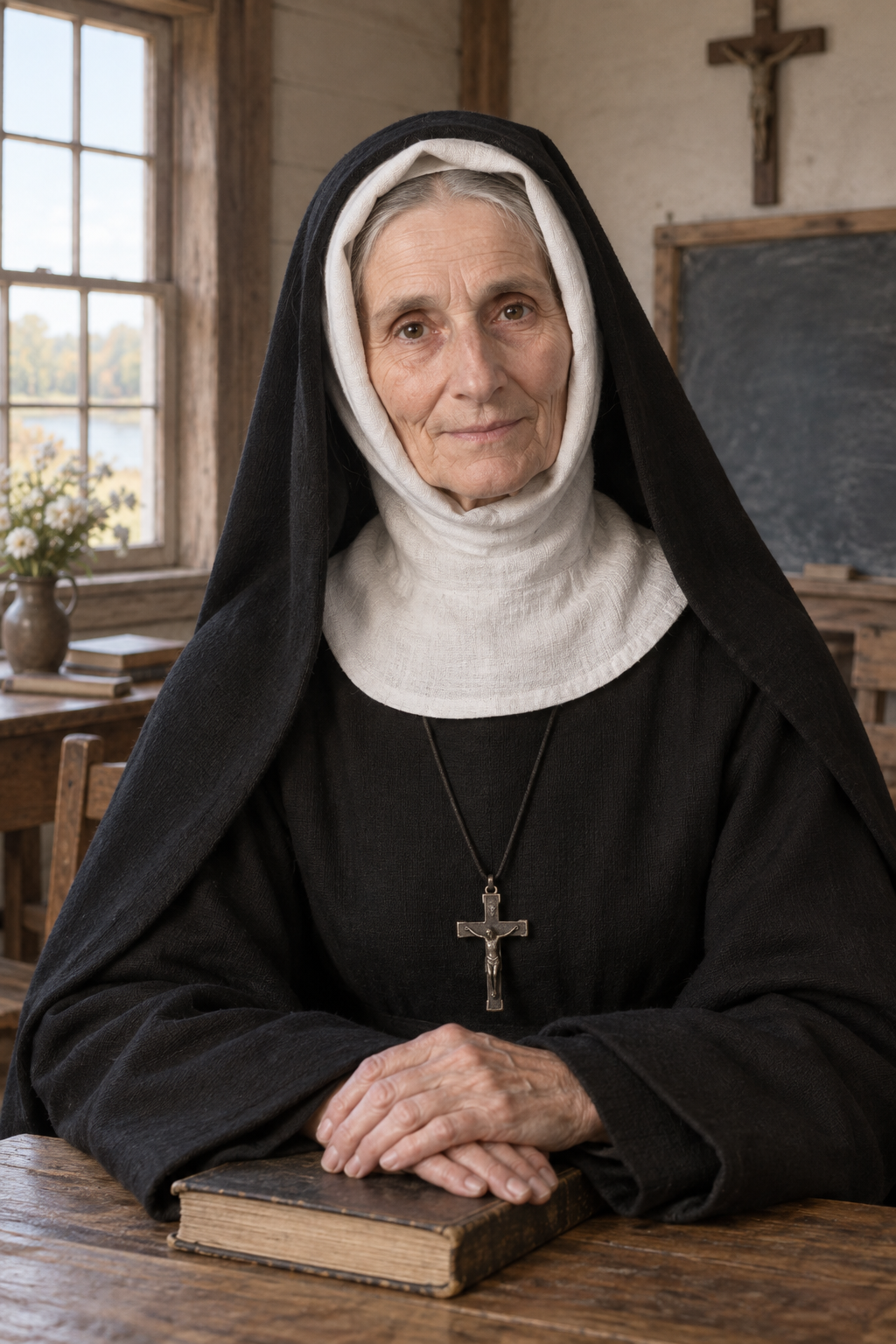
About Rose Philippine Duchesne
Rose Philippine Duchesne joined a deep attachment to prayer with the demanding work of education. Remembering her at her canonization, John Paul II described a woman who crossed the boundaries of her own language and culture to serve in North America. He connected her willingness to go with the long hours she spent in Eucharistic prayer. Her vocation brought contemplation into contact with the material needs of children and families.
She was born in Grenoble, France, on 29 August 1769. Her family participated in the city's political and commercial life. Educated by the Visitation sisters at Sainte Marie d'en Haut, she was drawn toward their contemplative way of life. She entered against her family's wishes. The Revolution dispersed the community and sent her back to her family, but it did not end her religious commitment. She nursed prisoners, helped priests reach the faithful, and taught and fed poor children.
Attempts to rebuild convent life proved difficult. The congregation's chronology records her taking possession of Sainte Marie in 1801, only to be left the following year with a small group and a handful of pupils. In December 1804, Madeleine Sophie Barat came to join her community to the Society of the Sacred Heart. Philippine made her first vows in the Society in November 1805. The chronology also remembers her returning to the abandoned monastery with her sister and niece, showing how family ties accompanied the difficult effort to begin community life again after the Revolution.
She had to work through the tension between love for her familiar monastery and a desire for distant missions. Carolyn Osiek's history describes her coming to a greater readiness to leave during prayer in 1806. The opportunity did not arrive immediately. She served as secretary general in Paris while continuing to hope for a mission. When Bishop Dubourg sought sisters for his diocese, she pleaded for Barat's permission to accompany the undertaking. Permission finally opened the way to departure in 1818.
Philippine did not cross the Atlantic alone. Her companions were Eugénie Audé, Octavie Berthold, Catherine Lamarre and Marguerite Manteau. They brought different histories and abilities to the journey. Octavie knew English, Italian and Latin; Marguerite joined the others at Poitiers on their way toward Bordeaux. Eugénie had expressed her own desire to go to America. At forty-eight, Philippine was the oldest of the five, yet she would outlive them all. Their chaplain on the ship was Bertrand Martial, who later wrote admiringly of the women's virtue.
At St. Charles in Missouri, the new foundation faced severe cold, exhausting labor and scarce funds. Philippine also struggled to learn English. Letters and news from France arrived slowly, making it difficult to remain close to the Society she had left behind. The school and community had to continue amid these practical limitations. The work demanded more than the enthusiasm with which she had set out.
After a year at St. Charles, the sisters moved to Florissant, where they again opened a free school and a boarding school. As the mission expanded, the original group separated. Eugénie Audé and the novice Mary Layton went to establish a school at Grand Coteau in Louisiana. The enterprise was becoming a network of communities, with responsibility shared among women who could no longer work in the same place.
That growth also depended on a grave injustice. The Society's archival history documents Philippine's participation in enslavement, rather than merely placing slavery in the distant background of her life. She wrote of wanting an enslaved woman for kitchen work. The same history describes Rachel challenging the Society's claim to own her, and Philippine defending that claim. Rachel was later sold. These records preserve a conflict between a woman's assertion of her own freedom and the authority that treated her labor as property. Acknowledging the harm is part of telling the history of the schools honestly.
In 1841 Philippine finally went to Sugar Creek to join the mission among the Potawatomi. She was too frail for heavy work and could not learn the language. Much of her contribution took the form of prayer. After a year she was recalled to St. Charles.
The Potawatomi had themselves been forced from their homes in Indiana. The mission was therefore situated within a history of displacement, not simply a new destination for a European religious woman.
Her later years still held important personal connections. Her niece Amelie Jouve visited St. Charles on the way to a Canadian foundation, sent by Barat as an expression of affection. Regis Hamilton later became her nurse, reversing the care Philippine had once given her.
Philippine died at St. Charles on 18 November 1852, aged eighty-three.
John Paul II canonized her on 3 July 1988. His homily emphasized both prayer and service, inviting others to respond generously to the needs of poor people.
Wondering how to weigh the stories and sources? Learn how to read a saint biography.
Prayers for Rose Philippine Duchesne
Rose Philippine Duchesne: sourced prayer excerpt
Fill us, who honor her memory today, with that same love and zeal to extend your kingdom to the ends of the earth.