Biography
Ruth
About Ruth
Ruth is the Moabite woman at the center of the biblical book named for her. The story looks back to the era of the judges, but its composition date is disputed and its narrator explains an old legal custom for later readers. The USCCB introduction calls it a classic short story developed from recollection of a historical figure. That careful wording allows neither dismissal nor modern certainty. Ruth’s exact birth, death, and age are not recoverable, so inherited dates are removed. Her life is presented here as scriptural and literary tradition, with documented claims reserved for what authoritative introductions say about the text.
The narrative begins not with romance but with famine, migration, and repeated bereavement. Elimelech and Naomi leave Bethlehem for the plateau of Moab with their sons Mahlon and Chilion. The sons marry Ruth and Orpah, but Elimelech and both sons die. Naomi decides to return after hearing that food is again available in Judah. She urges both daughters-in-law to seek security in their mothers’ homes. Orpah departs after an anguished farewell. Ruth clings to Naomi. The book does not condemn Orpah; it emphasizes that Ruth freely accepts a path carrying real economic, social, and personal danger.
Ruth answers Naomi with an oath of extraordinary solidarity: Naomi’s road, lodging, people, God, death, and burial will become hers. The note explains that burial in Naomi’s family tomb extends the commitment beyond life. This is not merely a private conversion formula. Ruth binds her future to an older widow who has no obvious means to reward her. They reach Bethlehem at the beginning of barley harvest. Naomi speaks publicly from grief, renaming herself Mara, or Bitter, and accusing the Almighty of harsh treatment. The story permits lament to stand; Ruth’s loyalty does not silence Naomi’s pain or make loss immediately meaningful.
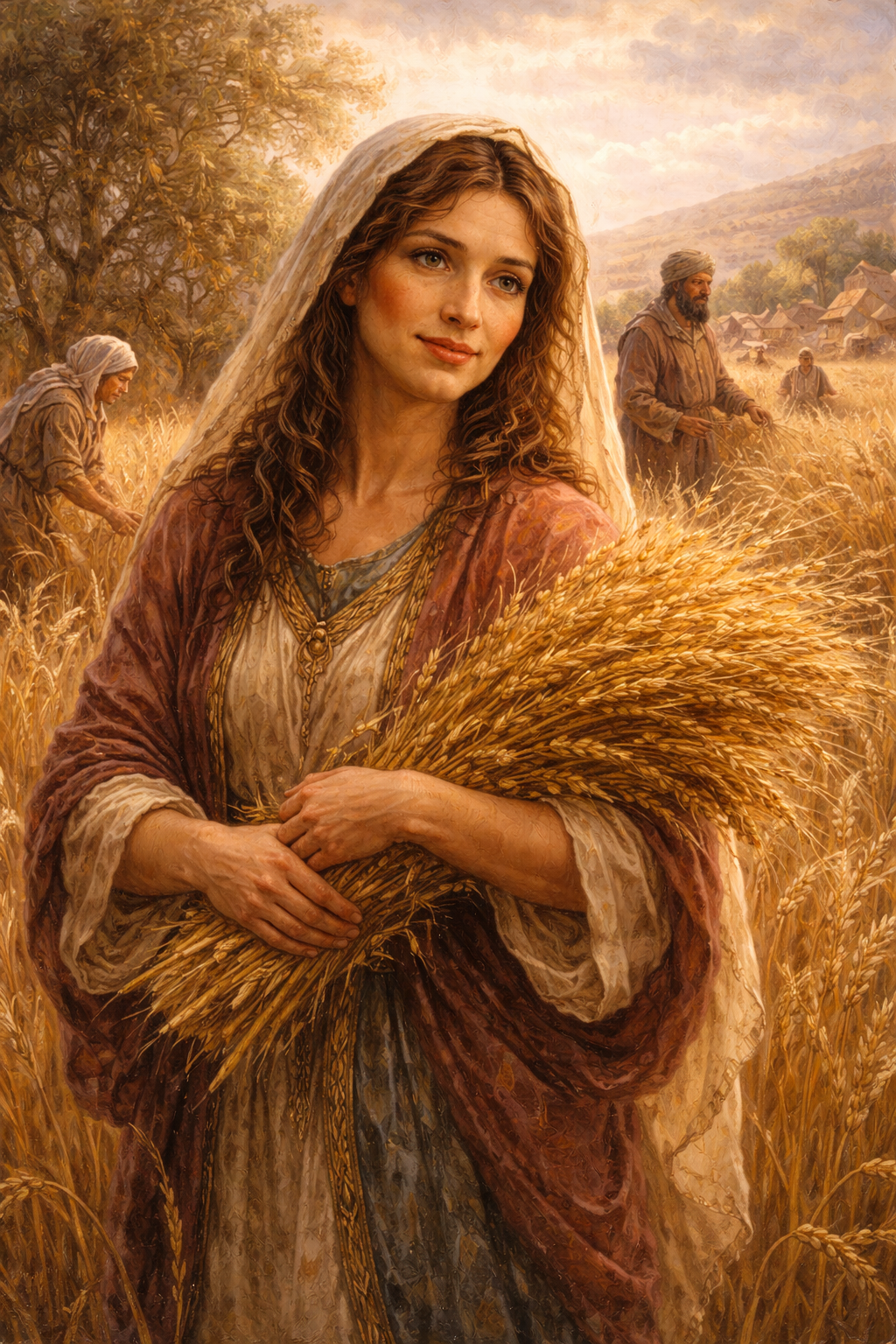
In Bethlehem, Ruth proposes gleaning behind harvesters, a precarious form of subsistence available to the poor and resident alien. She happens upon a field belonging to Boaz, a relative of Elimelech. Boaz has already heard how she left her parents and homeland to accompany Naomi. He directs workers not to molest her, gives her access to water and food, and orders grain left for her. The need for that command reveals vulnerability in the field rather than an idyllic workplace. Ruth labors until evening, threshes what she gathered, and carries food home, including leftovers from her meal.
Naomi recognizes Boaz as one of the family’s potential redeemers. The legal picture is more complicated than the familiar label ‘levirate marriage’: the nearest relative’s duty concerns land and family continuity, and the book combines customs in a distinctive plot. Naomi devises a nighttime appeal at the threshing floor. Ruth washes, dresses, waits until Boaz sleeps, uncovers a place at his feet, and lies down. The language is suggestive and the encounter exposes Ruth to reputational and physical risk. The text reports that Boaz praises her loyalty and promises to act, while acknowledging that another redeemer has prior standing.
Readers should resist turning that episode into advice that vulnerable people seek protection through secret sexualized encounters. Ruth follows Naomi’s plan within the story’s ancient social world; Boaz sends her away before recognition and gives barley for Naomi. At the town gate he convenes the nearer relative and ten elders. The nearer man first agrees to redeem Elimelech’s field but withdraws when Boaz links the transaction with Ruth and preserving the dead man’s name. A sandal exchange confirms the agreement. The narrator explicitly explains this as a former custom, evidence that the telling stands at some distance from the events it portrays.
Boaz marries Ruth, and the text attributes conception and the birth of Obed to God’s gift. Bethlehem’s women address Naomi: the child will renew her life, and Ruth, who loves her, is worth more than seven sons. Naomi takes the child to her breast and becomes his caregiver. The women, not Ruth, name him Obed. The genealogy identifies Obed as father of Jesse and grandfather of David. Matthew later includes Ruth in Jesus’ genealogy. The narrative thus places a Moabite widow within Israel’s royal and Christian messianic memory, while Ruth’s own voice disappears from the closing domestic scene.
The story’s warmth should not conceal its structural inequalities. Women’s security depends on harvest access, male kinship, land transfer, and marriage. Ruth is repeatedly called ‘the Moabite,’ keeping her foreignness before the audience. Deuteronomy contains an exclusion concerning Moabites, and Ezra and Nehemiah later oppose some foreign marriages; the USCCB introduction notes that some scholars read Ruth’s favorable portrait as a response to those postexilic measures. The interpretation is debated because the book’s date is disputed. What the finished story unmistakably does is make responsible care by a foreign woman central to communal survival.
Jewish tradition reads Ruth at Shavuot, as the USCCB introduction notes, but that is a liturgical use of the book rather than a sourced Christian saint feast for Ruth alone. No feast observance is therefore entered here without a jurisdictional authority. The narrative’s spiritual power lies in ordinary, costly actions: Ruth stays with Naomi, asks permission to glean, works through the day, shares her food, listens while retaining initiative, and helps rebuild a household after catastrophe. Her courage is not conquest. It is steadfast presence across ethnic boundaries, practical labor amid poverty, and willingness to let another person’s future become inseparable from her own.
Wondering how to weigh the stories and sources? Learn how to read a saint biography.