Biography
Samson
About Samson
Samson’s story fills Judges 13–16 near the end of the book’s accounts of pre-monarchical leaders. The introduction to Judges explains that a judge is a leader rather than simply a courtroom official and that the stories derive ultimately from older oral tradition. No contemporary record gives Samson a secure birth or death year. The catalog therefore removes its former precise-looking BCE dates and presents the narrative as traditional sacred history rather than a modern biography.
Judges begins under forty years of Philistine power. A messenger appears to the unnamed wife of Manoah, who has had no children, and announces that she will bear a son. She is told to avoid wine, strong drink, and unclean food because the child will be a nazirite from the womb and will begin Israel’s deliverance. Manoah asks for further instruction. After an offering, the messenger ascends in its flame, and Manoah’s wife answers his fear with calm reasoning. The chapter says she bears Samson, that he is blessed, and that the spirit of the Lord begins to stir him.
As a young man Samson sees a Philistine woman at Timnah and asks his parents to arrange the marriage. They object, while the narrator says the conflict will provide an occasion against Philistine rule. On the journey, the spirit of the Lord rushes upon Samson and he tears apart a lion. Returning later, he finds bees and honey in the carcass, eats some, and gives some to his parents without telling its source. Judges does not explicitly say here that this act ends his nazirite status, so the packet does not make that inference a fact.
At the wedding feast Samson proposes a riddle based on the lion and honey. The Philistine companions threaten his wife and her family unless she obtains the answer. After persistent pressure, Samson tells her, and she passes it to them. Samson then kills thirty men at Ashkelon to supply the wagered garments and leaves in anger. His wife is given to his companion. The chapter presents coercion, secrecy, killing, and retaliation; a careful account should not describe these acts as harmless cleverness or uncomplicated virtue.
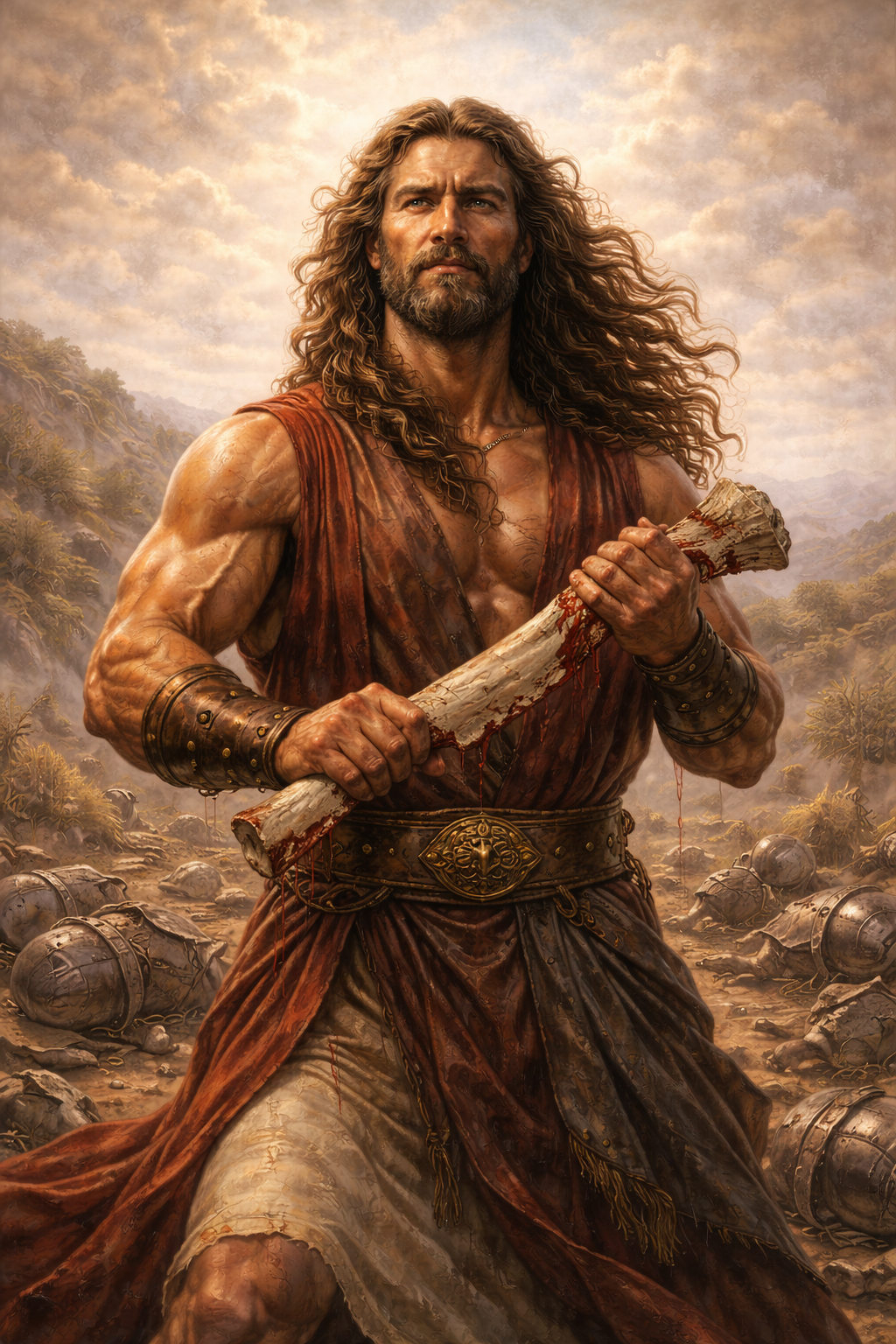
When Samson later returns, the woman’s father refuses him entry. Samson retaliates by releasing animals with torches among Philistine grain, vineyards, and olive groves. Philistines then burn the woman and her father, and Samson answers with further violence. Men of Judah bind him for delivery to the Philistines. Judges says the spirit rushes upon him, his bonds fall away, and he kills a thousand men with a donkey’s jawbone. The number and extraordinary strength belong to the narrative and are not independently verified statistics.
After the fighting Samson cries out from thirst and acknowledges that victory has come through God’s servant. The text says water emerges at Lehi and revives him. It then states that he judged Israel for twenty years in the days of the Philistines. This internal duration does not establish absolute calendar dates. Later Christian teaching particularly associates Samson’s strength with the action of the divine Spirit, while Hebrews names him in its list of figures connected with faith.
Judges 16 first places Samson at Gaza, where he visits a prostitute and escapes an ambush by carrying away the city gate and posts. It next says he loves Delilah in the Wadi Sorek. Philistine rulers offer her silver to discover the source of his strength. Samson gives three false answers before telling her that no razor has touched his head because he has been a nazirite from the womb. The narrative does not call Delilah his wife, identify her ethnicity, or provide evidence for later romantic embellishment.
Delilah has Samson’s hair cut while he sleeps. Judges says his strength leaves him and that he does not realize the Lord has left him. The Philistines seize him, blind him, bind him, and force him to grind in prison at Gaza. His hair begins growing again, but the text does not say that hair itself mechanically creates divine power. The story has tied the uncut hair to his consecration and now emphasizes broken trust, captivity, and dependence rather than an autonomous superhuman ability.
During a festival to Dagon, the Philistine rulers bring Samson from prison for amusement and place him between the temple’s supporting columns. Samson asks the attendant to let him feel the columns. He prays to be remembered and strengthened once more, explicitly seeking vengeance for his eyes. He then pushes the columns down, killing himself and those gathered. The violence and mass death remain morally grave even within a narrative of conflict and deliverance; this packet does not turn them into a generic weekly example.
Samson’s family retrieves his body and buries him in his father Manoah’s grave between Zorah and Eshtaol. Judges closes by repeating that he judged Israel for twenty years. The Orthodox Church in America names Samson among the best-known judges in its teaching on Old Testament history, and Catholic teaching cites him among frail leaders empowered by the Spirit. His lasting significance lies in a difficult portrait of consecration, strength, appetite, violence, captivity, prayer, and death—one that resists both dismissing him as a caricature and praising every action he takes.
Wondering how to weigh the stories and sources? Learn how to read a saint biography.