Biography
Samson Occom
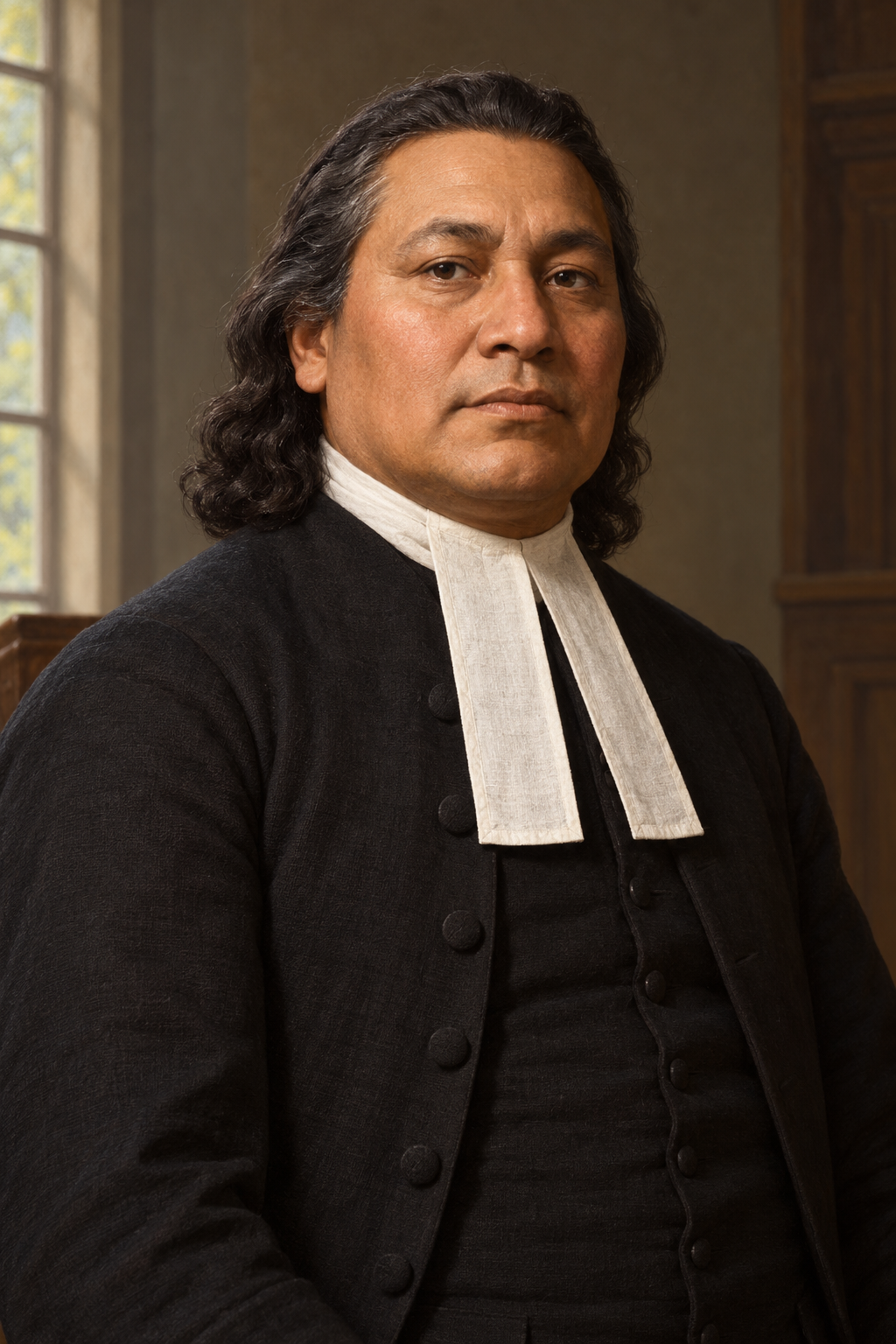
About Samson Occom
Samson Occom was a Mohegan teacher and Presbyterian minister whose work joined Christian preaching with the defense of Native communities. Born at Mohegan in 1723, he grew up amid the religious changes of the Great Awakening. He became a Christian in his youth and sought the learning that would allow him to teach others. His life took him from Connecticut and Long Island to Britain and to Native settlements in New York, where education, worship, and the protection of land remained closely connected.
In his autobiographical account, Occom described learning English letters with a primer and help from neighbors. His mother approached the minister Eleazar Wheelock about instruction. What Occom expected to be a short visit became four years of study. He later taught at Montauk, where families supplied food and welcomed a school. His account describes religious instruction, visits to sick people, and assistance with disputes and burials. Teaching was part of a wider responsibility within the community, rather than an isolated classroom occupation.
Occom married Mary Fowler, a Montaukett woman, in 1751. In 1759 the Suffolk Presbytery ordained him. He subsequently made missionary journeys to Oneida communities. His ministry crossed cultural and linguistic boundaries, but his position within colonial religious institutions remained unequal.
His autobiography challenged the financial arrangements under which he worked. Occom stated that twelve years of his service had received the same total support as a single year of another missionary venture. He described supporting his family by farming, fishing, bookbinding, and other work alongside teaching. He concluded that his treatment reflected prejudice against him as an Indian. The account preserves his own judgment of the institutions that employed him, including the burden of serving as teacher, minister, and interpreter.
Land advocacy also brought him into conflict with colonial authorities. He supported the Mohegan claim in the Mason land dispute and appealed to King George III for intervention. Dartmouth’s account records that he continued supporting the claim until the decision against the tribe in 1773.
In December 1765 Occom sailed to Britain to raise money for Wheelock’s educational work. His preaching attracted support, but on returning in 1768 he found that his family had suffered neglect. The Brothertown Indian Nation’s account places this disappointment within a wider history of Native land loss and frustrated hopes for education. The school’s later move and its increasing emphasis on educating white students deepened the breach between Occom and Wheelock.
The chronology matters: the college charter came in 1769, after his return, and the school moved in 1770.
Writing to Wheelock in July 1771, Occom argued that British donors had understood their gifts to support Native youth. He feared that the changed purpose would make both men appear dishonest. His letter questioned the college’s priorities and the absence of Native students, while leaving open the possibility of helping if its educational promises were fulfilled. Wheelock disputed Occom’s account in marginal notes. The disagreement concerned responsibility to donors and to Native communities, not simply a personal quarrel between a former pupil and his teacher.
Occom’s own record also requires qualification. In October 1765 he asked Wheelock to lend him an enslaved worker and a yoke of oxen for farm work. The surviving request documents his willingness at that time to use enslaved labor; it does not establish that a worker was sent or that Occom owned one.
Dartmouth’s historical account identifies a later change: he opposed slavery in a sermon of 1787. It also records the wide circulation of his 1772 sermon delivered at the execution of Moses Paul, a Wampanoag man. Print gave Occom’s preaching an audience beyond the communities he could visit.
Occom helped create Brothertown with people drawn from seven Native communities. Land offered by the Oneida provided a place where these Christian communities could seek a shared future. The Brothertown Indian Nation remembers him as a cofounder, while preserving the distinct histories of the peoples who joined the settlement.
His own household moved there in May 1789. Conflict over leases to white settlers soon drew him into further struggles over Native land. In 1791 he petitioned the New York legislature to restrict residents’ power to lease land, and later that year moved his family to New Stockbridge. He died there on July 14, 1792. These final years continued the connection between ministry and collective survival that marked his earlier work.
The Episcopal Church remembers Occom on July 14.
Brothertown separately established that date as a tribal holiday in 2020. His significance endures in the community he helped found and in writings that preserve a Native minister’s account of faith, education, and unequal treatment.
The Mohegan Tribe records that Dartmouth agreed in April 2022 to return Occom’s papers. The collection includes letters, journals, an autobiography, and early examples of written Mohegan, preserving his voice for later generations.
Wondering how to weigh the stories and sources? Learn how to read a saint biography.