Biography
Sarah Josepha Hale
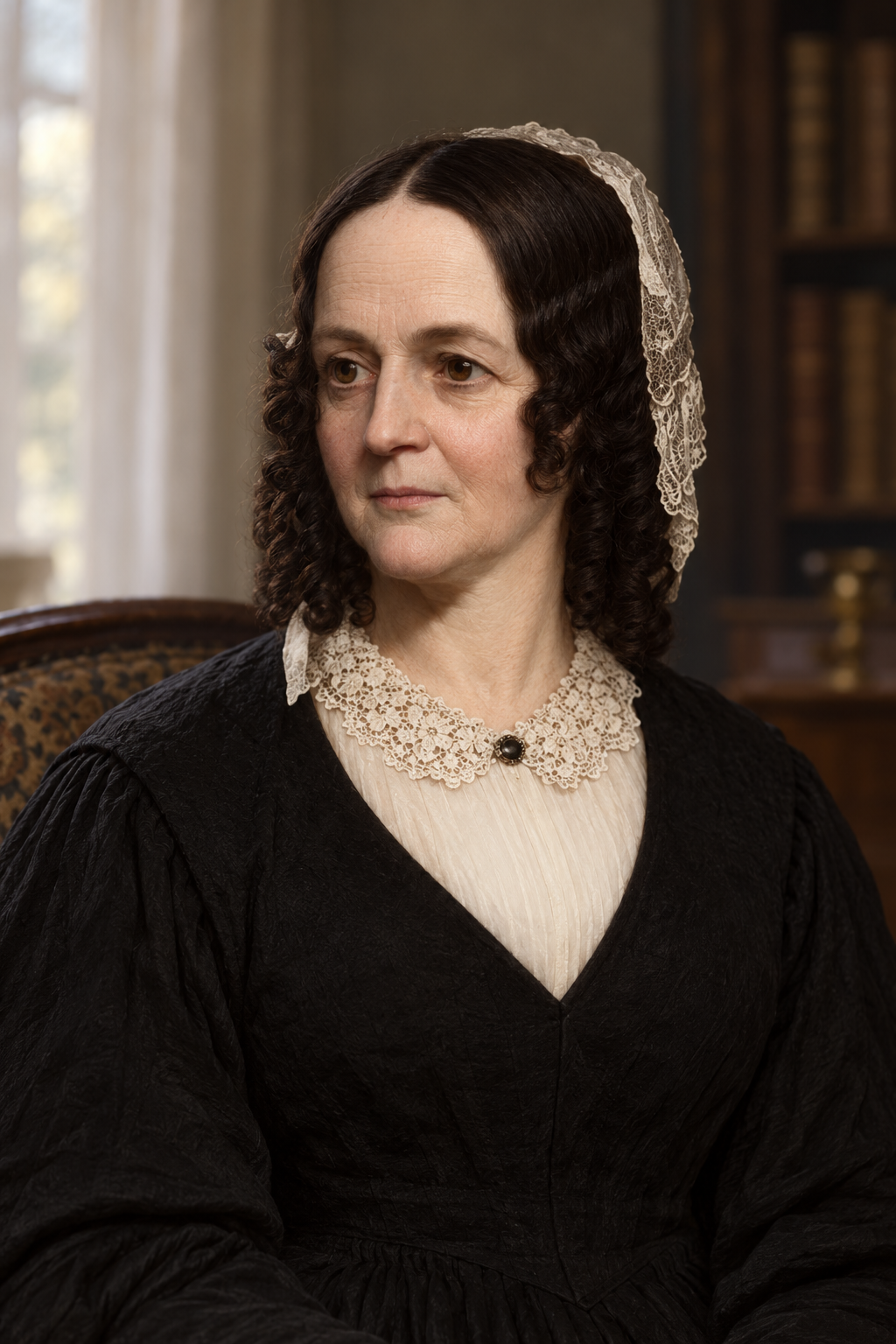
About Sarah Josepha Hale
Sarah Josepha Hale made a long editorial career into a platform for women’s education and public service. Working first in Boston and later in Philadelphia, she encouraged women to write, supported their intellectual development, and organized practical projects through the readership of her magazines. Her influence rested on the steady work of editing, correspondence, and persuasion.
Born in Newport, New Hampshire, in 1788, she received her education at home. Her mother and her brother Horatio, who studied at Dartmouth, helped her learn. She became a teacher and married the lawyer David Hale in 1813. His death in 1822 left her responsible for a growing family.
She had four children and was pregnant with a fifth when she was widowed. The need to support them formed the background to her emergence as a professional writer. Her first poetry collection, The Genius of Oblivion, appeared in 1823.
Hale also tried running a millinery business with her sister-in-law. She continued to write amid the demands of earning a living and caring for her children. The success of her novel Northwood in 1827 opened the way to an editorial career.
Northwood addressed slavery, but its proposed answer included sending enslaved people to Liberia. That position needs to be distinguished from a commitment to equal citizenship within the United States. Hale’s advocacy for improvement did not mean that she challenged every hierarchy of her society.
She became editor of the Boston Ladies’ Magazine in 1828. In 1837 it joined Godey’s Lady’s Book, the Philadelphia publication with which she would be associated for the rest of her working life. Her editorial program encouraged women’s education while retaining separate roles for men and women. She believed that educated women would exercise a stronger moral influence in their homes. She did not support women’s suffrage. The combination of intellectual ambition and political conservatism is central to understanding her work.
Her writing reached children as well as adults. Poems for Our Children, published in 1830, included Mary’s Lamb, the poem familiar to later generations as Mary Had a Little Lamb. As an editor, she also published other women writers, including Lydia Maria Child and Lydia Huntley Sigourney. Her work therefore involved both writing under her own name and creating space for other authors.
In Boston, Hale helped establish the Seaman’s Aid Society in 1833. It supported sailors’ wives and children through opportunities for work and assistance. Women associated with the society later organized a fair that helped fund completion of the Bunker Hill Monument. Hale participated in mobilizing women’s networks for the effort. These projects connected the domestic skills available to women with organized work beyond their own households.
Her ambitions also took the form of a large biographical reference book. Woman’s Record, first published in 1853, gathered accounts of distinguished women. The project gave sustained expression to her conviction that women’s achievements deserved a place in the written record.
Her interest in education also brought her into contact with Emma Willard. Hale appealed for support for Willard’s school in Troy, New York, and sent her daughters there. She valued the training of women who could themselves become teachers.
In 1860 she began corresponding with Matthew Vassar about his plans for a college for women. Their exchange continued for eight years. She offered advice, publicized the college, and made its educational ambitions known to readers of Godey’s. Her support was practical: the magazine carried some advertising free and offered reduced rates for other notices.
Hale was willing to disagree with Vassar. She objected to proposed uniforms, the planned winter vacation, and the word female in the institution’s name. She preferred a name that she believed better expressed the dignity of women. Although they never met in person, their correspondence became a sustained relationship in which Vassar sought her judgment on matters including finances and faculty appointments.
Another sustained campaign concerned Thanksgiving. In her September 28, 1863, letter to Abraham Lincoln, Hale asked for a common national observance on the last Thursday of November. She explained that she had promoted the idea in her magazine for fifteen years and had approached governors, diplomats, missionaries, and naval commanders. She believed a presidential proclamation could achieve coordination more quickly than separate legislation in every state. She also told Lincoln that she had written to Secretary of State William Seward.
Lincoln’s proclamation of October 3 invited Americans at home, abroad, and at sea to observe the last Thursday of November. Its language joined gratitude for harvests and other blessings with penitence and concern for people bereaved or injured by the Civil War. Hale’s request thus belongs to a wartime effort to give national expression to thanksgiving; she did not invent the practice of giving thanks.
After becoming an Episcopalian, Hale belonged to Holy Trinity Church in Philadelphia.
She retired from Godey’s in December 1877, aged eighty-nine.
She died on April 30, 1879.
The Episcopal Church’s 2009 General Convention authorized her April 30 commemoration for trial use.
Wondering how to weigh the stories and sources? Learn how to read a saint biography.